News
2026-09-24
Human rights: part of professional training?
By: Alejandro García Suárez – Advisory Office of Communications



I am your virtual assistant, here to help you quickly and easily.
▲ Back to Top
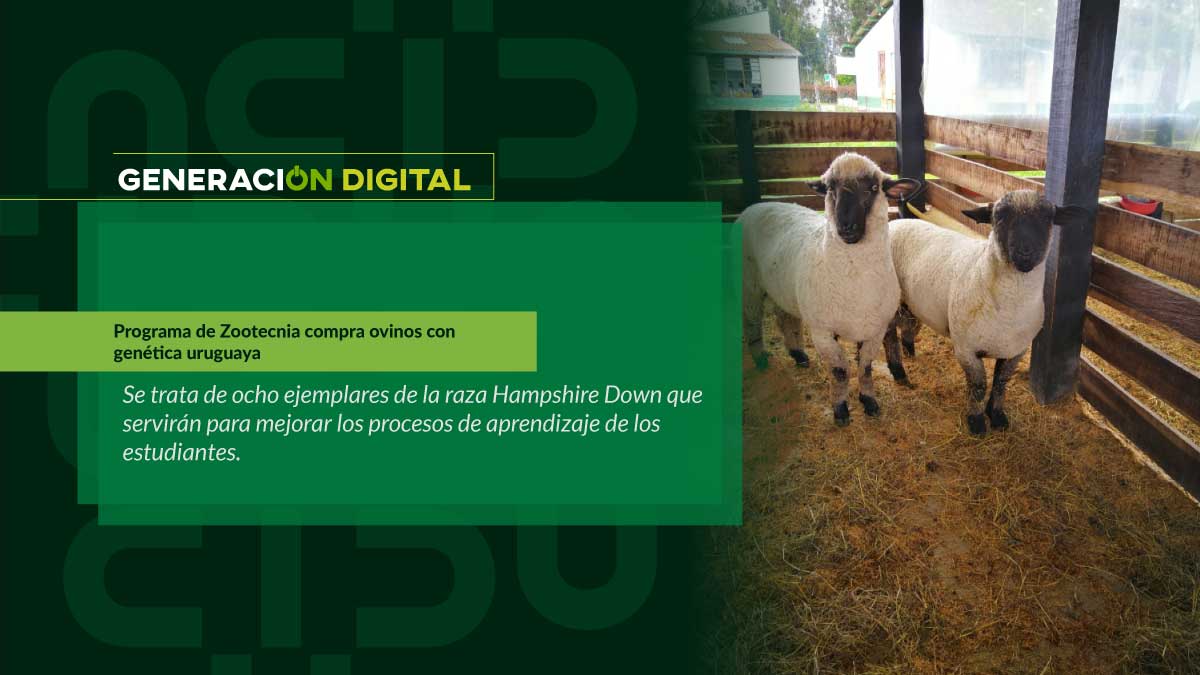
UCundinamarca News (NUC) interviewed Camila Arévalo, manager of the El Tíbar Agro-environmental Unit, about the scope of this acquisition, which will improve the pedagogical processes of this multidimensional field of learning.
NUC: How many copies were purchased?
Camila Arévalo: Six females with Uruguayan genetic lineage and two males were acquired. The animals are suitable for breeding and obtaining purebred genetics of the breed, selected for phenotype and genotype, with hardiness and adaptability to the agroclimatic grazing conditions of the high-mid tropics. All have genealogical certificates issued by FEDEANCO and come from the María Antonia farm.
NUC: What characteristics does this breed have?
Camila Arévalo: The Hampshire Down breed belongs to the group of breeds known as meat breeds. This means that their production potential is geared towards meat production. They also produce wool, which must be sheared for the animal's health and well-being.
Among the main characteristics are the ewes' excellent maternal ability for milk production and their capacity to quickly wean lambs when they reach 30 kilograms. This early growth in the offspring is important for achieving an animal with the appropriate weight for sale in a short time. The rams generally have a good libido, so they are able to detect and mate with ewes in heat.
Animals of this breed possess a suitable bone structure; rams weigh over 100 kg and ewes around 80 kg, with no leg conformation problems. They have well-developed hindquarters, deep ribs, a broad chest, and a length that allows for the development of their loins, among other characteristics.
NUC: How will buying this breed help in the learning process?
Camila Arévalo: This breed will allow us to intensify our educational processes, focusing on new knowledge and teaching about sheep breeding and production for meat. We also aim for students to learn about, work with, and understand genetic improvements in any animal production system. Furthermore, we hope that the knowledge acquired by students and future professionals will motivate them to create new large-scale production units, not only in the region but also throughout the department.
NUC: In what subjects have these examples begun to be shown?
Camila Arévalo: Currently, they are used in animal health with parasitological analyses, in addition to the thematic core of Production in Small Species II. Likewise, zootechnical parameters specific to the species are being evaluated to begin processes with the thematic core of Reproduction I and II, taking into account that the livestock, in terms of age and weight, do not yet meet the conditions to begin the reproductive stage.
NUC: What care should be taken with this breed?
Camila Arévalo: Nutritional and health care are the main aspects, without neglecting the environmental factor, remembering that these are the pillars for this breed to show its full potential. That's why we provide them with optimal nutrition, proper handling, and an ideal environment for their development and growth, so they can express the full potential characteristic of the breed.
They are hardy animals unsuitable for low tropics; feeding must be efficient in order to produce females with good maternal skills.
In this way, UCundinamarca is working to improve pedagogical processes by purchasing new species to train professionals in animal husbandry who are in tune with the advances and the reality demanded by the working world.
News
News
News
News