News
2026-09-24
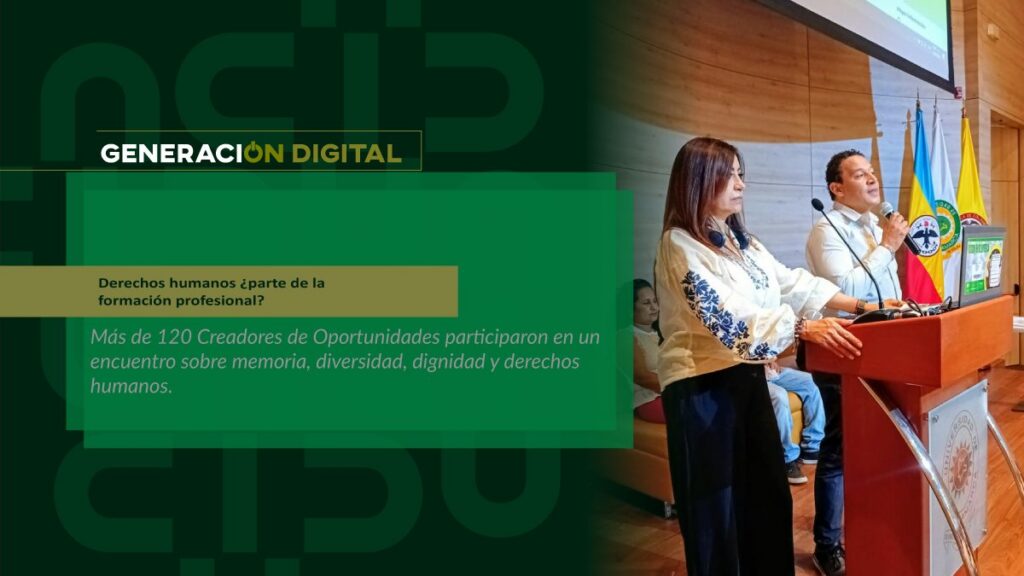
Human rights: part of professional training?
By: Alejandro García Suárez – Advisory Office of Communications


I am your virtual assistant, here to help you quickly and easily.
▲ Back to Top
By: Alejandro García Suárez – Advisory Office of Communications
The University of Cundinamarca also projects itself from the perspective of those who, after graduating, remain linked to its history and challenges. This is the case of Luis Carlos Rojas, a 2015 graduate of the Business Administration program at the Girardot branch, who presented the proposal “The University that transcends: knowledge, territory and country building. Horizon 2027–2037”.
Their approach stems from a simple but profound conviction: the University does not end with the awarding of a diploma; on the contrary, the knowledge acquired must remain alive in the territories, engage with their realities, and become a tool to generate solutions, strengthen communities, and contribute to building citizenship.
For Luis Carlos, the University of Cundinamarca has an opportunity to deepen its regional character and continue advancing in the democratization of knowledge; this implies strengthening the links between academia and the territories, recognizing the cultural, social and economic particularities of the municipalities where the institution is present.
In its proposal, it aims to strengthen the branch campuses and extensions as spaces for thought, research, culture, innovation and dialogue, articulating and enhancing the capacities that already exist in the University to respond to the needs of each territory and generate transformative processes with impact.
According to their vision, the democratization of knowledge also involves strengthening critical thinking and digital citizenship, as well as exploring initiatives such as Radio UCundinamarca, as a Territorial Knowledge Network, conceived as a possibility to expand the circulation of knowledge and connect the University with its communities.
Another key component is the role of graduates, who can contribute their professional experience, knowledge, and perspectives to the processes of institutional development. For Luis Carlos, maintaining this connection allows former students to remain active participants in the University and its transformation.
Thus, their proposal represents an invitation to look at the future from the territory and to recognize that a University is strengthened when it listens to those who are part of it; the University that transcends is the one capable of taking knowledge beyond its classrooms, connecting it with reality and putting it at the service of building the country.
From this perspective, Luis Carlos Rojas' contribution adds to the collective exercise of designing the University of Cundinamarca for 2027–2037, recognizing in the voices of its graduates an experience and knowledge that enrich the path towards the University that we are and want to continue building.
This vision aligns with the Transmodern Digital Educational Model (MEDIT), which understands education as a process that transcends the classroom and connects with the realities of the local community. From this perspective, Luis Carlos's proposal reaffirms the purpose of developing individuals capable of learning, transforming, and contributing to society, putting knowledge at the service of communities and strengthening the University of Cundinamarca's commitment to nation-building.
News
News
News
News