
I am your virtual assistant, here to help you quickly and easily.
▲ Back to Top
The proposed educational model aims for the University of Cundinamarca to leave behind professionalizing models that merely transmit knowledge and information, in order to focus on educating a transhuman person for life, democratic values, civility, and freedom. This means shifting from an education for doing and work to an education for being. The goal is an individual who, in addition to achieving personal development, will become a transformative agent who contributes significantly to their environment, society, and nature.
The name of MEDIT responds to an ideal, a dream, an aspiration that points to the public university of Cundinamarca as a translocal and transmodern social organization of knowledge and learning.
It is an educational model, not a pedagogical one, since it does not seek to engage in theoretical discussions about pedagogy and didactics; rather, it establishes a university educational ideal in keeping with the present moment—that is, within a specific socio-historical and cultural context. It is a roadmap that embodies the institution’s vision and aspirations.
At the University of Cundinamarca, the institution adopts an approach known as “dialogic and formative construction,” which serves as the foundation for building students’ knowledge and learning, with a view toward personal transformation that positively influences society.
From the philosophical stance of transmodernity assumed by (Rodríguez Magda, 2004), the University of Cundinamarca does not renounce the pending utopias of modernity and postmodernity, such as justice, solidarity, and freedom. Consequently, it seeks to form a free subject, who is explained within the other and in nature, who through dialogue and construction, as a regulative ideal, forges their identity and personal development, appropriates the local and ancestral context, and acts as a transhuman person who transforms reality.
In this sense, translocality is also assumed, understood according to (Rodríguez Magda, 2017) as a characteristic of the current moment that accounts for the way the global and the local intertwine, and how new communication technologies have been disrupting social relations and daily life. This entails the challenge of not falling into the trap of the global as homogenization while, at the same time, asserting one's own culture, identity, memory, and ancestral and territorial knowledge.
In this way, the University defines itself as “translocal” in the sense of defending its identity as a public university, of understanding itself within its departmental context and its reality in the face of globalization; it recognizes, but does not accept a totalizing, consumerist, and hegemonic worldview; it identifies as an agent of social transformation that solves problems in its own unique way, making an impact in each of its local communities and reclaiming cultural initiative and leadership.
Globalization does not solve the local problems of Fusagasugá, Ubaté, Girardot, Chía, Zipaquirá, Soacha, Facatativá, and Chocontá, which is why the university aims to educate an individual who transforms reality from their environment for the benefit of local development.
Regarding the digital, it is a way of being, thinking, and doing that stands in contrast to the binary, analog thinking characteristic of Eurocentric Western modern culture, structured around a dichotomous view of the subject-world relationship and which, in the construction of scientific knowledge, has been termed Cartesian dualism—the dominant conception of Western thought logic that presupposes the separation and disconnection of the life-world and the subject in relation to knowledge (Varela, Thompson, & Rosch, 2005).
The digital encompasses an entire historical moment in the world today, which implies another way of understanding it, being, and doing; therefore, it is not reduced to a mere conception associated with virtuality and technology, but is recognized in its impact on the ways subjects know
MEDIT is committed to the development of the individual; consequently, the purpose of the educational process is to ensure that every action taken contributes to the betterment of life, the individual, society, civility, democracy, nature, and freedom. In this sense, the vision of the University of Cundinamarca is to build through dialogue and education, with the aim of fostering active, transformative, and free individuals who act within the reality in which they live and assume an autonomous position in each community, seeking to mitigate the effects of globalization.
This model advocates for an education for life, rather than one that is vocational and competency-based. Education for doing and for work is left behind, seeking to transcend beyond the instrumental and the informational. Relevance lies in the way each young person acts and self-improves, while simultaneously transforming the social, political, economic, and cultural reality of each territory within the University's sphere of influence.
The goal is to educate in order to adopt a personal lifestyle that allows each young person to be happy, live well, recognize themselves in others and in nature, understanding that life is the great stake of the 21st century; which represents self-fulfillment and development as a transhuman person.
Education in democratic values is provided so that young people adopt solidarity, responsibility, legality, fraternity, diversity, tolerance, respect, the common good, and respect for human rights and human dignity as hallmarks of their conduct. These are values that, in transmodern society, enable them to fully practice democracy—as a lifestyle and form of government accepted worldwide—in order to live peacefully.
Civility is formed because young people assume norms, beliefs, uses, and customs that allow them, as transhuman persons, to contribute so that the community lives in peace and harmony.
Finally, it is directed toward freedom, because a free individual is the only one who self-regulates, self-administers, and self-controls to achieve constant and permanent self-improvement; where their behavior influences the development of society, the exercise of democracy, and the preservation of peaceful coexistence, overcoming consumerism and the lack of identity that leads to chaos and annulment.
Along these lines, training is understood from the perspective of collaborative and co-creative knowledge, with the participation of the university community in general. For example, the graduate of the University of Cundinamarca joins, through their actions, those of other young people aimed at impacting lives, strengthening democratic values, and achieving real transformation, starting from within themselves.
Consistent with the purpose pursued by MEDIT, the principles and values that support it are: Life, human dignity, nature, otherness, solidarity, fraternity, happiness, love, diversity and plurality, respect, the common good, coexistence, autonomy, freedom, responsibility, civility, and dialogical and formative construction
- The model is based on four pillars: ethics, learning, knowledge, and technology.
- In ethics, because every member of the university community must self-regulate, in order to act at a given moment for their own good, that of society, of nature, and for coexistence.
- A transformative act of improvement is sought that allows the individual, among different actions, to autonomously choose the one that benefits them and does not harm themselves, nature, society, coexistence, and democratic life. This can only be achieved by a free and responsible transhuman person who opts for a social and ecological reason, for the other, living beings, and harmonious coexistence.
- Regarding learning, although different positions are supported regarding its definition, there is consensus in pointing out that it is today's educational problem.
- In the MEDIT, it is understood as an enhanced act achieved in a multidimensional learning field, a concept adapted from (Stiglitz & Greenwald, 2015).
- The leading role of the teacher and the passive role of the student give way to the need to recognize both as having an active role, within a collaborative and co-creative learning community.
- Technology is also a constituent axis of the educational process, given the strong presence of digitization in daily life, which implies rethinking learning through virtuality and different technological devices, beyond the automation of processes and the design and use of platforms.
- Another axis is knowledge, understood as a dialogic and formative construction that contributes to the transformation of the individual, Cundinamarca, Colombia, and the world.
- Finally, the University of Cundinamarca, 21st Century Generation, proclaims itself as a social organization of knowledge and learning.
The 21st-century classroom is obsolete as a four-walled space where the teacher speaks and students listen, contents are transmitted, and information and teaching take place. The educational process involves more than speaking and listening; it is a process of interaction, action, and transformation, in such a way that a learning outcome is sought which is achieved in a multidimensional learning field.
Consequently, from an institutional perspective, the University of Cundinamarca is conceived as a multidimensional learning field, where the classroom is not the only source of learning; rather, realities such as culture, the individual, society, the institution, the family, and nature—interacting with one another—give rise to the expected learning outcome, evidenced in an improved and transformative act, where students take action, live experiences, and solve problems of social, disciplinary, and personal reality.
From this perspective, Pierre Bourdieu's concept of field is adapted, specifically based on his definition, understanding it as a social space where “objective relations that may be of alliance or conflict” converge (Moreno Durán & Ramírez, 2013, p.33).
The following image presents the structural axes, dimensions, and purpose of MEDIT.
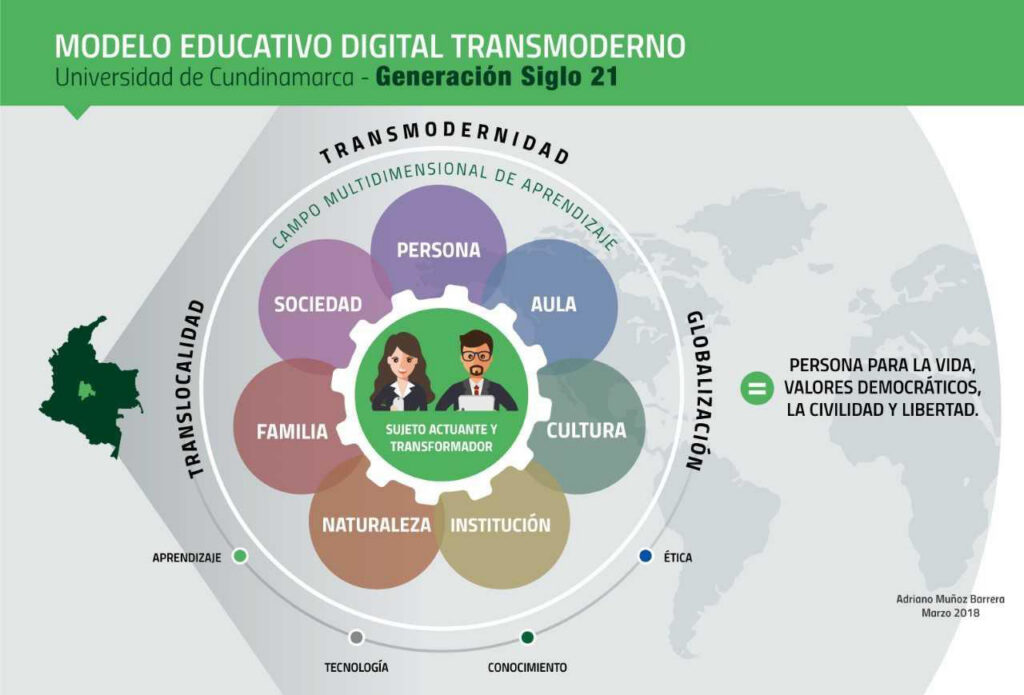
Figure 1. MEDIT.
The multidimensional field of learning, as shown in Figure 2, consists of three fields (institutional, disciplinary, and cultural), and seven dimensions (individual, classroom, culture, family, nature, institution, and society), which work together to foster a person’s preparation for life, democratic values, civility, and freedom.
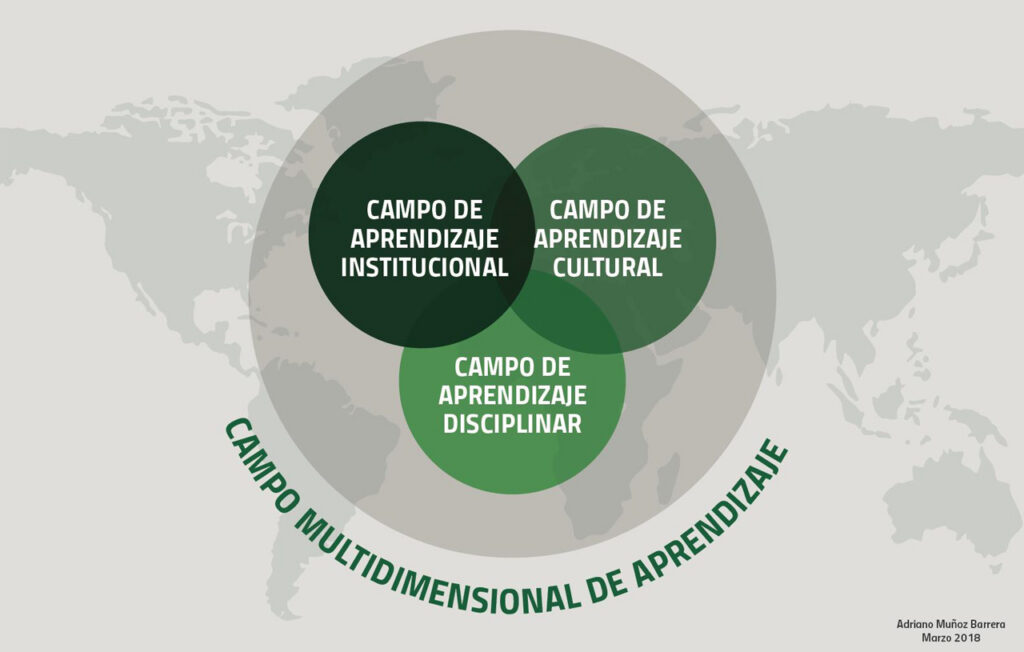
Figure 2. Multidimensional learning field.
The dimensions necessary to achieve the expected learning outcome are as follows:
- The person themselves is the main driver of constant and permanent improvement.
- The classroom is the expanded space where collaborative work between students and the professor takes place. Culture represents the customs, traditions, knowledge, beliefs, principles, values, norms, behaviors, and guidelines that define the spiritual, material, intellectual, emotional, and moral character of the University of Cundinamarca.
- As a social organization, the institution promotes a formative framework through its norms and rules.
- Nature is the totality of living beings and materials that, in dialogue with the university community, manage to coexist for the sake of the survival of the human race.
- The family is the primary foundation upon which the greatest results in the development of a transhuman individual are achieved; consequently, it plays an active role in the educational process.
- Ultimately, it is society that takes ownership of the learning that has taken place, becoming the embodiment of development and transformation.
The institutional learning field (Figure 3) refers to the University’s commitment to structural and foundational learning nuclei that shape the transhuman individual and the identity of the translocal, transmodern university. Members of the university community—especially students—forge their personality, character, identity, autonomy, and sense of responsibility at their alma mater, grounded in their relationships with others and with nature.
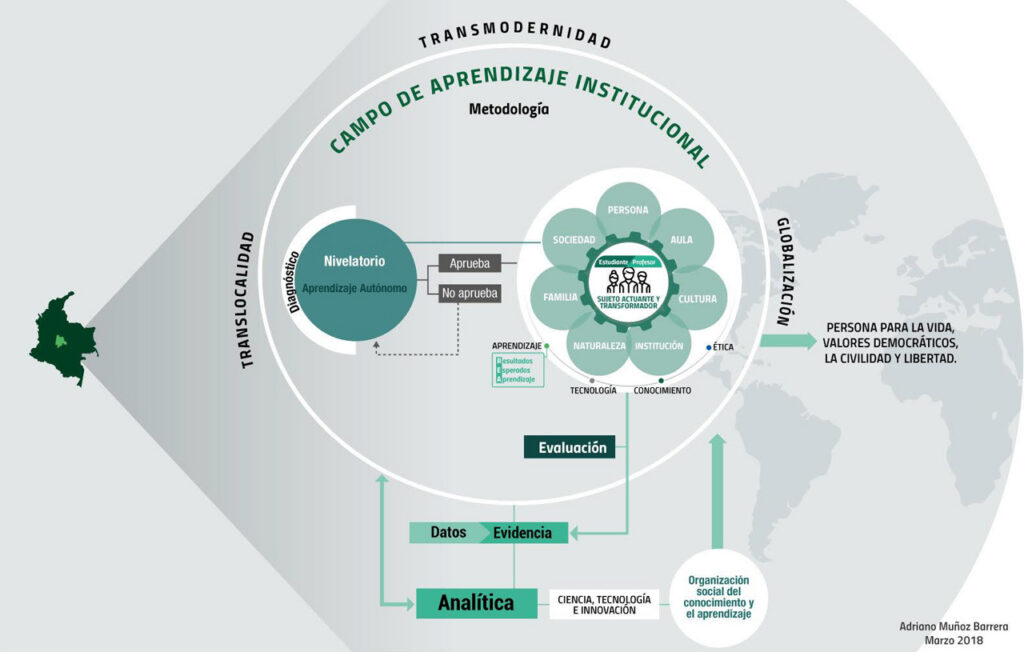
Figure 3. Institutional learning field.
The field of cultural learning (Figure 4) seeks to cultivate, strengthen, and create experiences, practices, symbols, customs, principles, and values that spiritually and materially distinguish a university community dedicated to shaping a transhuman individual. At the University of Cundinamarca, all spaces where students engage are significant for learning; therefore, the institution must actively shape these spaces so that they are reflected in actions or behaviors that improve life and strengthen democratic values, civility, and freedom.
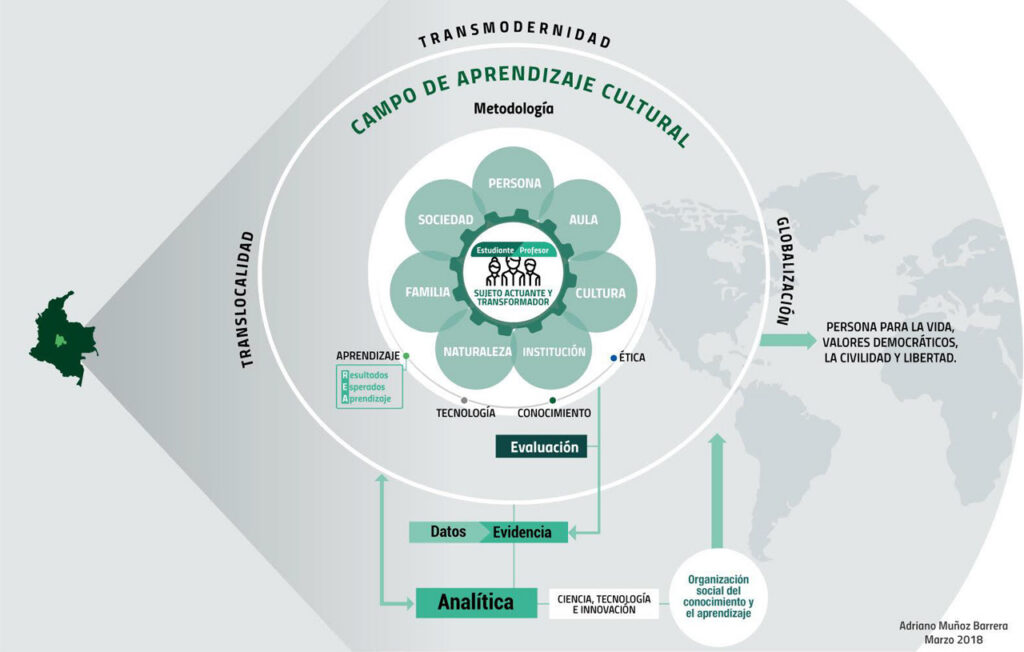
Figure 4. Cultural learning field.
The disciplinary learning field (Figure 5) corresponds to the knowledge of each discipline that the university offers to the Department of Cundinamarca, the nation, and the world.
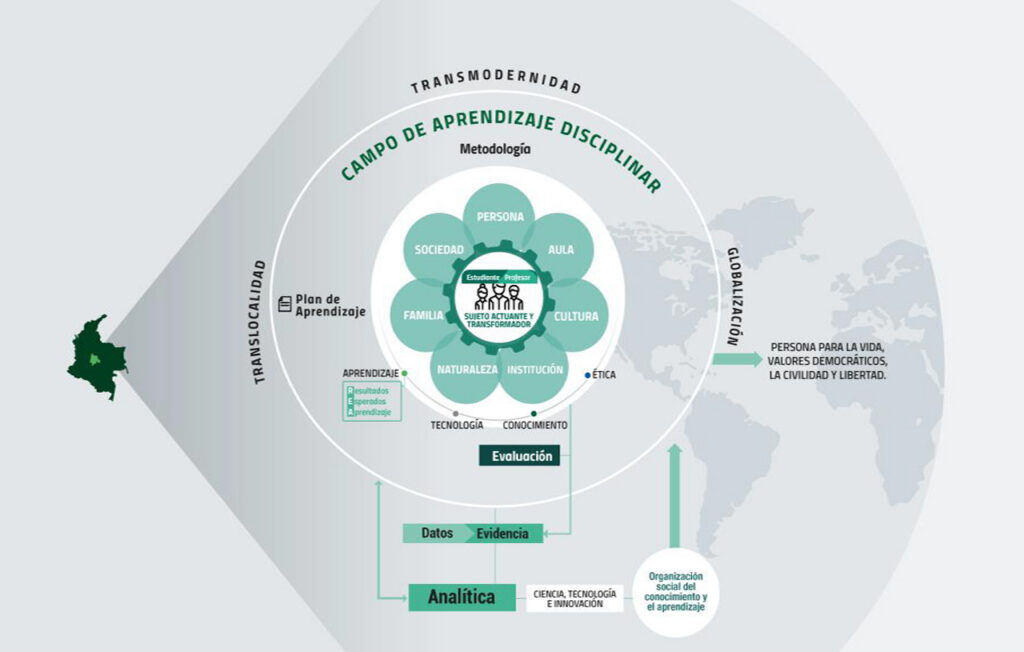
Figure 5. Disciplinary learning field.
Each field represents the combination of the dimensions identified by the institution, where participants gain experience, solve problems, and develop behaviors, with the aim of educating them through technology-supported, self-directed, and collaborative learning.
In this regard, assessment is an analytical process that involves collecting data to demonstrate the transformation, improvement, and achievement of students or participants in the field of learning.
In summary, from an institutional perspective, the University of Cundinamarca is a social organization dedicated to knowledge and learning that operates in a multidimensional field comprising three domains: the institutional, the cultural, and the disciplinary, and each of these, in turn, consists of seven dimensions: the individual, culture, the institution, the classroom, the family, nature, and society; these dimensions converge to educate for life, democratic values, civility, and freedom. Education grounded in ethics, learning, technology, and knowledge
In this paper, I present some considerations on the proposal I made in the 2016-2019 Universidad de Cundinamarca 21st Century Generation Rectoral Plan (Muñoz, 2015) related to the EDUCATION FOR LIFE, DEMOCRATIC VALUES, CIVILITY, AND FREEDOM , purpose of TRANSMODERN DIGITAL EDUCATIONAL MODEL (hereinafter MEDIT).
Adriano Muñoz Barrera.
President of UCundinamarca
- Ambrose, S., Bridges, M., & Dipietro. (2017). How Learning Works. Barranquilla, Colombia: Editorial Universidad del Norte.
- Amo, D., & Santiago, R. (2017). Learning Analytics: Telling the Story of Learning Through Data. Barcelona, Spain: Editorial UOC.
- Bautista Segalés, JJ (2014). What Does It Mean to Think from Latin America? Toward a Transmodern and Post-Western Rationality. Madrid, Spain: Ediciones Akal.
- Bourdie, P. (2011). Issues in Sociology. Madrid, Spain: Ediciones Istmo.
- Cubillo Guevara, AP, and Hidalgo Capitán. (2015). Beyond Subsistence, Development, and Post-Development: Transdevelopment as a Manifestation of Transmodernity. *Revista de Economía Mundial*, 41, 127–158.
- De Sousa Santos, B. (2007). The University in the 21st Century: Toward a Democratic and Emancipatory Reform of the University. La Paz, Bolivia: CIDES-UMSA, ASDI, and Plural Editores.
- Dussel, E. (2005). Transmodernity and Multiculturalism: An Interpretation from the Perspective of the Philosophy of Liberation. Mexico. Retrieved from https://redinterculturalidad.wordpress.com/2014/01/26/transmodernidad-e-interculturalidad-enrique-dussel/
- Dussel, E. (2015). Interview on Transmodernity. International Seminar: “Hope and Plans for the Future in Latin America: Social Sciences and Critical Thinking. Issues in Theory and Method.” (IPECAL, Compiler) IPECAL. University of Cundinamarca.
- Moreno Durán, A., & Ramírez, J. (2013). Pedro Bourdieu. 21st Century Project. Bogotá, Colombia: Latin American Institute of Higher Studies.
- Muñoz Barrera, A. (2015). University of Cundinamarca. Retrieved from https://www.ucundinamarca.edu.co/index.php/plan-rectoral-2015-2019
- Ordine, N. (April 10, 2017). It seems that the university’s mission is to sell diplomas. (S. Rico, Interviewer) Retrieved from http://www.revistaarcadia.com/libros/articulo/entrevista-con-nuccio-ordine-academico-italiano-sobre-la-sociedad/65958
- Rodríguez Magda, R. (2015). The Transmodern Condition. Antropos, 9–45.
- Rodríguez Magda, R. (2017). Discussion on the Transmodern Digital Educational Model. Fusagassugá, Cundinamarca.
- Rodríguez Magda, RM (2004). Transmodernity. Barcelona, Spain: Anthropos Publishing.
- Stiglitz, J. and Greenwald, B. (2015). Creating a Learning Society: A New Approach to Growth, Development, and Social Progress. Barcelona, Spain: Editorial Crítica.
- Varela, F., Thompson, E., and Rosch, E. (2005). In the Flesh: The Cognitive Sciences and Human Experience. Barcelona, Spain
MEDIT model
MEDIT model
MEDIT model
MEDIT model