News
2026-09-24
III Transhuman AI Song Contest
Where human sensitivity creates, dialogues, and is enhanced by AI



I am your virtual assistant, here to help you quickly and easily.
▲ Back to Top
By: Alejandro García Suárez – Advisory Office of Communications
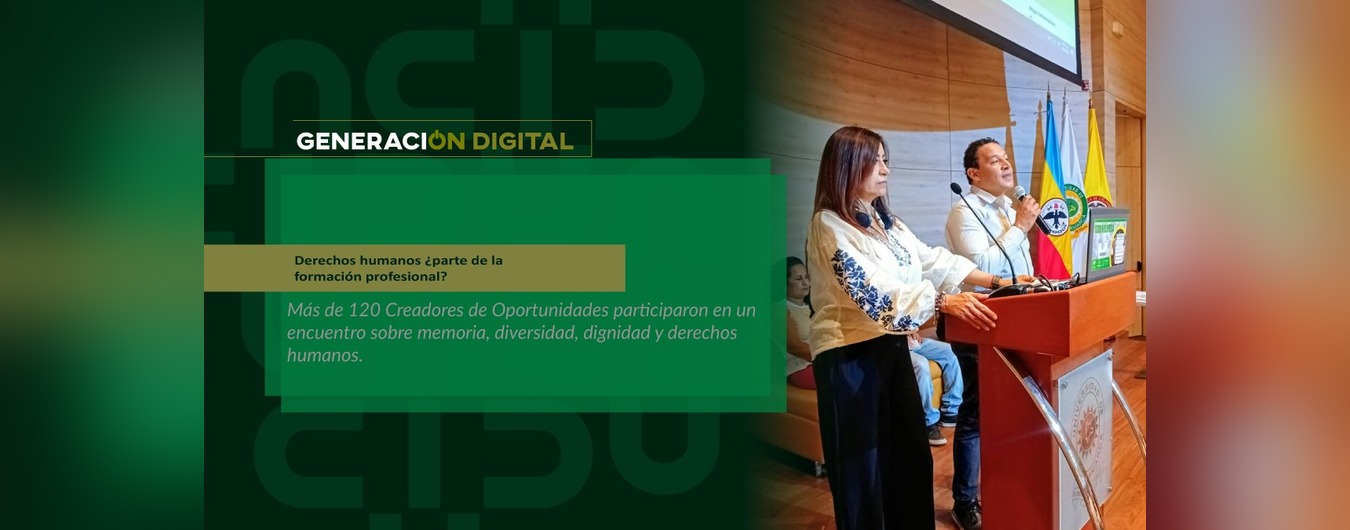
The Fusagasugá venue was the setting for the commemoration of Human Rights Day, a day that brought together Opportunity Creators, Knowledge and Learning Managers, representatives of social organizations and different actors from the territory to discuss dignity, diversity, memory and peacebuilding.
The experience was led by the Human Rights Committee of UCundinamarca, the PEACE-SCIENCE Cultural Learning Field of the Faculty of Education and the Bachelor's Degree in Social Sciences, and its central focus was the discussion "Memory, diversity and human rights".
The meeting allowed for listening to different voices and reflecting on the realities of the country and the territory, based on experiences and knowledge shared by representatives of the Women and Gender Advisory Council, the Youth Council, victims' organizations and members of the University's Human Rights Committee.
During the inauguration, the Academic Vice-Rector, María Nancy Garzón Soche, emphasized the importance of integrating human rights into an education that transcends academic content and becomes a daily practice. “We don’t want these words to remain just on paper, but to truly be lived,” stated the Vice-Rector, who pointed out that these spaces allow for discussion and the application of reflections on democratic values, civility, and freedom to different settings: the classroom, the University, homes, and society.
The vice-rector also highlighted the importance of knowing history and reflecting on the situations of violence that have marked the country, as well as the need to strengthen values that allow putting collective well-being at the center of decisions.
Educating for life
For Jorge Leonardo Tapias Ordóñez, coordinator of the Bachelor's Degree in Social Sciences, the main objective of the event was to generate reflection on life, human dignity, and the role of education in building a society based on democratic values. “Reflecting on life and human dignity also means recognizing how the Transmodern Digital Educational Model is committed to human rights and education for life and human development,” he explained.
The event was attended by more than 120 Opportunity Creators from different faculties, including Engineering, Agricultural Sciences and Education, who had the opportunity to exchange ideas with the guests and approach different perspectives on human rights.
The importance of these spaces was also highlighted by the students. Nicole Maldonado Patiño, a third-semester Systems Engineering student and Opportunity Creator, emphasized the need to bring these conversations closer to young people and strengthen their knowledge of the country's history. "If we don't have a memory, we are condemned to repeat it," the student stated, referring to the importance of knowing about the acts of violence that have marked Colombia's history and understanding them from a critical perspective.
Her reflection summarizes one of the purposes of the meeting: to acknowledge the past in order to generate conversations that allow us to build new ways of relating to each other and defend the rights of all people.
A commitment to dignity and diversity
For her part, Ivonne Maritza Ibarra Pinilla, representative of the Knowledge and Learning Managers before the Human Rights Committee, highlighted the importance of this type of experience to make visible the work that the Committee develops at the University.
She noted that these spaces contribute to promoting human dignity, equality, diversity, non-discrimination, and peacebuilding, in accordance with institutional principles, the MEDIT program, and the PEACE-SCIENCE Cultural Learning Field of the Faculty of Education. “This experience strengthens our commitment to respecting, promoting, and defending human rights throughout the university community,” she stated.
The day resulted in a meeting space between different generations, disciplines and social sectors, demonstrating that talking about human rights also means listening, recognizing differences, learning from memory and building collectively.
At UCundinamarca, these experiences are linked to the Transmodern Digital Educational Model -MEDIT, which promotes person-centered and life-oriented training, democratic values and the transformation of contexts.
Thus, the University continues to generate scenarios where knowledge does not remain in the classroom, but connects with the realities of the territory and with the challenges of a society that requires more dialogue, respect, memory and participation.
News
News
News
News