News
2026-09-24
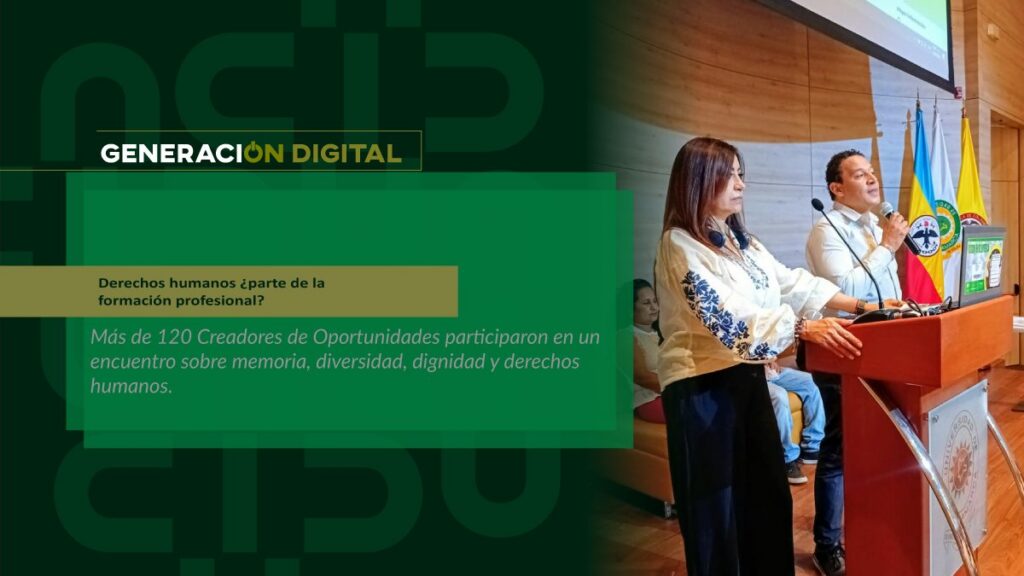
Human rights: part of professional training?
By: Alejandro García Suárez – Advisory Office of Communications



I am your virtual assistant, here to help you quickly and easily.
▲ Back to Top
The diploma course: Educating after war, pedagogy of conflict and reconstructive ethics, announced on June 17th via a Webinar and Facebook Live, features eight modules highlighting the thematic areas of Conceptualization, Memory, Methodological Foundations, Ethics and Decisions, Conflict, and Identity. It begins on June 24th and is a 100% virtual course with an intensity of 140 hours.
The diploma course will be led by Victor Eligio Espinosa Galán, An expert in the humanities, ethics, and philosophy, his bibliographic production is the result of his research and the publication of nine books, among which the following stand out: “Ethical Formation, Education for Peace and Moral Development” in Colombia 2015, Aula de Humanidades publishing house; ”School Coexistence, Education for Peace and Moral Development” in Colombia 2016, Aula de Humanidades, SAS publishing house, among others.
Reflections from the Webinar
“The education system, and therefore the school, understood as a space for training and socialization on the cognitive and coexistence level, can offer the conditions of possibility to make the learning of the culture of peace and non-violence viable, real, possible, strongly opposed to any violent manifestation that is justified by cultural right.”.
“When we talk about education for peace, some may wonder what kind of education is being referred to and what the concept of peace within that education is. Apparently, our society has been educated for generations to form citizens in and for peace, justice, democracy, and freedom. Therefore, when a proposal is put forward that explicitly offers Educating for peace, The questions that arise are: Weren't we educated for peace? Aren't we educating for peace? Probably not.”.
“Our culture demonstrates this through practices and discourses that justify violence as a way to resolve our conflicts, thus denying educational action and our capacity for dialogue. We have socially normalized categories such as just war, violence as a response to enemies of the state, preventive violent actions, liberating violence, etc. This therefore demands, as teachers and citizens, critical reflection, coupled with powerful and revitalizing pedagogical actions. Among these is education for peace.”.
News
News
News
News