News
2026-09-24
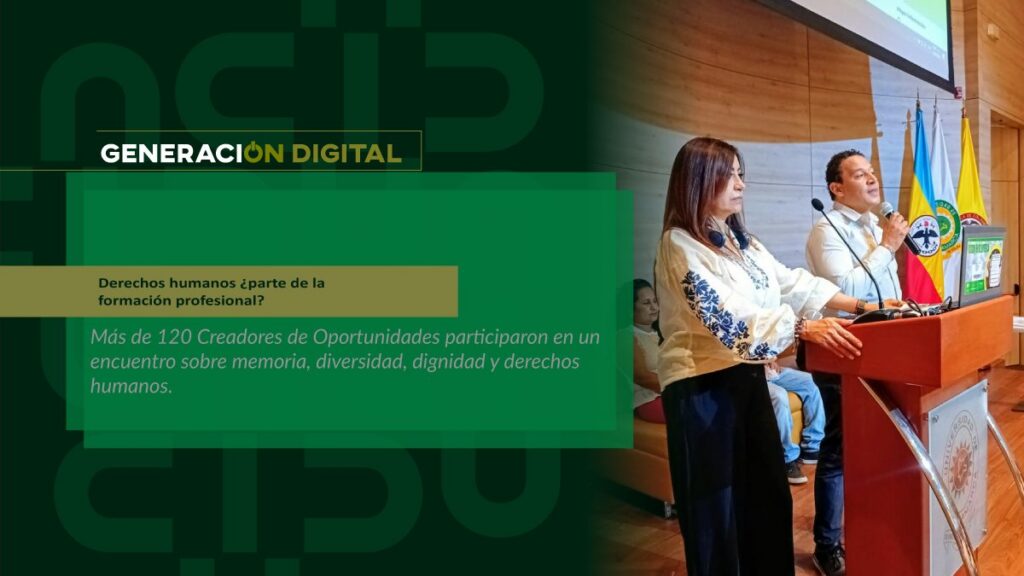
Human rights: part of professional training?
By: Alejandro García Suárez – Advisory Office of Communications



I am your virtual assistant, here to help you quickly and easily.
▲ Back to Top

The School of Teacher Training and Learning (EFAD), established less than five years ago, has become highly relevant in the professional development of faculty at the University of Cundinamarca, particularly during the pandemic, when it contributed to strengthening teachers' knowledge of technological tools. Now, with the return to in-person classes, the challenges continue, including "the creation of the learning community called 'Transform Yourself,' aligned with the Transmodern Digital Educational Model (MEDIT), which will allow us to develop strategies for this new era, in which we are called to be knowledge managers," stated Liliana Castro, pedagogical manager and leader of the EFAD S21 Training Circuit.
According to MEDIT, the teacher's leading role and the student's passive role must be transformed, since "both must recognize an active role in a collaborative and co-creative learning community, as the goal is a transformative act of improvement that allows the individual, among different actions, to autonomously choose the one that benefits them and does not harm themselves, nature, society, coexistence, and democratic life. This can only be achieved by a free and responsible transhuman person who chooses a social and ecological reason, for the other, living beings, and harmonious coexistence" (Excerpt from MEDIT).
In this sense, EFAD has structured three circuits that make up the professional field of the teacher, such as: Training, innovation and evaluation with an integrated route that allows the teacher to train and qualify in topics such as: 21st century citizenship, pedagogy and didactics, as well as in innovation and even learning in a second language.
“The training circuit is characterized by being very aligned with that vision of the country and the region, and it aims to be a tool that accompanies knowledge managers in the critical moments they experience every day in their work,” Castro added.
This is how the Training Circuit seeks to achieve ongoing reflection on pedagogical practice, prioritizing creative and collaborative learning. “We provide personalized support to our teachers when needed, because, as MEDIT states, these spaces should be conceived as enhanced and dialogical activities that allow us to access different aspects of learning, ultimately leading to problem-solving within disciplinary learning,” Castro explained.
“For this 2022, evaluations will be carried out in the training circuit on topics related to 21st century citizenship and the handling of a second language, achieving a “meditizing” teacher, that is, very aligned with the postulates of MEDIT.
News
News
News
News