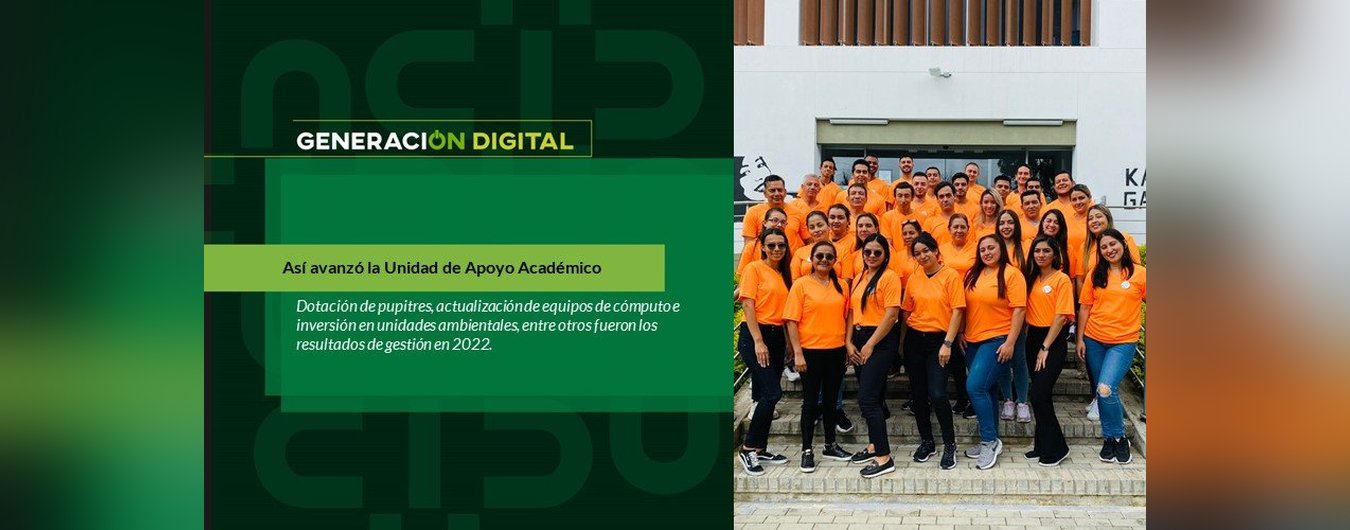
Among the results delivered by the Academic Support Unit in 2022 are the provision of desks, the updating of computer equipment, the investment made for the agro-environmental units, as well as the increase in specialized advice for students and teachers, and the strengthening of participation in projects led by libraries in the institutional sphere.
“In Budget execution, the unit has an equivalent of utilization and execution of the 97,7% Regarding the 100% of the allocated resources, we can highlight that the following acquisitions contribute to ensuring the learning and implementation of MEDIT in all our academic spaces in order to generate learning experiences with resources and elements already available at the forefront of transmodern education,“ assured the head of the Academic Support Unit, María de Los Ángeles Franco.
Some of the projects to highlight are:
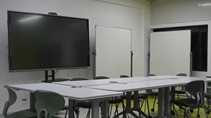
Provision of desks for the Fusagasugá headquarters and the Soacha extension; a total of 2,556 desks were acquired.
Upgrading computer equipment and renewing technological equipment in the different laboratories of the headquarters, branches and extensions for an investment of more than 500 pieces of equipment.
Acquisition of electrical and technological equipment, educational materials, provision of furniture, equipment maintenance, chemical supplies and reagents for the different laboratories of the headquarters, branches and extensions.
For the Agro-environmental units, investment was made in livestock feed, hardware items, veterinary supplies and medicines, and various agricultural inputs.
Physical adaptations, acquisition of furniture and technological equipment for the academic spaces of the regional units of the University of Cundinamarca that operate in the field of institutional learning.
Updating the different licenses of academic software that are for exclusive use by the academy represents an average investment of 900 million pesos.
Purchase of equipment for the year 2022 for investment projects and licensing of software for exclusive use by the academy.
Furthermore, regarding the results obtained by the Knowledge Management and Learning Center, the following stand out:
Conducting 583 specialized consultations for students and teachers, which represents the 54% of users advised on the total of the academic community, fulfilling the goal of the Metropolitan Library Network.
Compliance with 100 % of making use of the allocated resources, ensuring that the investment made is reflected in the appropriate use by the user community.
A total of 38,883 users consulted and browsed the different electronic resources, and there were 117,000 active sessions, exceeding the goal by a 100% of students, administrative staff, teachers and graduates making frequent use of our bibliographic tools.
To update the collections, approximately 5,000 copies were acquired for all regional units, representing an investment of around 520 million in updated material.
Achievement of the indicator goal of visibility of the institutional repository, through the publication and indexing in Google Scholar of 3,351 intellectual property documents of UCundinamarca and a visibility in sessions entered of 146,200 and 113,000 users who consult and download our documents internationally in countries such as Mexico, Peru, Ecuador, Spain, Chile among others.
The learning field has carried out different experiences, articulating the creation of tools and strategies for the management and self-management of knowledge and learning in science, technology and innovation, with the active participation of 400 users among knowledge managers.
This approach successfully increased the visibility of researchers' websites and strengthened institutional visibility. Our e-library website was updated, creating a user-friendly experience with easily accessible buttons and a user-friendly research interface. Filters and descriptions were added to help users understand the use and resources of each virtual library.
“We can conclude with the satisfaction of having contributed to the institution based on commitment and teamwork in order to strengthen the strategies of our Transmodern Digital Educational Model (MEDIT),” concluded Dr. Franco.