Fusagasugá Branch
2026-09-24
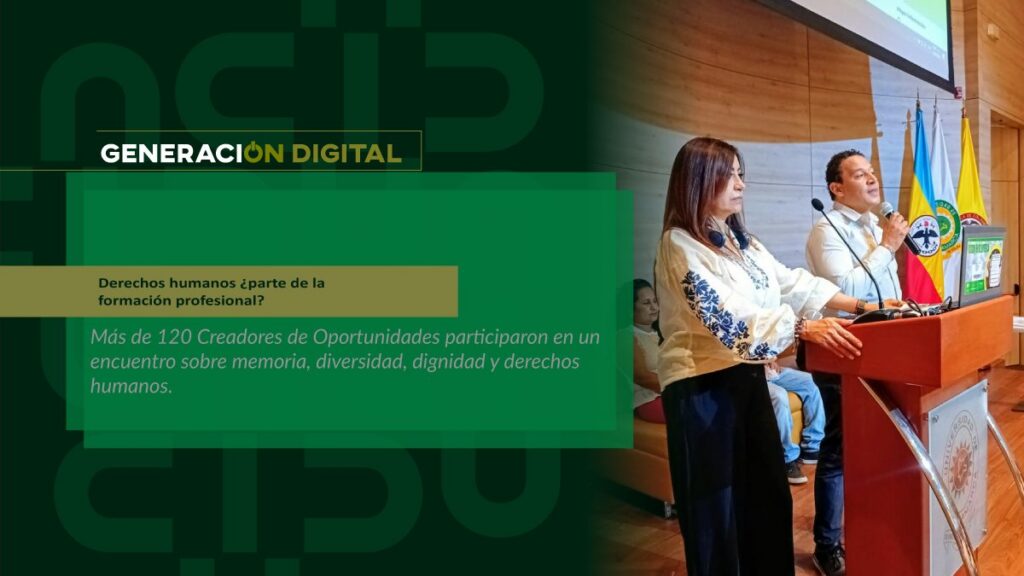
Human rights: part of professional training?
By: Alejandro García Suárez – Advisory Office of Communications



I am your virtual assistant, here to help you quickly and easily.
▲ Back to Top
Sustainable development is a highly relevant concept in today's society because its implementation allows us to meet needs and approach human development in different areas, based on sustainability. Therefore, with the aim of delving deeper into this topic and understanding its meaning, scope, and relationship to education, as well as analyzing the implications of the current pandemic from this perspective, we interviewed Marco René Rodríguez Ortiz, an anthropologist and graduate of the National University of Colombia with a master's degree in Development Studies, who currently teaches at the University of Cundinamarca in the Social Sciences program.
UCundinamarca: What is sustainable development?
Marco Rodríguez (MR): The word sustainability appeared linked to development in the late eighties. Specifically associated with the report “Our Common Future”, known as the “Brundtland” Report, presented to the General Assembly of the OECD (Organisation for Economic Co-operation and Development), in 1987.
As background, it is worth saying that development remains a controversial concept; subject to frequent scrutiny from various approaches, and therefore subject to a diversity of interpretations.
In this context, sustainability is a concept that encompasses a diversity of ideas, taking into account the warnings from developed countries about the socio-environmental consequences of indiscriminate economic exploitation, the negative effects of industrial practices, and population growth, to name a few.
Sustainable development is defined as development that meets the needs of the present generation without compromising the ability of future generations to meet their own needs. It is a concept that encompasses both social and economic dimensions, as is the concept of sustainability. It generally enjoys international political support and acceptance not only within civil society, but also among governments and institutions.
However, it has also been criticized for being ambiguous or contradictory. This is precisely due to a question of interpretation of the concept of development, which equates that idea with unlimited growth, thus clashing with the very idea of sustainability.
UCundinamarca: Is sustainable development only related to the environment, or in what other scenario can it be implemented?
MR: Sustainable development stems from the need to establish a different relationship with the planet and with all living things. This involves promoting values that oppose the indiscriminate exploitation of nature, individualism, and selfishness, allowing us to relate to each other and to the planet in a different way. Therefore, the Sustainable Development Goals address major challenges such as equity, equality, well-being, innovation, and partnerships; these are interconnected with issues like poverty, hunger, education, and employment, to name a few, since the issue is not just about resources, but about the values that underpin their appropriation and use.
UCundinamarca: How is sustainable development related to education?
MR: There is a direct relationship between sustainable development and education. On the one hand, it is necessary to understand sustainability, since it is a broad concept that does not refer only to economic aspects, biodiversity, or environmental responsibility; on the contrary, it entails profound ethical considerations and personal reflection. On the other hand, it is useful to understand the objectives set out in the 2015 Agenda for Sustainable Development. These are the goals for 2030, and one of them specifically aims at quality, inclusive, and equitable education.
On the other hand, it is important to learn to live together and to observe everything that is part of the community of life from the perspective of respect and responsibility. This is a term coined by L. Boff, comprehensive and interesting for understanding the broad dimension of the concept of sustainability. Consequently, sustainable development presents a vision and aims for a global commitment that involves taking action in all areas, starting from the individual and local spheres, toward the preservation and conservation of the planet. In my opinion, education has a fundamental role to play in transforming society, reorienting learning, and helping us to reevaluate the knowledge, skills, and practices necessary to balance our relationship with the planet.
UCundinamarca: How can education be strengthened in areas related to sustainable development?
MR: Promoting understanding of sustainable development and its overall goals is important for the nation and its territories. There is a global commitment to the SDGs, and it is the duty of national institutions to foster understanding and engagement with them. But beyond that, Sustainable Development Goal 4 outlines the values that should guide education. We must promote inclusive, equitable, and quality education. This is especially crucial given that the rates of school dropout among children and adolescents have exceeded 801% worldwide.
Today we know that education is directly linked to human well-being, as well as to poverty reduction, access to decent work, and the development of diverse human capabilities and options. Considering education as a lifelong pursuit for all is a responsibility of institutions today. Institutions like ours have the opportunity to make a significant impact on the youth of the province and on its sustainable development.
UCundinamarca: How important is sustainable development in Colombia at the territorial level?
MR: I consider the approaches that view the notion of development (including sustainability) as having different levels of resolution through which to be observed to be very valid. In this sense, the dimensions through which development operates, such as the ecological-environmental or the sociocultural, can be expressed at the local level. These are specific approaches to development in general; therefore, I affirm their importance, as well as their relational nature, within the idea of sustainability.
The local perspective on sustainable development is key, as it discovers and leverages the potential of local actors, their creativity, and their capabilities. The local approach offers an alternative to the traditional concept of development, focusing on the territory and making it the point of reference from which solutions are proposed for the challenges of daily life.
UCundinamarca: How might sustainable development be affected by the current pandemic?
MR: The pandemic is transforming the usual patterns of our lives and testing ways of life in many parts of the world.
The effects are far from uniform; because they are differential, they seem to increase the well-known and discussed gaps in inequality between societies.
The impacts are palpable. They are evident in the economic and social crisis stemming from critically rising unemployment and poverty. Additionally, violence against women is intensifying, along with high mortality rates from diseases other than COVID-19. I believe that, in relation to sustainable development, real governance and solidarity actions are needed today; political will must be mobilized for greater and more effective international cooperation; and human rights must be prioritized as a fundamental principle. The negative impacts are enormous, and the above contributes to mitigating them.
UCundinamarca: What authors or books do you recommend reading to expand your information related to the topic of sustainable development?
MR: There is a wide variety of literature on the subject. Publications from ECLAC (Economic Commission for Latin America and the Caribbean) and also from UNDP. However, I especially recommend authors who explore alternatives to development. For example: Arturo Escobar, with *Post-Development as a Concept and Social Practice*; Amartya Sen with *Development as Freedom*; *Development as Capacity Building*; and *Human Capital and Human Capability*. Mahbub Ul Hag, from *The Human Development Paradigm*; Martha Nussbaum with her *Capacity Building Approach*; Manfred Max Neef with *Barefoot Economics* and *Human Scale Development*; or Orlando Fals himself with his proposal in *Universal Origins and Current Challenges of Participatory Action Research*.
News
News
News
News