News
2026-09-24
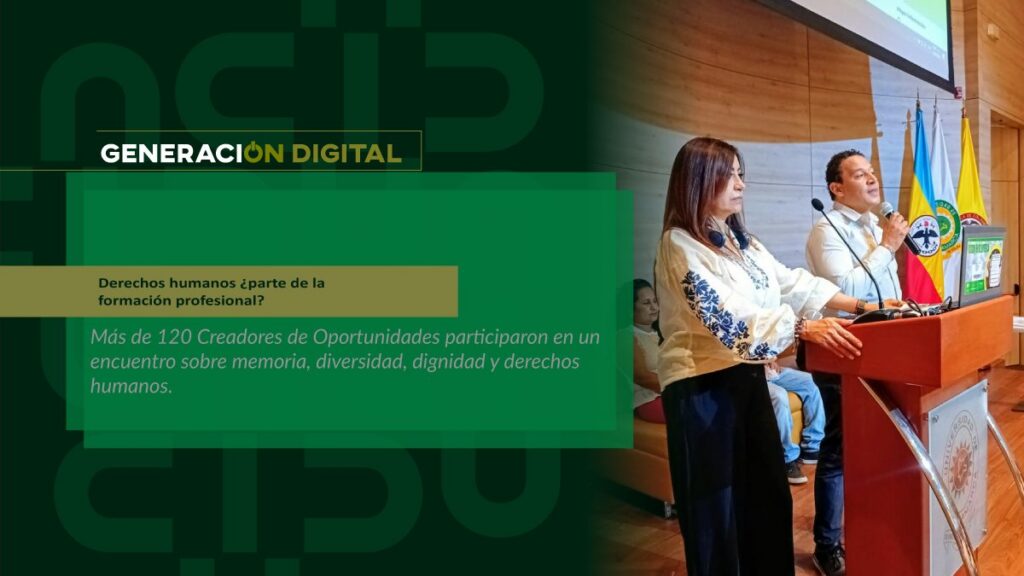
Human rights: part of professional training?
By: Alejandro García Suárez – Advisory Office of Communications



I am your virtual assistant, here to help you quickly and easily.
▲ Back to Top
Researchers from the ARADO group, attached to the Business Administration program, University of Cundinamarca, Fusagasugá campus, committed to the Region, the country and the planet, and with the aim of contributing to the construction of “knowledge societies”, carried out the research: Sustainable Strategies of Medium-Sized Enterprises located in the municipalities of Fusagasugá and Girardot”.
The ARADO group, created in 2004 with the main purpose of integrating the University of Cundinamarca into the social dynamics of the locality, the region and the country, has carried out projects benefiting economic sectors: commerce and service.
The researchers who participated in this project were: Noe Jiménez Rodríguez, Elizabeth Ann Escobar Cazal and María Cristina Velásquez Ardila, and research assistants from the AVANZA Seedbed: Yuri Ximena Vargas Sierra and María Camila Franco Arévalo.
The purpose of the research was to identify the state of administrative actions aimed at business sustainability, particularly by studying strategies for the protection and conservation of the environment, as well as compliance with corporate social responsibility, which led to proposing a “sustainable business model”, designed with the guidance of the SDG proposal and other international models.
The methodology, exploratory in nature, used a study population of 41 medium-sized companies, 20 located in Fusagasugá and 21 in Girardot. Fieldwork was conducted using structured observation and the application of a technical instrument, covering the three proposed areas: Environmental Management, Corporate Social Responsibility, and the use of ICT in the financial and commercial aspects.
As an integral part of this work, the First Business Sustainability Seminar was held. This event took place in the Emilio Sierra Auditorium at the University of Cundinamarca on November 13, 2018, with 350 attendees, including business owners from Fusagasugá and members of the academic community. In fulfillment of the University's social outreach function and within the framework of the research project, this seminar was organized to encourage business leaders and entrepreneurs to reflect on the importance of developing sustainable strategies within their organizations.
Based on the premise that, “although these industries are the engine of local economic development, they are considered the main cause of negative environmental impact and detriment to human and social well-being,” the business sector must be at the forefront by adopting or developing sustainable strategies on its own initiative, according to its specific circumstances.
The event included a workshop with entrepreneurs, using the "German seminar" methodology, which allowed for the exchange of experiences, initiatives, and actions implemented by entrepreneurs, providing a foundation for building a sustainable business model.
Speakers, experts, and renowned businesspeople participated, representing organizations with environmental certifications, recognition for social responsibility, and environmental management.
Research findings
The results showed that 68.31% of companies have an environmental management policy, while 611% have a certified environmental management system, demonstrating greater management and commitment to the environment.
51% of companies structured administrative units responsible for regulating and leading the Corporate Social Responsibility (CSR) component. 44% stated that they had an expert assigned to this issue.
These indicators are significant, given that the application of policies and the management of CSR requires leading professionals or a team to implement them.
Another important factor is the application of current environmental regulations (Decrees: 1500 of 2007; 321 of 2014; 1604 of 2002; 4741 of 2005; Resolutions: 482 of 2009; 1164 of 2002), related to compliance with waste collection, risk control systems, water and energy conservation, noise and visual pollution control, water quality, and wastewater discharge. This also includes the environmental code, NTS 005, and ISO 14001 certification, which comprise the environmental management system; and NTS 002, which addresses sustainable tourism.
Regarding water consumption reduction policies, 75.6% of companies comply with this saving; 70.7% reduced electricity energy expenditure.
This demonstrates that most companies comply with environmental regulations, also showing concern for the responsible management of natural resources and environmental protection, as well as for the health and well-being of their employees.
Communication and training are central elements to create a culture of corporate sustainability. The results showed that 72% of these organizations have mechanisms for dissemination, outreach and training of employees, some in alliances or agreements with institutions, such as: SENA, CAR, Chambers of Commerce and Faculties of environmental engineering in Higher Education Institutions.
On the other hand, the relationship that companies have with environmental or sustainable NGOs was evident. It was shown that only 27% have partnerships, a situation that should be improved because they can benefit by receiving economic and tax incentives.
Regarding the use of Information and Communication Technologies in financial and commercial transactions or e-commerce, 85.41% of companies use the internet to carry out these activities. 80.51% have a business website.
This data is relevant because some sustainable development goals are being met.
News
News
News
News