News
2026-09-24
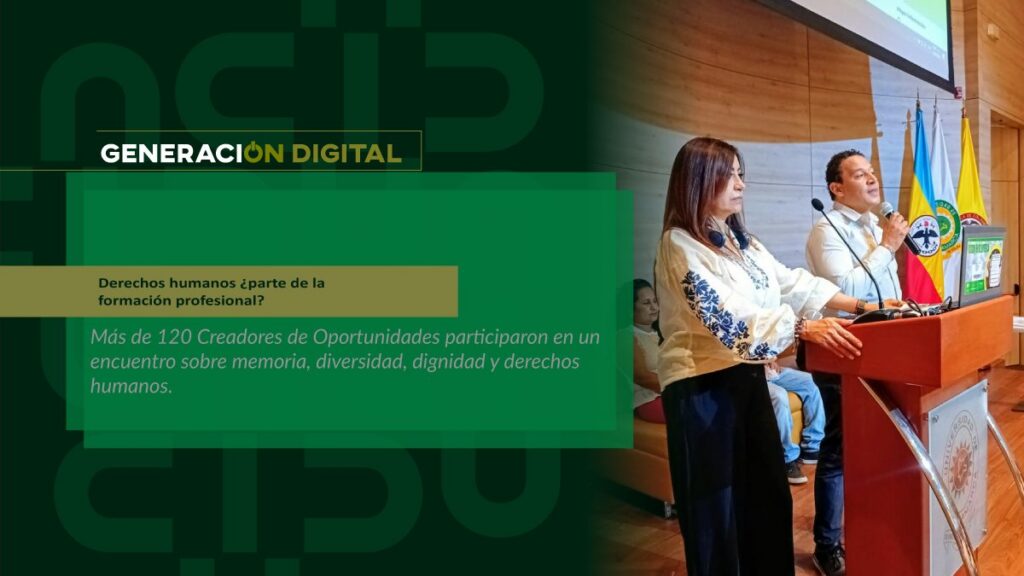
Human rights: part of professional training?
By: Alejandro García Suárez – Advisory Office of Communications



I am your virtual assistant, here to help you quickly and easily.
▲ Back to Top
By Juan Camilo Salas Cardona, Ph.D. 1
The term “education”, which comes from Latin “educere”, It refers to the act of "leading," as well as the actions of "guiding" and "orienting," understanding these as belonging to those who dedicate themselves to preparing others to lead a life that deserves to be called "human.".
Now, the fundamental question that arises from this etymological meaning is: “To lead towards what?” or “To guide towards what purpose?” These are questions that should guide every educational project, every curriculum, and, in general, every action of an educator with respect to their students. And it is precisely this awareness that should lead us to remember that in every educational action, two components must converge and harmonize, one of a situational, which relates to time, space and the specific purpose of pedagogical actions, and another, of humanizing character, aimed at the fundamental task of “learning to live humanely”.
A reflective look at Greco-Roman antiquity shows us how these components, which we could call "learning to do," of a contingent nature, and "learning to be," of a humanizing character, are justified in valuations of the human being as a unitary being in which two great processes develop: one internal, which tends towards maturity, reflection, the development of consciousness and the cultivation of ethical virtues, and another external, which is oriented towards the realization of professional projects, the development of skills and the achievement of social goals.
This dual and simultaneous endeavor is evidenced by such notable thinkers as Isocrates, Aristotle, Cicero, and Seneca, among others, in whose work it is clear that a project of “professionalization,” to use a contemporary term, cannot be separated from one of “humanization.” This leads to the easy conclusion that there cannot be a good professional if they are not also a good human being, a good citizen, and, in general, a good person, which is equivalent to saying that the human development of the professional becomes the “conditio sine qua non” so that their professional practice is humanizing and promotes quality of life, from their particular work perspective.
When we perceive, with a good degree of bewilderment, that, on many occasions in Latin America, education, especially university education, has become a lucrative business that “almost literally” sells degrees and diplomas to students, whose main effort must be to make the payments due, and when we note that, in an almost generalized way, higher education has forgotten the ideal of “formation”, about which Hans Georg Gadamer spoke to us so lucidly at the beginning of his famous work “Truth and Method”, Because we prioritize professionalizing, instructive processes that generate analytical and factual skills, we miss the existence of proposals that, while continuing to prepare professionally to face the growing needs of today's world, recover, articulate and propose educational models that enhance and make viable the human project that each person must carry out.
The absence of this type of formative vision has become particularly evident in the case of the Wall Street crash or the Enron corporation a few years ago, when a study was conducted on the universities where their managers had been trained, very good indeed in technical and professional terms, and graduates of the best university institutions in the world, but with obvious limitations in the ethical, humanistic and social sphere, which led them to make the deplorable decisions that led to the downfall of their companies.
In Latin America and the Caribbean, we have not conducted similar studies to determine where the protagonists of the notorious corruption cases we have suffered, and continue to suffer, come from. However, it is almost certain that many of them are graduates of prestigious educational institutions where professional excellence is valued, to the detriment of so-called "filler," "speculative," or "soft" knowledge, referring to disciplines such as ethics, philosophy, and the humanities in general.
It is true, and must be acknowledged, that the presence of courses in these disciplines, which have historically been included in many curricula, has not been successfully integrated with the knowledge they provide for practical application. This could be due, among other things, to their lack of integration within a coherent curriculum. It must also be acknowledged that those of us who have taught these courses have erred in trying to unjustifiably complicate them, to make them appear as "serious, rigorous, and profound discourses," driven by an unspoken desire to "have a demanding course." However, we have ended up distorting their motivational, critical, guiding, and awareness-raising role. This mea culpa will require further reflection on another occasion.
Based on this educational landscape, full of challenges, needs, and growing expectations from local and global society, the MEDIT proposal at the University of Cundinamarca constitutes a motivating milestone. This proposal, wisely and without sacrificing the growing academic quality that has distinguished it, now opts for a comprehensive, systematic, and interdisciplinary recovery of the humanistic and formative component, which universities in the West have been losing sight of in the fog of time.
The French writer André Malraux said in his anticipatory vision of the present century, which he did not live to see, that “The 21st century will be spiritual, or it will not be.”, By spirituality, he means the humanist perspective and the increased awareness that Paul Ricoeur called “the horrible 20th century” sorely lacked. Gilles Lipovetsky echoes this premonition when he states, paraphrasing Malraux, that “The 21st century will be ethical or it will not be.”.
Ambas afirmaciones apuntan a un componente existencial, antropológico y axiológico como el que atraviesa la propuesta del MEDIT, la cual, tomando prestada la sentencia de Ricoeur, se hace totalmente necesaria ante el “horrible siglo XX” que vivió la sociedad colombiana, el cual, a nuestro pesar, parece prolongarse inclementemente en este nuevo siglo.
Nothing could be more timely for a society like Colombia's, notoriously insensitive to the pain of others, deeply violent, averse to dialogue and consensus, markedly intolerant, devoid of ethical values, and polarized to the extreme, than a proposal like MEDIT, which not only resonates with a neglected dimension of modern and contemporary Western education, but also recovers the original meaning of the public university.
On this point, it should not be forgotten that Napoleon Bonaparte, who was the manager and promoter of public education, as we know it today, considered that the university should train the professionals that society needed to carry out its project as a nation, responding to its concrete needs, and building the spaces for a better quality of life from the different professional horizons.
This observation allows us to infer, without much mental effort, that a project like MEDIT is necessary and urgent for a public university that wants to respond effectively to the expectations and needs of contemporary Colombian society. In this context, the resounding success of humanities, philosophy, and formative courses is noteworthy, such as the one taught by Michael Sandel at Harvard University, who, according to many, is the "most popular professor in the world," and another course at the same university that addresses the fundamental problem of happiness, which attracts a remarkable 1,400 volunteer participants each semester.
These cases are tangible examples that a humanistic, philosophical, ethical, and axiological proposal, such as the one incorporated by MEDIT, not only has enormous social justification, but can also be extremely successful if each member of the educational community of the University of Cundinamarca gives their best to achieve it.
[1] PhD in Philosophy and Master's in Ethics and Democracy from the University of Valencia, Spain; PhD in Law from the University of Strasbourg, France; Specialist and Master's in Latin American Philosophy from Santo Tomás University; Professional and Master's in Theology from Javeriana University; Specialist in Bioethics from El Bosque University; and Lawyer from the Nueva Granada Military University. He is currently a Professor at the University of Strasbourg, France, and collaborates as a visiting professor with the National University of Colombia and the University of Medellín.
News
News
News
News