Fusagasugá Branch
2026-09-24
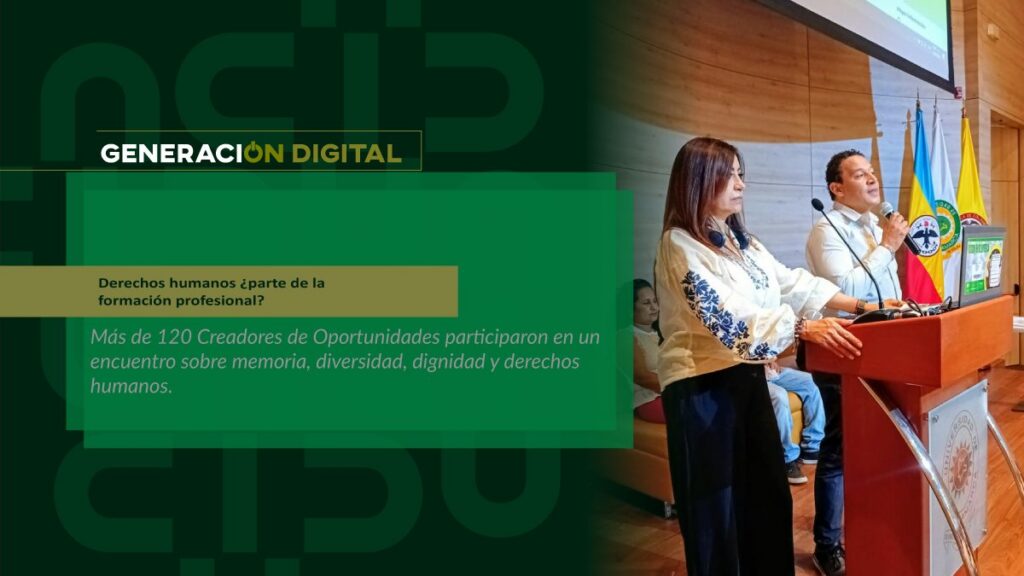
Human rights: part of professional training?
By: Alejandro García Suárez – Advisory Office of Communications


I am your virtual assistant, here to help you quickly and easily.
▲ Back to Top
By: Alejandro García Suárez – Advisory Office of Communications
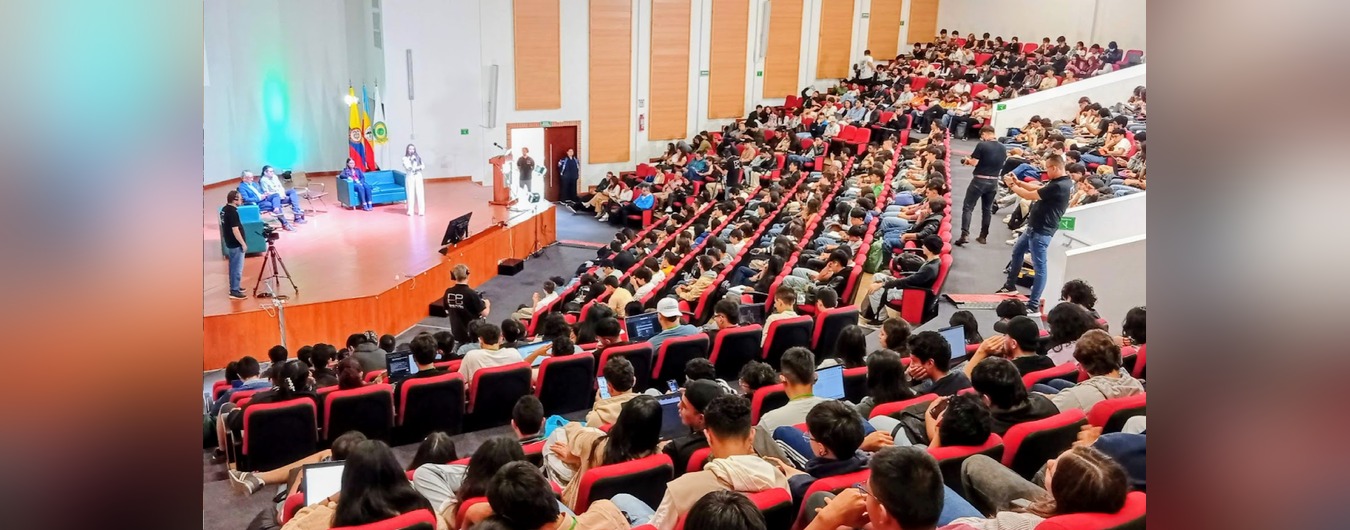
With broad participation from the academic community and environmental specialists, the University of Cundinamarca hosted the panel at its Fusagasugá campus “How, being transhumans, can I contribute to the improvement of the Bogotá River?”, a dialogue scenario that invited reflection on the challenges and opportunities for the recovery of one of the region's most important ecosystems.
During his speech, José Ricardo Rodríguez Díaz, an official of the Ministry of Environment and Territorial Development and project director Water-centered land use planning and climate change adaptation in the Chingaza, Sumapaz, Guerrero, and Guacheneque páramos, he emphasized that academia must move from reflection to action. He noted that, in a country with enormous biodiversity, it is necessary to go beyond “nice theses” and take on a more active role, recognizing that scientific knowledge is a fundamental player in contributing to the improvement of the river. He also called for transforming everyday actions, reminding us that change begins with individual decisions.
His presentation proposed a comprehensive reading of the environmental crisis of the Bogotá River, pointing out that its problems cannot be addressed through isolated actions. He explained that the basin functions as a continuous system, where decisions made upstream impact the entire territory. In that sense, the challenge is not only environmental or technical, but also one of territorial governance, which requires institutional coordination, shared information, and permanent monitoring.
For her part, María Camila Acosta Santos, a research professor in Environmental Engineering at the Facatativá extension, explained that the river's problem is not limited to point-source pollution, but is related to the territorial occupation model. As she noted, it is necessary to rethink the development of Bogotá and the Sabana in order to reorganize the territory around water and prevent the overexploitation of the water resource.
Her research analyzes water governance in the middle basin of the Bogotá River and highlights the role of community aqueducts in guaranteeing the human right to water. From a legal, territorial, and environmental perspective, the study shows progress in institutional coordination, but also tensions between a centralized state model and forms of community self-management.
Knowledge and Learning Manager and researcher Germán Andrés Quimbayo Ruiz, from the Bachelor’s Degree in Social Studies, presented an overview of environmental conflicts in the Bogotá-region, the result of more than fifteen years of research. His work analyzes socio-ecological inequalities associated with accelerated urbanization and territorial planning in the middle basin of the Bogotá River, demonstrating how these dynamics have generated multiple environmental tensions in recent decades.
From a territorial application perspective, Camila Silva Cruz, a graduate of the Environmental Engineering program in Girardot, presented the methodology Resilient Communities: Communal Production Regions (RPC), a proposal that seeks to strengthen food sovereignty, social organization, and productive sustainability in vulnerable territories. This model integrates sustainable urban agriculture, community governance, social appropriation of knowledge, and entrepreneurship, with the purpose of generating local solutions to environmental and social challenges.
The panel also featured the active participation of students; Juan Esteban Cleves Morales, from the Bachelor's Degree in Social Sciences, highlighted the value of the meeting's interdisciplinary approach, pointing out that being transhuman implies using knowledge capacities to provide concrete solutions. From the social sciences, he explained, it is possible to understand the historical and cultural factors that have influenced the contamination of the river.
Along the same lines, David Alfonso Villalba, an Agronomic Engineering student, drew attention to the risks of food production using contaminated water, warning that it is not viable to offer agricultural products if they are exposed to heavy metals or wastewater from the river.
The Opportunity Creators stated that the approach of the Transmodern Digital Educational Model (MEDIT) encourages students and teachers to move beyond theory and take action in the field, understanding that the recovery of the Bogotá River depends not only on major infrastructure projects, but also on real changes in daily and productive practices.
From this dialogue between experts, students, and the community, reflections emerged that invite us to rethink the role of knowledge, territory, and sustainability in environmental transformation.
From the institution, this reaffirms the commitment to the generation of knowledge, lifelong learning, and collaborative work with the territory, contributing to the protection of the Bogotá River and the conservation of the ecosystems that sustain life in the region.
News
News
News
News