News
2026-09-24
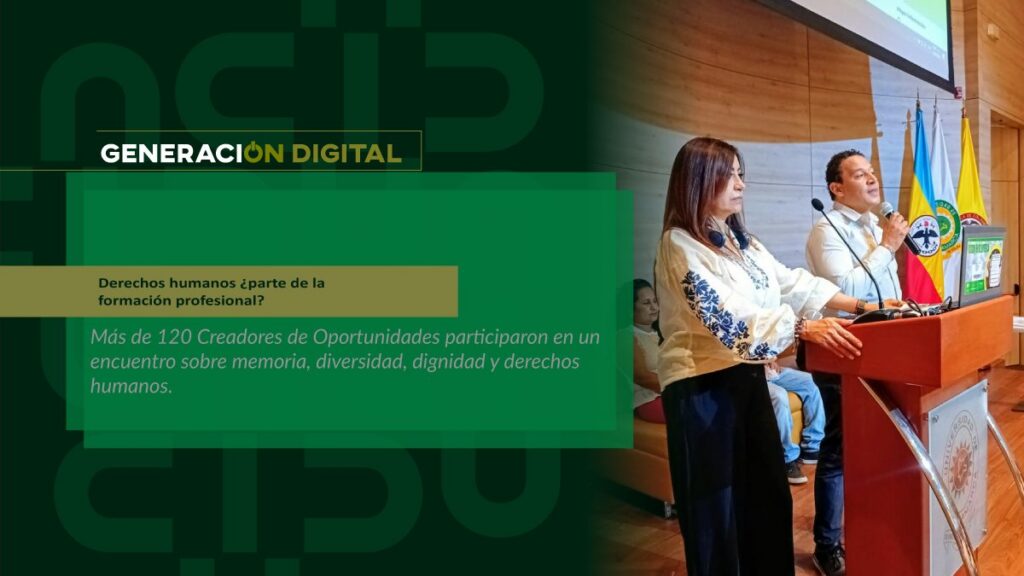
Human rights: part of professional training?
By: Alejandro García Suárez – Advisory Office of Communications



I am your virtual assistant, here to help you quickly and easily.
▲ Back to Top
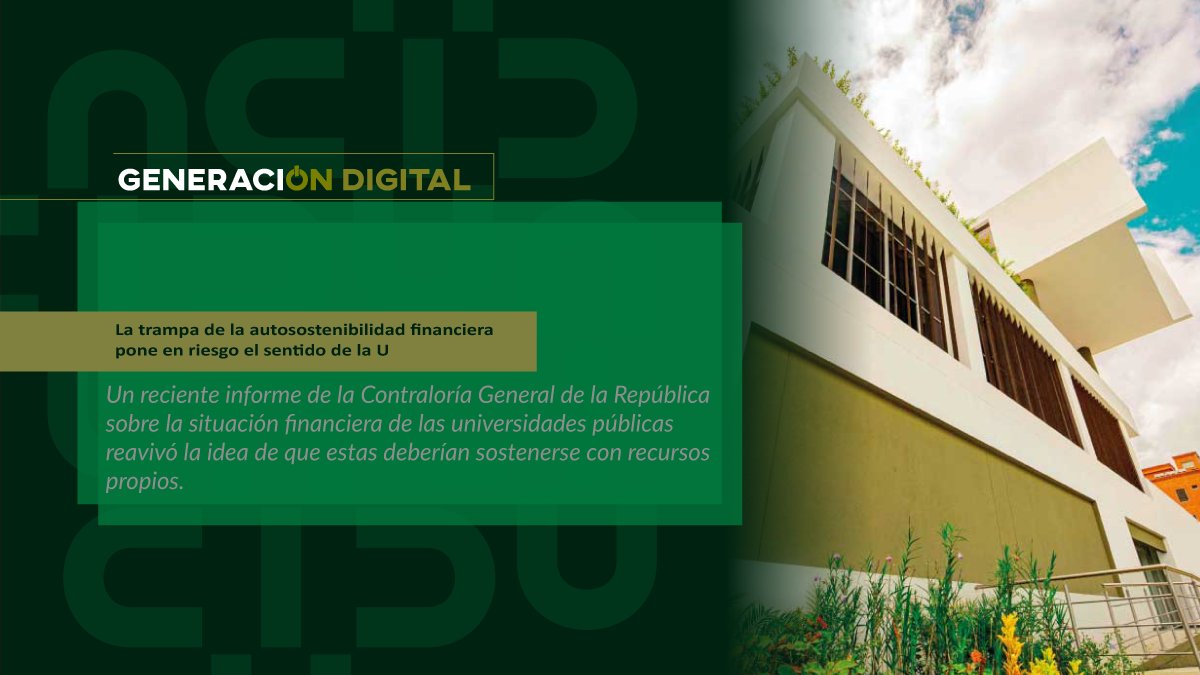
The study Financial sustainability of Colombian public universities (2019-2024), A report recently published by the Comptroller General of the Republic analyzes the situation of the country's 34 public universities and concludes that the state university system is experiencing structural financial fragility, which compromises the quality and sustainability of these institutions.
According to the oversight body, the causes of this situation include a high dependence on transfers from the national government, a limited capacity for self-financing, profound inequalities between national and territorial institutions, general expenses and payroll costs, as well as the burden of pension liabilities.
However, most press coverage has focused on the finding regarding the financial self-sufficiency of public universities. The study reveals that only one public university—the National Open and Distance University (UNAD)—manages to cover all of its operating costs and expenses with its own resources, while the remaining 971,000 public universities cannot sustain their operations without state funding.
Although the study acknowledges that public higher education institutions have gradually diversified their sources of income, it places greater emphasis on questioning their dependence on contributions from the national government. In national institutions, resources provided by the national government during the 2019-2024 period represented 54.1% of their income, while their own resources constituted 42.1%. In regional institutions, the distribution is more diversified, given the contributions from local and regional governments.
Although the study offers a robust diagnosis of the financial situation of public universities, its analysis reveals an unresolved tension between acknowledging a structural budget crisis and the nature of the solutions it suggests. Its findings seem to imply that the central problem lies in the universities' insufficient generation of their own resources, rather than in the limited fiscal responsibility assumed by the State.
This premise is problematic for several reasons. The first is the theoretical framework of public finance adopted in the study—centered on the principles of efficiency and financial sustainability—which is insufficient to understand the nature and purposes of the public university. The American economist Richard Musgrave—cited by the report to support an efficiency-based approach to resource allocation—introduces the concept of merit goods or preference goods, that is, the goods and services that society considers socially desirable and necessary, even when not all individuals spontaneously demand them in the market, or cannot afford them on equal terms.
Thus, the financial sustainability of public universities does not depend on their ability to "better manage" scarce resources or replace state funding with their own income, but on a fiscal and political decision by the State to guarantee sufficient, progressive and countercyclical levels of funding —understood as those that grow steadily and are reinforced in crisis contexts—, when it comes to strengthening social rights, generating new knowledge and responding to the needs of the country.
Another aspect to consider is that the comparative analysis of all institutions demonstrates that between 2019 and 2024, “total average income consistently exceeded operating costs and expenses.” However, when excluding transfers from the national government and comparing costs and expenses only with self-generated income, the report concludes that “the 97% of universities is unable to sustain its operations with self-generated resources.”.
This result, far from being a groundbreaking discovery, is largely tautological. Demonstrating that public universities cannot operate without state funding does not necessarily prove a supposed institutional inefficiency, but rather confirms their legal and mission-related nature as public entities dependent on the public budget.
In fact, the study is based on two debatable premises. On the one hand, it states that Law 30 of 1992 “introduced the concept of self-financing as a way to alleviate the dependence of public universities on the state budget,” and that it “established that universities should generate approximately 50% of their budget through their own sources.” The text of the Law does not set percentages for generating own income nor does it enshrine financial self-sufficiency as an objective of the public university system; on the contrary, it establishes that its financing should be based primarily on contributions from national or territorial budgets, with its own resources being a complementary, not a substitute, source.
In contrast, the Comptroller General's Office appears to misinterpret "financial autonomy" as independence from state transfers. However, the interpretation of the Political Constitution (Article 69), Law 30 of 1992 (Articles 28, 86, and 87), and constitutional jurisprudence—particularly rulings C-547 of 1994 and C-177 of 2002—clearly establishes that the funding of public universities is an essential responsibility of the State, and that university autonomy cannot be understood as a duty of financial self-sufficiency. Furthermore, in ruling C-311 of 1994, the Constitutional Court urged the State to advance, based on principles of progressivity, in the conception of higher education as a fundamental right.
The emphasis on diversifying funding sources risks reversing the root causes of the problem. The report acknowledges that Law 30 of 1992 established a budget allocation rule that adjusts transfers annually based on inflation, which barely preserves the value of money without considering the real growth of university costs, enrollment expansion, quality standards, or the salary and benefits obligations defined by the State itself.
In this context, the search for internal resources does not appear as a complementary option but rather as a forced response to an insufficient funding model, which progressively shifts the financial burden from the State to the institutions, and in many cases to students and their families. The study also omits the figure presented by the State University System (SUE) in 2021, according to which public universities stopped receiving more than 17.2 trillion pesos over the more than 30 years the Law was implemented—a shortfall they had to cover with their own resources.
The exaltation of the UNAD case as an example of financial sustainability reinforces a methodologically questionable comparison, as it contrasts institutions that operate under radically different educational models, cost structures, and academic commitments, as the study itself acknowledges. While universities like the National University of Colombia (UNAL) and the University of Antioquia (UdA) register the highest per capita expenditures in the system—27.93 million pesos and 29.07 million pesos per student, respectively—related to research, postgraduate training, scientific infrastructure, and outreach, UNAD presents the lowest per capita expenditure, at 3.11 million pesos.
Taken out of context, this data has fueled the narrative that traditional universities "generate losses" compared to a supposedly exemplary model of sustainability. Presenting this case as an implicit benchmark can lead to erroneous conclusions and undue pressure to homogenize institutional models that, by definition, are diverse and respond to different territorial and mission-related realities.
Source: UNAL Newspaper
News
News
News
News