News
2026-09-24
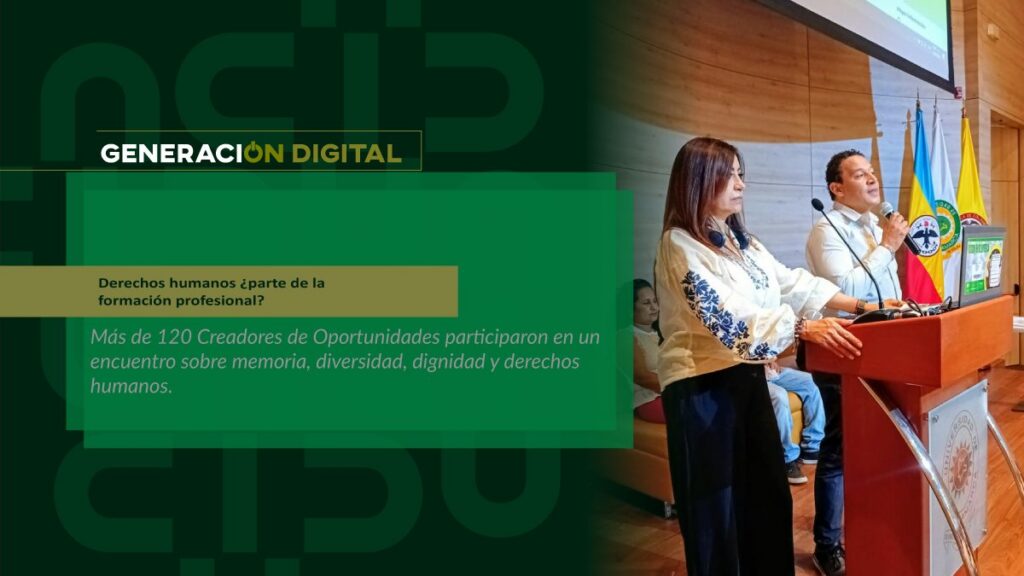
Human rights: part of professional training?
By: Alejandro García Suárez – Advisory Office of Communications


I am your virtual assistant, here to help you quickly and easily.
▲ Back to Top
CALL FOR APPLICATIONS
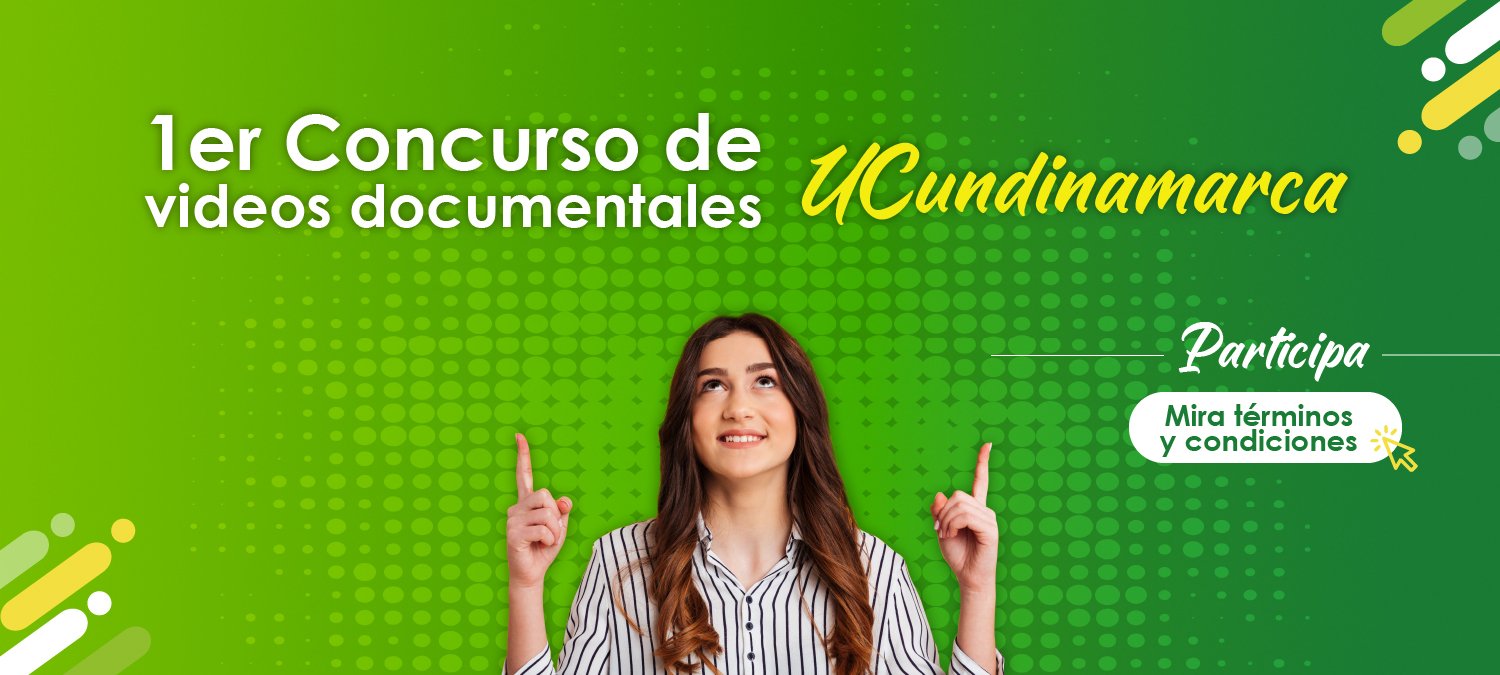
FIRST UCUNDINAMARCA DOCUMENTARY VIDEO COMPETITION
The University of Cundinamarca invites undergraduate students to participate in the first documentary competition.
The winner will receive an exemption from paying tuition for the first semester of 2021.
WHO CAN PARTICIPATE?
Undergraduate students from all branches, extensions, and headquarters. Individually or in groups of up to three (3) students.
DOCUMENTARY TOPICS
-NATURE
-LIFE
-THE INSTITUTION
-THE CLASSROOM
-THE FAMILY
-THE PERSON
-SOCIETY
NOTE: The dimensions of Medit should be addressed from the perspective of the territory. The participant(s) may choose one or more themes.
PRESENTATION FORMAT
A link to the video uploaded to a personal YouTube or Vimeo channel must be submitted. The video must be between 20 and 30 minutes long. The documentary may be recorded with a cell phone, but care must be taken to ensure good quality.
SUBMISSION DEADLINE
The video link should be sent to the email address provided. [email protected] until December 2, 2020 until 6 pm with a letter in word where you clearly register the data of the author or authors, institutional email, semester, student code, telephones, title of the work, duration and theme chosen for the making of the recordings.
The two shortlisted videos will be published on the University's website and official social media channels on December 5th, and a notification will also be sent to the winner(s)' email address. The winner(s) will be announced on December 10th through the University's communication channels.
GENERAL CONSIDERATIONS
JURY
The jury will consist of the three audiovisual producers from the University of Cundinamarca, the dean of the Faculty of Education, a professor from the music program, and a professor from the humanities program.
AWARDS
The criteria that will be used to choose the winner will be
| CRITERIA | SCORE |
|---|---|
| The theme is developed in accordance with the values promoted by MEDIT | 40 POINTS |
| Cinematic narrative | 30 POINTS |
| Audiovisual quality (sound, image) | 30 POINTS |
GUIDE ON HOW TO CREATE A DOCUMENTARY
Part 1
Do pre-production
1Choose a topic (about what you want to do in the documentary). Remember that you will need to complete the project. Think about the people and objects you will film and the location. Develop a basic story idea.
2 Watch documentaries. Once you've determined the type of documentary you'll make, analyze similar documentaries to identify common conventions. Be sure to pay attention to the narrative structure of the documentaries.
3 Write a treatment. The initial document should include a summary of the documentary and its objective or purpose. Outline the script, covering each main section, but keep it under 300 words.
4 Write a script based on the concept of your story. You'll need a script, or you won't have a documentary. When you think of a concept, Make sure you write something interesting. for your viewers. For example, if you're giving the script to someone who likes drama, add several dramatic elements to the documentary. If they like comedy, add comedic events, and so on.
5 Prioritize the scenes. Identify the main scenes taking into account the outline.
6 Draw a storyboard illustrating the shots you plan to use. Don't worry about following the storyboard exactly. Putting your thoughts on paper is a good idea and an excellent way to determine if you can communicate an idea visually rather than having the actors communicate the concept verbally. The audience will see first and then hear.
7Get feedback. Show what you have of the documentary to your friends, family, teachers, etc. Refine your work until you are ready to film.
8 Get ready. Brainstorm the worst things that could happen while making the documentary and how you'll deal with them. Remember to look for technical and narrative problems.
Part 2
Carry out the production process
1 Get ready to film. Choose the equipment—a device that can record video. There are many options. This process can take months or even years, but you should keep looking. Make sure the video recorder is compatible with your VCR or editing equipment.
2 Learn how to use a few functions of the recording device and review how it works. Learn how to start and stop recording, fast forward, rewind, repeat, and any other function you might need. Save the special effects for your second or third project.
3 Look for people who are not busy and are willing to work hard on your documentary. Provide food for your team members. They'll appreciate it and might even stay with you longer.
4 Create a shooting schedule. That way, you'll stay focused on your project.
5 Film the footage. If you want to showcase your pet, you can film it while it eats, sleeps, and plays, and even add music. If you're short on time, consider using a second camera to be twice as efficient.
6 Interview the subjects.
7 Keep a journal. Keep a journal in which you write about how the filming went, the mistakes you made, how you could avoid them next time, and ideas about what to film on other shoots.
Part 3
Carry out post-production
1 Record the footage. Before editing the documentary, watch all the footage and write notes on each take, mentioning whether it works or if there are technical problems. This will save you a lot of time during the editing process.
2 Edit the documentary. Learn how to "cut" the footage together and add music or dialogue to the video. Check your camera's manual or use editing software (some basic programs are available for free). If the documentary is in digital format, you can also convert the final edit to a playable format for emailing. Additionally, if the documentary is in digital format, you can upload it to YouTube or another video-sharing website. Check the website's video formats to determine if you can upload your documentary.
TERMS AND CONDITIONS
I declare that the group as a whole has no disqualification or incompatibility to participate in the 2020 UCundinamarca Documentary Competition Calls for Proposals and that we have read the general and specific participation requirements of the call in which we are participating. We authorize the University of Cundinamarca to use and/or publish copies of our project or work in order to fulfill the necessary verifications within the competition. By submitting this work or project, we acknowledge and accept all the requirements of the call for proposals.
AUTHORIZATION FOR USE
We authorize the University of Cundinamarca to use these works and/or excerpts thereof for educational, cultural, and pedagogical purposes only. In light of the foregoing, it is understood that the University acquires the right of reproduction in all its forms, including for audiovisual use, and the right of public communication and distribution, solely and exclusively for the purposes described above. This authorization does not imply the transfer of copyright, and the University of Cundinamarca will guarantee compliance with the provisions of Article 11 of Andean Decision 351 of 1993 and Article 30 of Law 23 of 1982, regarding the attribution of the author's name.
This authorization is granted free of charge and may be used nationally and internationally for five (5) years, renewable with prior agreement from the author. By virtue of this document, the authors guarantee that they are the sole owners of the exploitation rights to the work(s) and, consequently, may authorize its use, as there are no encumbrances, limitations, or restrictions on them. In any case, we will be responsible for any copyright claims that may arise, releasing the University of Cundinamarca from any liability.
I authorize the University of Cundinamarca to process my personal data registered here, in accordance with Law 1581 of 2012 and the Personal Data Processing Policy, for the purpose of carrying out the functions inherent to the Entity. See our processing policy on the page. www.ucundinamarca.edu.co
GROUP CONSTITUTION
The undersigned, (full name of all members, with identification documents) _________________________________________________________________, authorize (full name of the group representative) ________________________ identified with national identity card No. _________________ to act on our behalf and represent us before the University of Cundinamarca, for all matters related to the presentation, execution, and dissemination of the project _________________________________ submitted as a constituted group to the 2020 UCUNDINAMARCA DOCUMENTARY COMPETITION. The duration of this group will be equal to the term of the execution and dissemination of the project approved by the jury.
The group representative is expressly authorized to carry out all necessary procedures with the Institution, receive the incentive payment (award), and make all necessary decisions regarding the execution and fulfillment of the submitted project. By signing, we fully accept the terms and conditions of the call for proposals in which we are participating. THIS FORM MUST BE SIGNED BY ALL GROUP MEMBERS, INCLUDING THE GROUP REPRESENTATIVE ____________________________________ ___________________________________ NAME, SIGNATURE AND ID NUMBER NAME, SIGNATURE AND ID NUMBER ____________________________________ ___________________________________ NAME, SIGNATURE AND ID NUMBER NAME, SIGNATURE AND ID NUMBER City and Date __________________________________________
Download the competition rules

News
News
News
News