News
2026-09-24
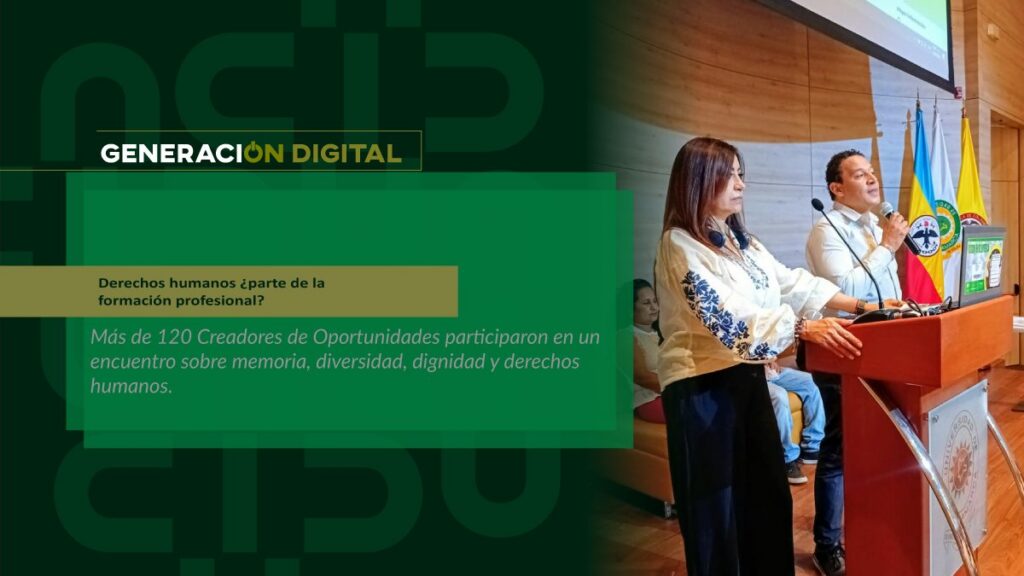
Human rights: part of professional training?
By: Alejandro García Suárez – Advisory Office of Communications



I am your virtual assistant, here to help you quickly and easily.
▲ Back to Top
The University of Cundinamarca, through its Environmental Management System and the Faculty of Agricultural Sciences, advances and implements sustainable actions for the conservation and preservation of the environment, and also consolidates the green university project, ensuring an education in environmental values for life.
The environmental management system, through six programs, has been carrying out the following actions:
PGIR – Comprehensive Waste Management Plan:
• Installation and adaptation of ecological points and containers.
• Classification and collection of waste electrical and electronic equipment (WEEE).
• Agreements with Tronex where 24 kg of batteries have been delivered since these require proper handling due to the hazardous components they contain and cannot be disposed of in the trash.
• Contract with Descont for transport, collection and final disposal of waste, where 636 kg of chemical waste from laboratories, contaminated and hazardous materials have been collected.
• Agreement with Hewlett-Packard, Hp Planet to whom 102 kg of toner have been delivered.
• Agreement with Tapas Para Sanar, where 431 kg of recyclable material and 9.6 kg of plastic caps were collected and donated to help children with cancer.
• Construction or adaptation project -UTAC- for temporary storage of recyclable and non-recyclable material.
• Proper classification of 100 kg of glass.
• Source sorting; where recyclable material and ordinary waste are separated; obtaining 800 kg of paper and files.
• Management of organic waste, since some waste is recoverable and not everything should go to the trash; 600 kg have been recovered.
• CAR eco container for PET material and batteries; 100 kg of plastic have been collected.
PUEE – Energy Efficiency Program:
• Contributing to savings, generating less impact, and improving luminosity.
• Use of LED bulbs; a 70% at the university already has this system.
• 176 photovoltaic lamps have been installed in Fusagasugá.
• Implementation of 80 solar panels for energy supply in facilities (halls, offices, common areas and lighting of pedestrian and vehicular paths).
• Preventive and corrective maintenance program for electrical networks.
• Promote the opening of windows in offices to reduce energy consumption from the permanent use of fans or air conditioning.
PUEA – Efficient Water Use Program:
• Using a pressure washer has saved 50% of water.
• Rainwater harvesting and utilization.
• Preventive maintenance of hydraulic networks.
• Campaigns for saving and using water efficiently.
PUEM – Efficient Use of Materials Program:
• Responsible use of materials, for example: paper
• Reduction in impressions.
• Increase in digital documents.
• Efficient use of paper
• Digital signature management.
PUESE – Program for the efficient use of ecosystem resources:
• Tree planting and living fences.
• Adaptation of green areas approximately 9000 m2.
• Reforestation days, planting of trees and plants, where around 4000 trees have been planted.
• 50 million has been invested in vertical gardens or green facades, in 400 m2.
• Maintenance days.
PRAU – University Environmental Project:
• Agreements for the acquisition of bicycles for the educational community in agreement with the CAR.
• Campaigns promoting environmentally friendly mobilization practices.
• Improvement of bicycle parking facilities at all branches, locations, and headquarters. (Soacha has 110 spaces, Facatativá 95 spaces, and Ubaté 120)
• Preventive maintenance of institutional vehicles.
• Inclusion programs.
• Research seed group projects.
It is worth noting that the Faculty of Agricultural Sciences, through the Agro-environmental Studies Center “La Esperanza” Fusagasugá, “El Vergel” Facatativá and “El Tibar” Ubaté, leads research projects on agricultural, environmental and forestry production topics for the appropriation of knowledge, and transformation of communities in order to live in harmony with nature and Mother Earth.
Help us take care of the Earth
• Always use a reusable bag.
• Use paper straws.
• Always use a reusable bottle.
• Don't pour oil down the sink, store it in reusable containers and give them to the recycler.
• Reduce meat consumption.
• Plant and grow your own chemical- and pesticide-free garden in pots or in your home garden.
• Support eco-friendly products and companies.
• Do not use aerosols and do not buy products tested on animals.
• Reduce water consumption: turn off the taps while brushing your teeth, reuse washing machine water, and collect rainwater for cleaning.
• Try not to turn on the lights during the day and use energy-saving light bulbs.
Origin of Earth Day
The origin of Earth Day dates back to the late 1960s. In 1968, Professor Morton Hilbert and the United States Public Health Service organized a conference on the effects of environmental degradation on health.
Following that incident, Hilbert and his students decided to dedicate a day to environmental awareness. This initiative was joined by the Survival Project, spearheaded by Northwestern University, and Senator and activist Gaylord Nelson, who ultimately became a key figure.
In 1970, Nelson organized a day of rallies across the United States to demand the creation of an environmental protection agency. One of his goals was to maximize the participation of university professors and students, so he chose the week of April 20-26 because it didn't coincide with exams or spring break. He selected Wednesday because he believed more students would be on campus that day, given the distance from the weekend.
It was April 22, 1970, and the senator named the day Earth Day, accepting the advice of Julian Koenig, a friend of his who worked as an advertising executive.
The event grew stronger year after year. And in 2009, at Bolivia's request, the UN established April 22 as International Mother Earth Day in "recognition that the Earth and its ecosystems sustain our lives.".
News
News
News
News