Fusagasugá Branch
2026-09-24
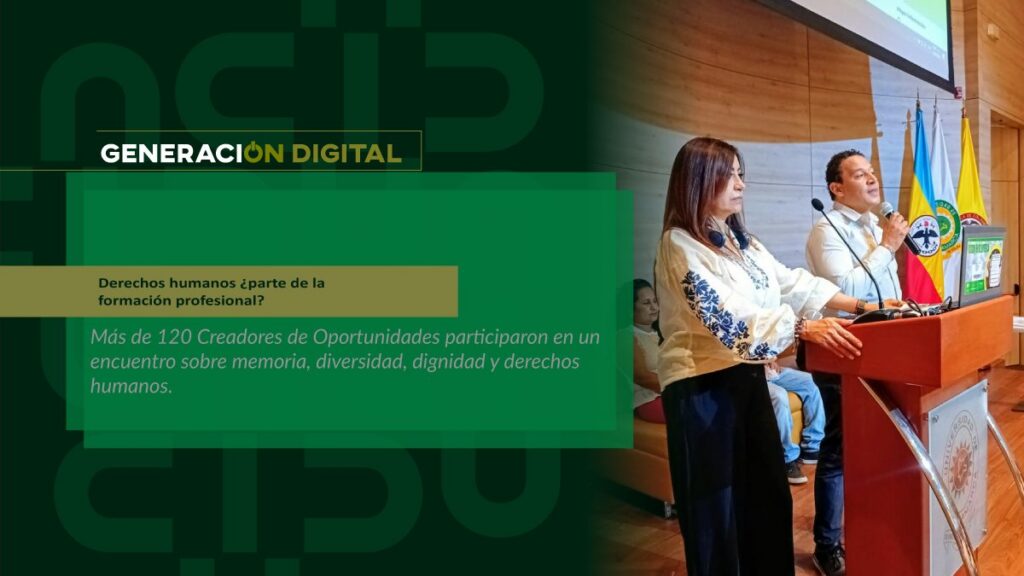
Human rights: part of professional training?
By: Alejandro García Suárez – Advisory Office of Communications



I am your virtual assistant, here to help you quickly and easily.
▲ Back to Top

In a public session, the Academic Council of the University of Cundinamarca shared with the educational community the first version of the updated student statute document for undergraduate and postgraduate students.
This version aims to educate for life, democratic values, civility and freedom.
The document establishes the rights, obligations, requirements, opportunities and administrative and academic situations of the students, and also has the purpose of strengthening the substantive functions of the institution such as Training and Learning, University Social Interaction and Science, Technology and Innovation.
It is worth noting that the Student Statute has not been revised since 2006, so the update responds to the institutional dynamics in the face of new academic realities and administrative developments with the application of the Transmodern Digital Educational Model (MEDIT).
Regarding this update, the rector of the University of Cundinamarca, Adriano Muñoz Barrera, made it clear that "we are not interested in building a Student Statute hastily, but with the contribution of everyone; we invite you to participate.".
Furthermore, during the presentation of the first draft of the Student Statute, Dr. Adriano Muñoz Barrera indicated that the following actions will be taken:
1. Continue publishing the document on the web so that everyone can read it and give their opinion using the form provided there.
2. Conduct dialogic meetings with students for each academic program, analyze the document, and gather relevant opinions for its construction.
3. Gather input from curriculum committees for the construction of the Student Statute.
4. Consolidate and collect the contributions of students and teachers in the different spaces or in the participation link that is on the web and resubmit the document at a next Academic Council.
Watch Facebook Live here where the changes in the new statute are explained.
At the end of the Academic Council meeting, and within the conclusions, the board members emphasized the importance of submitting the document for review by
part of the curriculum committees, faculty council, deans' council and dialogical and formative meetings to strengthen the final document.
Also, a schedule of meetings will be established next semester for final approval; students will have their participation in the document.
Below are some proposed adjustments to the statute version No. 1
• Unification of a single statute for undergraduate and postgraduate students.
• Expansion of training modalities such as virtual, understood as the incorporation of ICT; Blended Training characterized by mixing face-to-face and virtual learning for the development of learning fields, experiences, real-life situations, problems, actions and curricular activities; the Other Modality that combines face-to-face, virtual and blended training.
· Averages that for two consecutive academic periods are less than three point five (3.5) in undergraduate programs, the quality of student is lost.
· There is a loss of student quality when eighty percent 80 % of the Expected Learning Outcome (REA) has not been achieved in the Institutional Learning Field (CAI) and Disciplinary Learning Field (CADI).
· Students who do not enroll for two (2) continuous or non-continuous years will not be able to be readmitted to the program and, consequently, will lose their student status.
The duration of postgraduate student enrollment, including the preparation of their final research report, thesis, or dissertation, will be as follows: specialization, one year; master's degree, two years; and doctorate, six years. After this time, student status will be lost, unless expressly stated otherwise.
News
News
News
News