News
2026-09-24
Human rights: part of professional training?
By: Alejandro García Suárez – Advisory Office of Communications



I am your virtual assistant, here to help you quickly and easily.
▲ Back to Top
By: Carolina Rojas Cendales
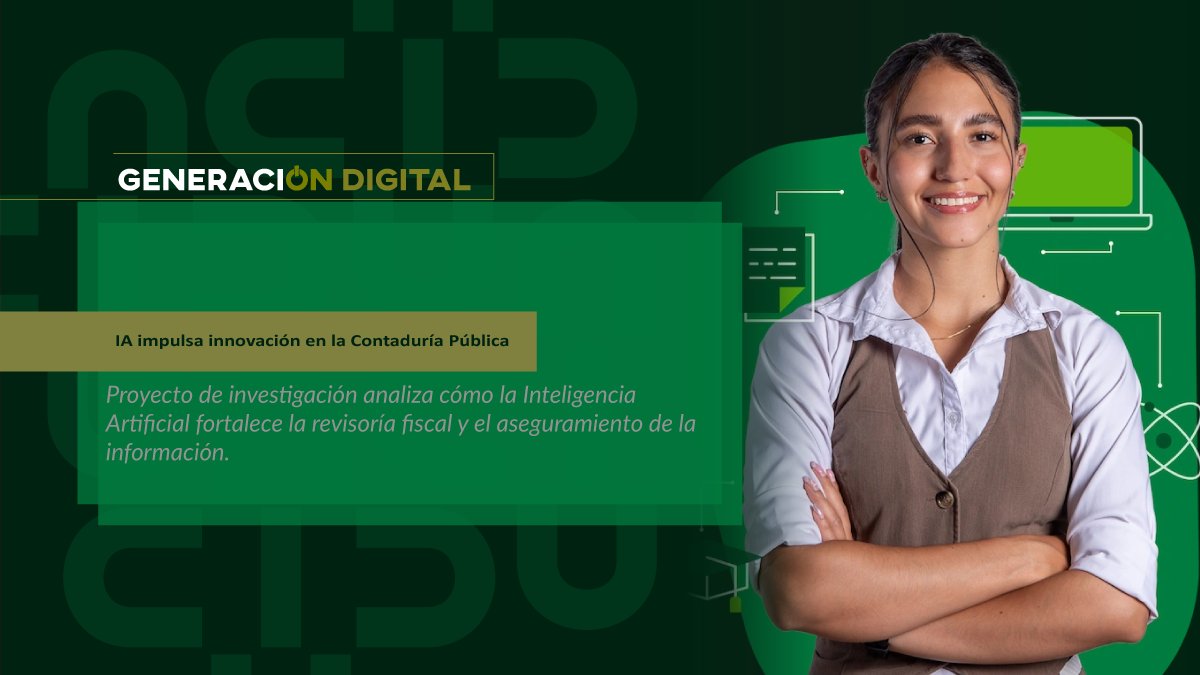
Artificial intelligence is transforming organizational and professional processes across multiple sectors, and public accounting is no exception. To understand how these technologies are impacting professional practice and how they can be responsibly integrated, Knowledge and Learning Managers and Opportunity Creators at the University of Cundinamarca are developing a research project that aims to bridge the gap between academia and the new realities of the accounting sector.
The initiative, called “Artificial intelligence applied to the exercise of statutory auditing and the assurance of information in accounting firms located in Chía and Ubaté, Cundinamarca” is led by Knowledge Manager Hernán Alejandro Alonso Gómez as principal investigator, along with research managers Nathalia Carolina Rubio Buitrago and Sonia Yaneth Martínez Gómez, as well as Luz Ginneth Pacheco Medina as research assistant.
According to manager Nathalia Carolina Rubio Buitrago, the project arises from the need to understand how Artificial Intelligence can become a support tool for accounting professionals, especially in activities related to information analysis, risk identification, inconsistencies detection, and the automation of repetitive tasks.
Beyond questioning whether these technologies will replace public accountants, the research seeks to identify opportunities, benefits, and challenges associated with their implementation, taking into account aspects such as training, technological availability, professional ethics, and current regulations.
One of the project's most noteworthy aspects is its collaborative approach. In addition to the research team, students from the Public Accounting program, belonging to the ADCODER research group in Ubaté and the DOPyS – Organizational, Prospective, and Sustainable Development group from the Chía extension, participate as research assistants.
Their participation includes activities such as reviewing specialized literature, searching for and organizing information, approaching study participants, applying data collection instruments, and analyzing results. This experience allows them to learn firsthand how Artificial Intelligence is transforming the dynamics of the accounting profession.
“The research also has a very important educational impact because students not only learn concepts from the classroom, but also interact with professionals who are already using these tools in their work processes,” Rubio points out.
Currently, the project has successfully connected public accountants, auditors, and accounting firms that are already incorporating Artificial Intelligence tools into some of their activities. This approach allows for the sharing of real-world experiences with the technologies used, the benefits obtained, the challenges encountered, and the limits that must be established to preserve professional judgment, responsibility, and ethics in accounting practice.
Through interviews and surveys, the research team hopes to identify usage patterns, opportunities for improvement, limitations, and training needs. These findings will be used to generate practical recommendations and develop training programs for industry professionals to promote the responsible adoption of these technologies.
The research also strengthens the relationship between the University and the professional community. Auditors, public accountants, accounting firms, and organizations from Chía, Ubaté, and nearby municipalities actively participate, sharing their experiences and knowledge, which allows for a more accurate assessment of the profession's current state.
This interaction fosters an exchange of knowledge that benefits both parties. While professionals contribute practical information, the University transforms that input into analyses, recommendations, and tools that can subsequently contribute to strengthening the sector.
For the researchers, one of the project's main contributions is to help close the gap between academia, technology, and professional practice. It also aims to strengthen the training of future public accountants and contribute to the development of skills among professionals already working in the region.
The ultimate goal is to promote a vision of Artificial Intelligence as a strategic tool for the profession. This technology, when used with knowledge, sound judgment, and ethical principles, can enhance the work of public accountants and help them respond to the new challenges organizations face in increasingly dynamic and digital environments.
News
News
News
News