News
2026-09-24
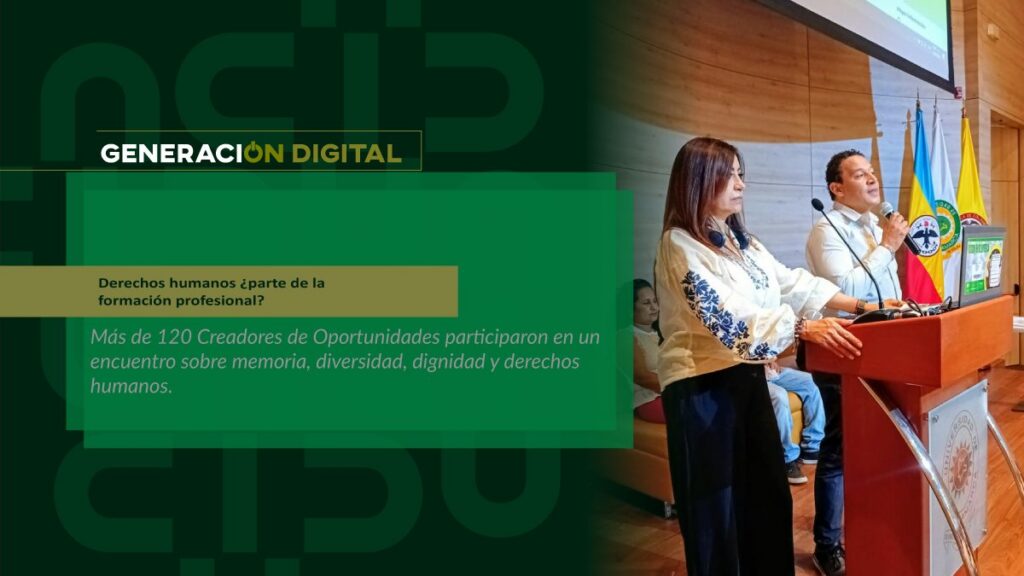
Human rights: part of professional training?
By: Alejandro García Suárez – Advisory Office of Communications



I am your virtual assistant, here to help you quickly and easily.
▲ Back to Top
Currently, there is a very visible gender gap in the world of scientific research. According to UNESCO, only 33% of researchers are women, even though they represent 45% and 55% of undergraduate and master's students, respectively, and 44% of those enrolled in doctoral programs.
This trend is also repeated at the national level, although the gap is a little smaller, since, according to the Minister of Science and Technology, Mábel Torres, in Colombia only 38% of recognized researchers are women (6,411 in 2019).
However, this indicator changes when we look at the University of Cundinamarca, where, for example, the Research Directorate is headed by Dr. Olga Marina García Morato, and more than 50 researchers have published with our Publishing House.
Returning to the national level, the last public call for applications to recognize researchers was in 2021, in which 94,627 CVs registered and certified in the CvLAC application were evaluated. However, as this information was published at the end of January, it is not yet disaggregated by gender.
For this reason, the Ministry of Science and Technology's Call for Proposals No. 833 of 2018 is the official document to consult for numerical data on the role of women in research in Colombia. In fact, this census recognized that 36.6% of researchers were women four years ago, making it clear that this indicator is on the rise, according to Minister Torres.
Furthermore, the data shows that in the field of Engineering and Technology, of the 8,523 researchers, only 26% are women, making this the field with the largest gender gap. Similarly, in the social sciences (which produces the largest number of researchers: 12,700), the figure is 39%. In the medical and health sciences, there is greater parity, with 46% of researchers being women. And in the agricultural sciences and humanities, the gap does not exceed 36%.
What do these figures tell us? That globally, a gender barrier may exist that relegates women in terms of scientific production. That in Colombia and at the University of Cundinamarca, efforts are being made to overcome this gap and be more inclusive in research processes.
While gender bias can exist in the field of technology, health sciences and social sciences (which have a faculty at UCundinamarca) are the most gender-balanced. However, since statistics alone cannot tell us about individual cases, the Office of Communications has compiled the voices of three women dedicated to research in the following special feature commemorating March 8th.
“There is an emphasis on the feminine perspective in research on care, health, and environmental protection.”
Alexandra B Andrade
“We are not less, we are almost equal, in some research groups women are leading.”
Laura Fonsenca Hernández
“Much of research is about vocation and doing things well.”
Jenny Paola Moreno López
News
News
News
News