News
2026-09-24
Human rights: part of professional training?
By: Alejandro García Suárez – Advisory Office of Communications


I am your virtual assistant, here to help you quickly and easily.
▲ Back to Top
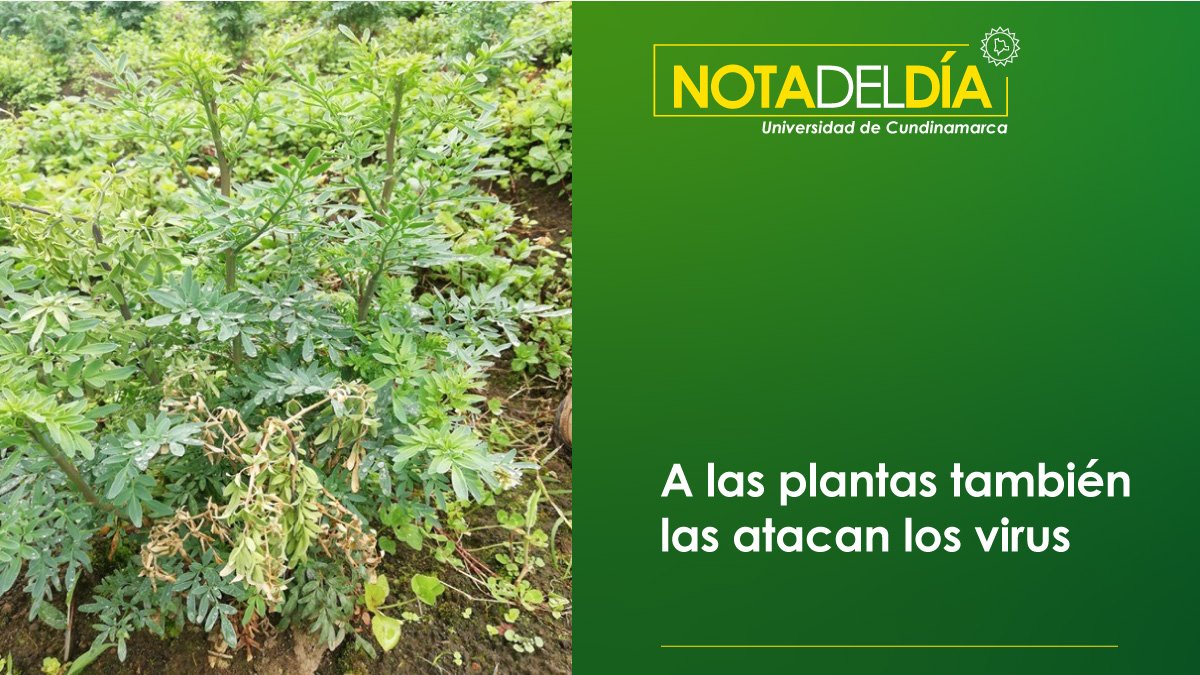
We often think that only human beings are attacked by viruses, bacteria, fungi and other microorganisms that, as happens with COVID-19, end up infecting millions, and we forget that plants, on which our food and our economies depend so much, also fight against countless infections to survive.
The good news is that since 2015, the Research Group in Epidemiology and Management of Plant Diseases at the University of Cundinamarca has been studying the health problems of various plant species in our region associated with pathogens. In fact, thanks to these analyses, a fungus linked to rue wilt has been identified, and a biological control initiative for gorse is also being planned.
“This research group, attached to the Agronomic Engineering program, has focused on phytopathology, which is the science that studies plant diseases. In this sense, we identify pathogens, from fungi to nematodes (parasites) that affect them, in order to begin formulating solutions that can be implemented by farmers and growers,” explains Professor Jenny Paola Moreno, leader of the research group and member of the PROSAFIS research group.
In fact, thanks to this work, the seedbed was able to identify the fungus in 2019. Fusarium oxysporum as the causal agent of vascular wilt in rue, a plant used in Cundinamarca and throughout Colombia for its analgesic properties. It is worth mentioning that this initiative won the First Internal Call for Proposals for Strengthening Seedbeds and that its results were disseminated in the community of the San Raimundo village, and that it will soon be published as part of a scientific article.
“This recognition has greatly encouraged the students who are part of the research group, who acquire methodologies and skills during their investigations that they don't acquire in a classroom. In fact, many of them even improve their communication skills, and they no longer express themselves only to a community of scientists, but to the community at large,” says Professor Moreno.
And there are still more projects in the research group, such as a study on the fungi that affect cacao plants in the Tequendama province, in Viotá, and an initiative to study fungi that affect spiny broom, an invasive species of the Andean highlands, whose biological control is one of the major projects being carried out this year by UCundinamarca. According to Professor Moreno, the goal is to find a pathogen that, while affecting spiny broom, does not harm endemic plants like frailejones (Espeletia).
“To treat plant diseases, we must first isolate their origins, and that is what we have been doing with great effort and in collaboration with students from our research group. This is just a first step in a larger undertaking, which is to identify how the disease attacks and how to control it, but we are satisfied with the results and are certain that in the coming years the impact of the research will be more visible,” concludes Professor Jenny Moreno.
News
News
News
News