News
2026-09-24
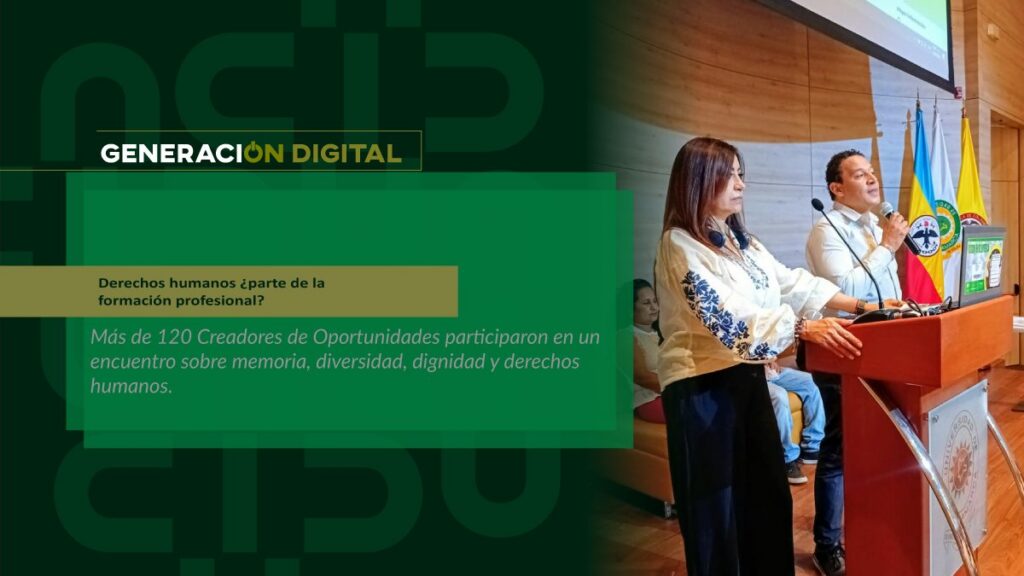
Human rights: part of professional training?
By: Alejandro García Suárez – Advisory Office of Communications



I am your virtual assistant, here to help you quickly and easily.
▲ Back to Top

The Colombian education system has been severely impacted by the effects of the pandemic, not only in terms of the suspension of in-person activities but also in terms of its financial sustainability. Colombia has a mixed higher education system offered by both the state and private institutions. Currently, 2,408,041 students are enrolled in the higher education system, distributed as follows: 2,234,962 in undergraduate programs and 173,079 in postgraduate programs.
The public undergraduate system has an enrollment of 1,150,591 students; of these, 615,168 belong to the 32 public universities that make up the State University System, and 535,434 belong to public technical and technological institutions (ITTU). Private universities have an undergraduate enrollment of 1,084,371 students. These figures are quite telling in terms of coverage. It is worth noting that only 52.1% of young Colombians access university, while the remaining 48.1% have no opportunity to enter; a social crisis that requires a state public policy to guarantee the fundamental right to education.
This situation is impacting higher education. In the case of the State University System, a tuition-free policy for students from socioeconomic levels 1, 2, and 3 in vulnerable situations has been proposed in recent years, given that 70.91% of its students belong to these levels.
To address the crisis generated by the pandemic, the national government allocated $97 billion pesos for tuition subsidies for students from socioeconomic levels 1 and 2 at public higher education institutions. This, combined with the efforts of regional institutions, municipalities, and governorships, provided tuition subsidies to students at public universities within their jurisdictions. This allowed for free tuition to be guaranteed for the last two semesters.
While the tuition waiver announced by the national government is a significant step towards achieving free public higher education, further progress is needed to make higher education a fundamental right guaranteed by the State. Furthermore, the financial impact of Covid-19 on public universities is significant and exacerbates their underfunding, given that 481% of the income that public universities operate on is generated by their own resources.
That figure corresponds to 1.4 trillion pesos annually; of which 1.1 trillion pesos corresponds to tuition fees. These are distributed as follows: 847 billion pesos for undergraduate tuition and 260 billion pesos for postgraduate tuition; the remainder of the university's own income comes from the sale of services, capital resources, loans, stamp taxes, and other sources; all of which have been affected by the crisis.
This situation requires state intervention, from the central to the regional level. To address this, the University of Córdoba developed a support model for our students, guaranteeing their continued enrollment through tuition-free education, psychosocial support, and technological resources such as tablets, computers, and internet access. This model, supported and coordinated with the Córdoba Governor's Office, the municipality of Montería, the Ministry of Education, and the University of Córdoba's own institutional efforts, enabled us to secure the necessary resources to implement a tuition-free program that benefits a community of 17,000 students and their families.
In this regard, it is important to jointly promote the participation of territorial institutions represented in municipalities and departments, an action that allows for the processing of territorial taxes to be invested in increased coverage through the regionalization of public universities; with this, we not only increase coverage and access to higher education, but we would also generate inclusion, social mobility and a transformative social impact in the most geographically remote regions, which have remained invisible to the most basic benefits of development.
It is imperative and unavoidable to allow access to knowledge for 2,400,000 young people in Colombia who do not have this opportunity; this requires not only an agreement and commitment, but also the political will to make it possible.
Free tuition is a step in that direction; however, we need to move forward in solving the problems of coverage, democratization, massification, and financing; in this way, education can be made possible as a social public good, a fundamental right guaranteed by the State; the above implies carrying out a true educational revolution.
The youth of Colombia demand it; they need it and want it to make their dreams a reality, and the way to achieve this is through access to knowledge. It is time to be consistent with the needs of a nation that is often marginalized and overlooked. We need the leadership and commitment of the political class, largely represented by members of Congress, to understand, engage with, and appreciate this reality; and at the same time, to pass the necessary laws so that this right can be realized.
Therefore, it is imperative to make tuition-free education a permanent public policy. In this context, it is necessary to continue the debate on tuition-free public higher education.
Taken from The Observatory of the Colombian University
News
News
News
News