News
2026-09-24
Human rights: part of professional training?
By: Alejandro García Suárez – Advisory Office of Communications


I am your virtual assistant, here to help you quickly and easily.
▲ Back to Top
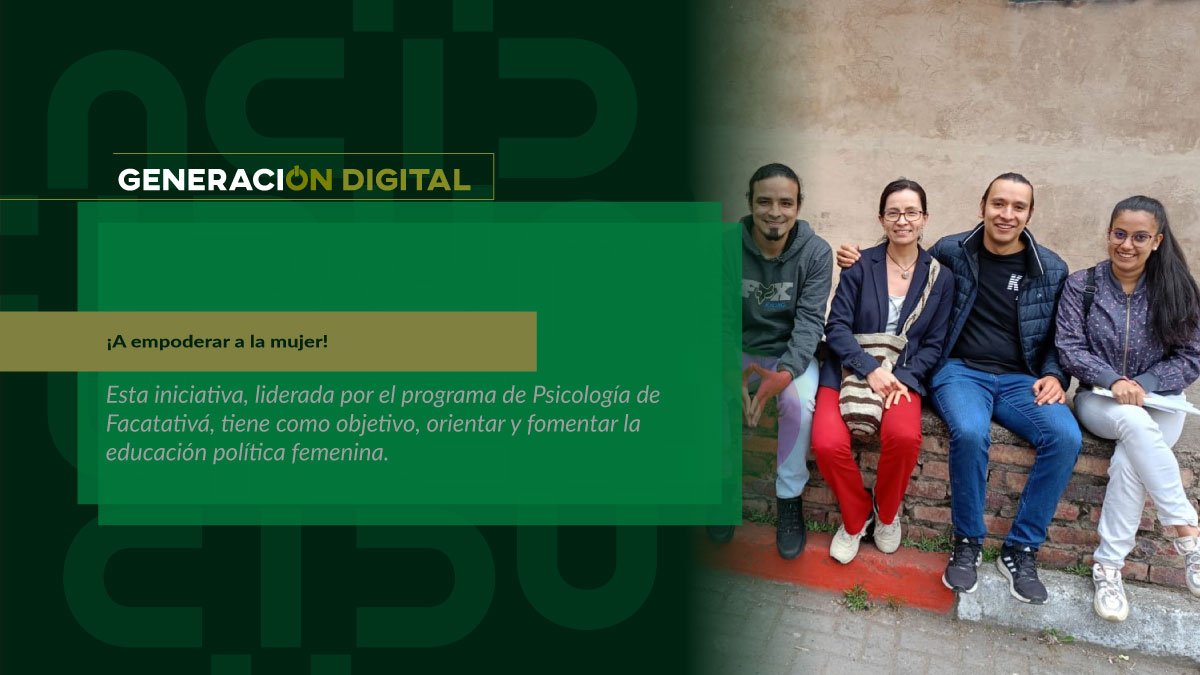
In this interesting research work entitled: Political Formation Process of Women in the Municipality of Zipaquirá, the beneficiaries were people belonging to the Advisory Council of said community.
UCundinamarca News spoke with knowledge manager Adrián David Galindo, who is the leader of this academic development that also seeks to generate a dialogue of knowledge for teachers, which is one of the goals of the Transmodern Digital Educational Model, thus fulfilling one of the substantive functions of UCundinamarca.
UCundinamarca News: How did this project come about?
Adrián David Galindo: The project arose from the gender inequality that still prevails in our society, the violence against women, and the recognition of their struggle in the political sphere. Based on this reality, we submitted it to the fourth call for proposals last year and began work this year. It was an eleven-month project. The objective is to guide and promote political education processes for women in Zipaquirá, focusing on their empowerment and civic participation to facilitate their entry into the political arena.
UCundinamarca News: What activities did the project have?
Adrián David Galindo: We started in January of this year and are now wrapping it up. We began by gathering information, and for this purpose, we worked with an existing participatory group that had identified many needs related to political education. We conducted interviews with thirty people about what had led them to participate in this group. Following this, we developed four training workshops focused on topics such as gender roles, violence, emotional and gender regulation, and the role of the other in political education.
UCundinamarca News: What research products will be obtained?
Adrián David Galindo: We will publish two articles as a result of the research; one podcast; A report detailing the process, its results, and how these can have an impact in other contexts. Additionally, we will create a website, which will be given to them to manage next year and serve as a pedagogical tool for political education.
UCundinamarca News: What has been the feedback from the women who participated in the project?
Adrián David Galindo: It was a very positive experience; it was a learning exercise for us as researchers, providing insight into their diverse perspectives. The group included three professors from the Psychology Program, two research assistants who are seventh-semester students, and one professor from the Software Development Technology program. For these leaders, this work involved recognizing how the university contributed to their growth based on their individual circumstances.
UCundinamarca News: How does the Transmodern Digital Educational Model look in this whole research process?
Adrián David Galindo: We recognize the model from a gender perspective, and also from the perspective of political formation as a dialogical process; that is, it sometimes leads to antagonistic views that prompt us to consider that the visions of men and women coexist as one, not as separate entities. So I think that's one of the things the model perhaps invites us to see in terms of this interconnectedness of processes, rather than as a fragmentation of situations. Therefore, I believe that the invitation stems more from this perspective, to unite and connect social realities rather than divide them.
UCundinamarca News: Who is participating in the project?
Adrián David Galindo: The project involves faculty members from the Eduser and Creser research groups within the psychology program, as well as the Gindesoft group from the Software Development Technology program. The knowledge managers who have worked on its development are: Jenny Patricia Bustos Abril, Jaime Andrés Amaya González, Manuel Hernán Alvarado, and research assistants Laura Gissel Díaz Sánchez and Daniel Felipe Acosta Torres, all from the psychology program.
In this way, UCundinamarca is committed to research with a translocal perspective to highlight the activities that are developed in this area based on the research groups and research teams it has.
News
News
News
News