News
2026-09-24
Human rights: part of professional training?
By: Alejandro García Suárez – Advisory Office of Communications



I am your virtual assistant, here to help you quickly and easily.
▲ Back to Top
By Carlos Eduardo Tibavisco Delgado
Lecturer, Industrial Engineering program
The software created has the purpose of improving the competitiveness of small and medium-sized manufacturing companies (SMEs) located in the municipality of Soacha, in relation to timely, clear, accurate and truthful information in the planning, production and quality processes.
This project was developed with the participation of Industrial Engineering and Software Development Technology students from the University of Cundinamarca, and students of the Master's program in Industrial Engineering who are part of the SEPRO research group of the Industrial Engineering program at the National University of Colombia.
Summary:
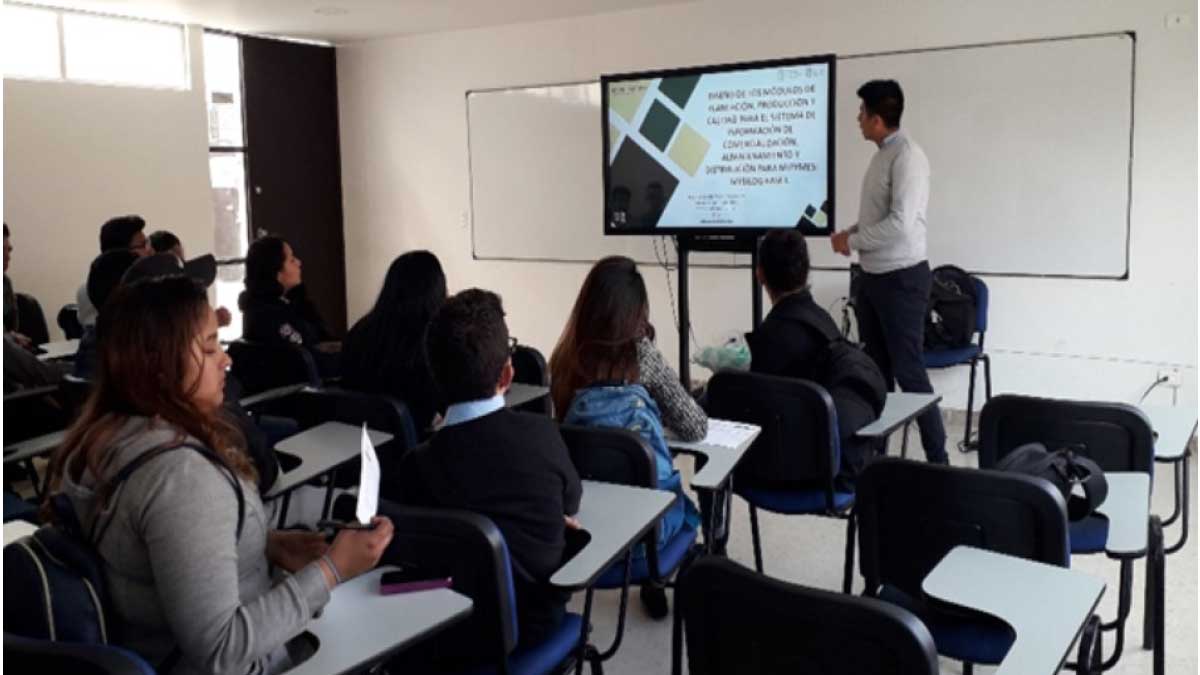
The project entitled: “Design of the production and quality planning modules for the marketing, storage and distribution information system for SMEs: Mysilog II – Phase I”.
In the first phase of the project, interviews and surveys were conducted with twenty-three micro-entrepreneurs who were members of CONAMIC (National Confederation of Microenterprise Entrepreneurs) in the garment sector of the municipality. The questions focused on planning, production, and quality control in their businesses in order to gather primary data.
Subsequently, three companies in the clothing sector were selected, where information was obtained that served as a source for the design of the production and quality planning modules, modules that control the information of the production process, from the generation of an order, the obtaining of raw material, the production and delivery of the final product to the customer, processes characteristic of an ERP (Enterprise Resource Planning) type software.
The modules developed in this project are part of the Mysilog information system, developed by the SEPRO research group for the control of marketing, storage and distribution for SMEs.
The central objective of the project was to design the production planning and quality modules for the MySilog application, applied to the specific needs of the business and industrial sector for the municipalities in which the University of Cundinamarca is present, working a first pilot with the municipality of Soacha.
Justification
Industrial engineering emphasizes solving problems found in industries, implementing methods or strategies that allow for their optimal development.
By having ERP systems and applying them in the business sector of Soacha, these will offer multiple configuration possibilities ranging from the selection and choice of modules to the provision of master data to direct access rights for different users (MINTIC, 2014) that through specialized software (MySilog) can maintain factors such as production and quality stable within the organizations, because the need exists initially to obtain a system that includes all the information of the micro-enterprises that adapts and is efficient from the operational and documentary point of view.
“ERP is a system that integrates information from all company operations, following the objective of managing and controlling up-to-date information for decision-making” (Padilla, 2011). From the above, it can be deduced that as a system, ERP develops modules for each of the operations in an organization, whose objective is to improve productivity and optimize processes according to the activity carried out by the company.
Over time, companies increasingly need an IT system capable of facilitating work, communication among different stakeholders, and increasing efficiency and competitiveness. This system stands out for the effectiveness and security it offers when carrying out operations within an organization, characterizing processes and improving the various internal indicators that the company performs in each of these areas (Aguilar Sánchez, 2009).
Given that Colombia is largely made up of MSMEs (Romero Reyes, Rico Lugo, & Barón Velándia, 2012), the need arises to generate new information systems that offer development for them, regardless of their commercial activity or corporate name, in order to become large platforms that each organization of this type has as its main vision.
Reducing the inconveniences faced by micro, small, and medium-sized enterprises (MSMEs) will lead to increased productivity. This can be addressed through the development of an ERP software prototype that answers questions such as: What elements should be considered when developing software aimed at improving operations management in MSMEs? How can this information be managed and controlled for the organization's employees? And how does this alternative increase the productivity of MSMEs? (Romero Reyes, Rico Lugo, & Barón Velándia, 2012).
Given the above unknowns, it can be hypothetically stated that through the development of software whose method is the ERP, it can offer greater solutions to any organizational and industrial field, since its needs are highly generated by the lack of information, technology, poorly designed integrated systems and even the production and quality in the development of the products that is intrinsically related to the operations or processes of SMEs.
These systems must be comprehensive, modular, and adaptable, with the goal of always improving quality, productivity, customer service, and reducing costs (Córdoba Barahona, 2011). This implies the elimination of unnecessary data and operations, always focused on industrial processes, reducing their time and costs, and resulting in improved productivity indicators. The use of software will allow the organization to have greater control over information and will enable it to plan with efficient strategies.
Project duration
The project development lasted 10 months, according to the following schedule
Activity / Months 1 2 3 4 5 6 7 8 9 10
Definition of the work methodology
Analysis and study of the MySilog system
Module design
Software development
Documentation and evidence
Methodology developed
For the development of this project, the same methodology used in the Development and Implementation of MySilog was continued, consisting of the following activities:
1. TOGAF (The Open Group Architecture Framework)
The Enterprise Architecture Framework is the overall methodology used in the project, consisting of four dimensions: Business, Application, Data, and Infrastructure. This methodology ensures that all project members speak the same language, using architectural standards, saving time and money, using resources more efficiently, and achieving an excellent ROI.
2. Principles to keep in mind:
a. Face-to-face communication in frequent progress meetings with other project participants and the end client.
b. Changing requirements that arise as the project progresses
c. Motivating the people working on the project, creating confidence and enthusiasm in each of them.
d. Constant and continuous work during each stage of the project
3. Use of best practices
4. Prioritizing tasks according to project requirements
5. Use and implementation of standards (in the application, reports, etc.)
6. Iterative and incremental development according to weekly project progress meetings.
7. Compliance with established working hours
Impact of the project in the industrial and business areas
Textile companies in the province of Soacha have their own business processes and manage information and production performance in different ways. These companies lack software to comprehensively manage and/or control information for each of their production and quality processes. This often results in inaccurate inventory and stock levels, rework, lack of traceability, problems with materials planning and quality control, and other issues that directly impact their production and quality processes.
The development of the Production Planning and Quality modules helps companies optimize their processes and plan their procedures so they can meet market demands and compete with quality products.
Project results
The following are some of the project's results:
1. In the student community
Students from the University of Cundinamarca, Soacha extension, participated in the design and development of the software:
– An Industrial Engineering student
– Two students from the Software Development Technology program
The development of the project generates the following products for the students
– Graduation Project
– Presentation at a national event
– Article submitted for publication in a specialized journal
Contribution to the training process
The analysis and design of the Production Planning and Quality modules for the MySilog system significantly impacts the training of Industrial Engineering and Systems Engineering students by involving them in the learning and direct application of the following concepts:
– TOGAF (The Open Group Architecture Framework) is a methodology used for the analysis, planning and development of a technological architecture.
– Quality control, as part of Quality Management, guides organizations in analyzing and meeting customer requirements, defining the processes that contribute to achieving products acceptable to the customer, and keeping these processes under control.
– The student must apply the necessary concepts for the development of organizational improvement processes, through the implementation of quality management systems in the organization.
– Knowledge and application of techniques for defining software requirements, which describe the services that the system must offer and the restrictions associated with its operation.
– Knowledge and application of methods for Production Planning.
– Knowledge and application of technological tools such as databases, web application design and development, and additional tools such as Google Drive, Rapidminer.
2. In the business community
With the development of the project, the manufacturing sector of small and medium-sized enterprises in the province of Soacha has software that will help it in its business development by having clear, concrete and precise information on its Production and Quality planning process, improving its production and competitiveness at the local and national level.
News
News
News
News