Fusagasugá Branch
2026-09-24
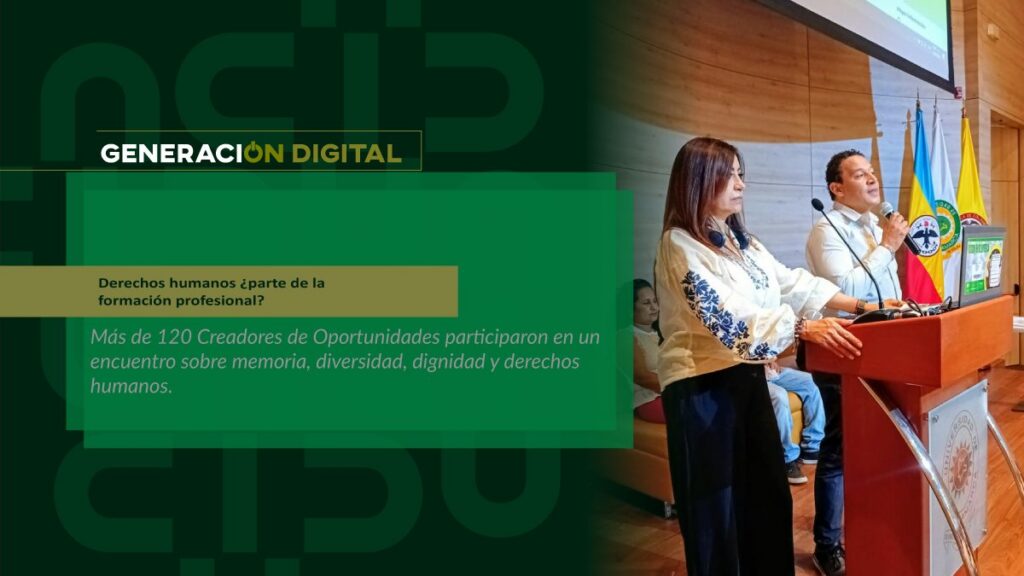
Human rights: part of professional training?
By: Alejandro García Suárez – Advisory Office of Communications



I am your virtual assistant, here to help you quickly and easily.
▲ Back to Top

Researchers from the University of Cundinamarca are in the final stage of a project that seeks to strengthen the state policy of bilingualism in the department through Fine Arts, Humanities and Psychology.
“The goal of humanistic education is to create for the student the necessary potential to achieve an academic, professional and personal benefit that favors, first and foremost, the student's life training, that is, the individual construction of the human being's life project from an educational point of view that goes beyond a utilitarian end,” said Martha Isabel Díaz, author of the project.
The research is called 'Promotion of bilingual learning fields through Fine Arts, Humanities and Psychology' and is currently very advanced, as they have managed to publish in an indexed journal, be involved in community activities, participate in scientific events and conduct creative workshops.
Therefore, they only need to publish a second article, finish a few chapters to deliver the complete book on the research, and conclude the master's thesis in education with the university student.
During the study process, it was determined that students do not use one or two specific techniques to learn English and instead rely on the use of various learning strategies such as reviewing notes, underlining what they consider important in readings, among others.
Professor Rafael Leonardo Cortés Lugo indicated that so far several conclusions have been reached, most of them based on the use of play with cultural elements and music.
One conclusion is the incorporation of English into the various bilingual creative workshops, which will achieve significant long-term learning.
“We determined the relevance of these types of musical and bilingual recreational activities for learning a second language. We also recognized the impact of these creative workshops in a second language on the development of the cultural landscape of the University of Cundinamarca, as they allow students to transform their professional field of action through the use of English in their own community and subsequently in other settings,” stated Professor Rafael Cortés.
The current researchers of the macro-project are:
– Research Groups: Bilingualism and Digital Convergence – Creser.
– Humanities Area: Yuberney Sánchez.
– English Area: Francy Martínez and Martha Isabel Díaz.
– Psychology Program: Ricardo Narváez – Rafael Cortés.
Results on learning strategies and analysis of the Placement Test and factors associated with English language proficiency.
• Acquisition, encoding, retrieval, and processing support strategies are used together to achieve adequate language learning.
• Strategies used by students: reviewing notes; underlining important aspects of readings; reflecting on what they study and reviewing the material.
• Students who scored high on this test also showed positive attitudes towards this language.
• There is a gap in English proficiency depending on economic purchasing power, which can be a determining factor when learning the language and an aspect to consider when generating intervention plans from an educational policy.
III Symposium on Science, Technology and Innovation: Science in the Digital Age.
News
News
News
News