News
2026-09-24
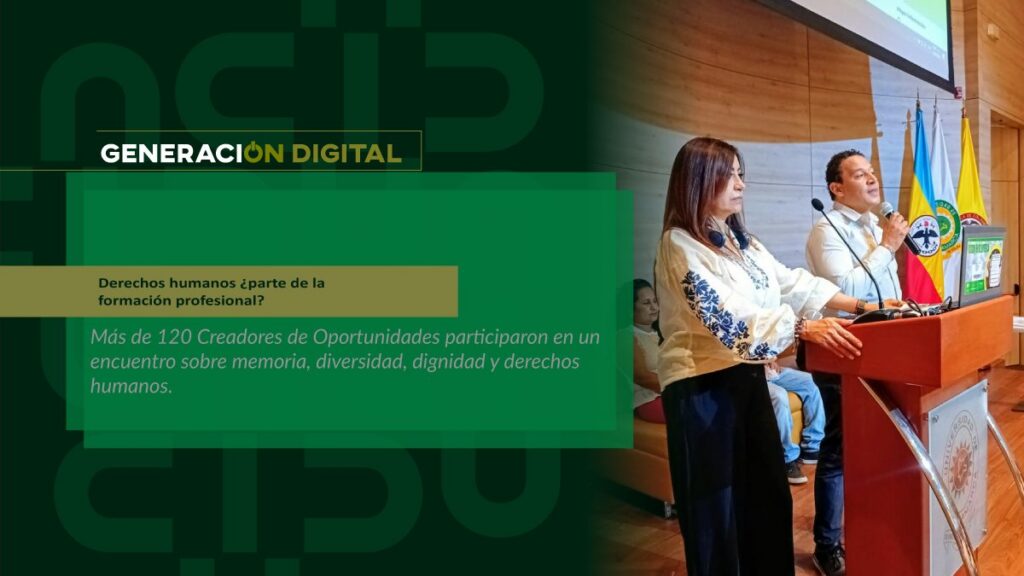
Human rights: part of professional training?
By: Alejandro García Suárez – Advisory Office of Communications



I am your virtual assistant, here to help you quickly and easily.
▲ Back to Top
Education continues to focus its efforts on improving quality and providing greater coverage through inclusion processes; however, in the last 25 years, Colombian society has changed, pedagogical practices, paradigms, and educational systems are different, the scale of values has been inverted, and societies must adapt to the new national and international trends that the globalized world demands.
What is needed now is a thorough review of the essentials of education in the 21st century, explained Francisco Cajiao Restrepo, a graduate in Philosophy, with a master's degree in Economics, a consultant to ministries of education in Latin America, Europe and the United Nations, and a columnist for El Tiempo.
The expert and authority on education spoke with the University of Cundinamarca about traditional education and the time lag the country's education system is experiencing. Cajiao points out that this system is designed for people who no longer exist.
UC: 21st century society has been changing, what should education be like today?
Francisco Cajio: The problem we have is a confused sense of time. On the one hand, one feels that nothing has happened, changes aren't happening, and one wishes the country would evolve. The world has changed in the last 25 years, and the problem is that education continues to act as if nothing has changed. This creates conflict within societies. Higher education isn't speaking to the people of today, but to the people of 25 years ago.
We find a large number of young people arriving at universities very poorly prepared. They don't read or write critically and clearly, and they lack a developed and structured logical thinking that translates into mathematical reasoning. Furthermore, history has disappeared from Colombian curricula, which is why young people don't know where they come from or where they are going, and therefore experience a serious identity crisis.
The education system is designed for people who don't exist today, which means it probably needs to be changed so that children can start discovering their vocations, their talents, or the things they are truly good at from a very early age, instead of continuing to teach subjects that leave them with admirable ignorance.
UC: Are we still in a traditional education system?
Francisco Cajio: We are still in a traditional education system; we are trying to improve an education that was remarkably good in 1960, but which did not have sufficient coverage; however, the model remains the same.
All this has happened because of technological, social and cultural change, because of the very high levels of globalization, so that the economy does not have the same lines of dynamism as at another time, the people we are preparing, we are preparing them for a world that we do not yet know, we do not know what it is.
UC: What is the challenge?
Francisco Cajio: There's a kind of time lag that needs to be addressed. The worrying situation is that in the last three years there's been a significant reduction in university enrollment; registration numbers have dropped, and fewer young people want to enter a university today.
Of the 341 young people who complete high school, only three out of every ten who enroll actually graduate. This situation arises due to a lack of available spaces, or because students don't apply; in some cases, there is difficulty accessing knowledge through the internet. This scenario highlights a significant crisis in formal education, partly because people are moving too fast while formal education is keeping pace.
UC: What educational model is required today?
Francisco Cajiao: No one has the answer to that question. Not even the Greeks did. There isn't one single educational model; there are many models that overlap, complement each other, or integrate. We have an educational model for work and human development—that's what we call non-formal education, which offers great flexibility.
On the other hand, there is the professionalizing educational model that takes place in higher education, without the pretensions of having great geniuses, it seeks to graduate lawyers, engineers, doctors, among others, but with the necessary skills and competencies, as well as the spectrum of virtual education, which trains a master or doctor, from anywhere in the world.
In conclusion, the education we currently have is arteriosclerotic, slow, arthritic, and inflexible in its joints.
In the coming days, we invite you to watch the second part of the interview with Francisco Cajiao about the headache of Public Universities in Colombia.
News
News
News
News