News
2026-09-24
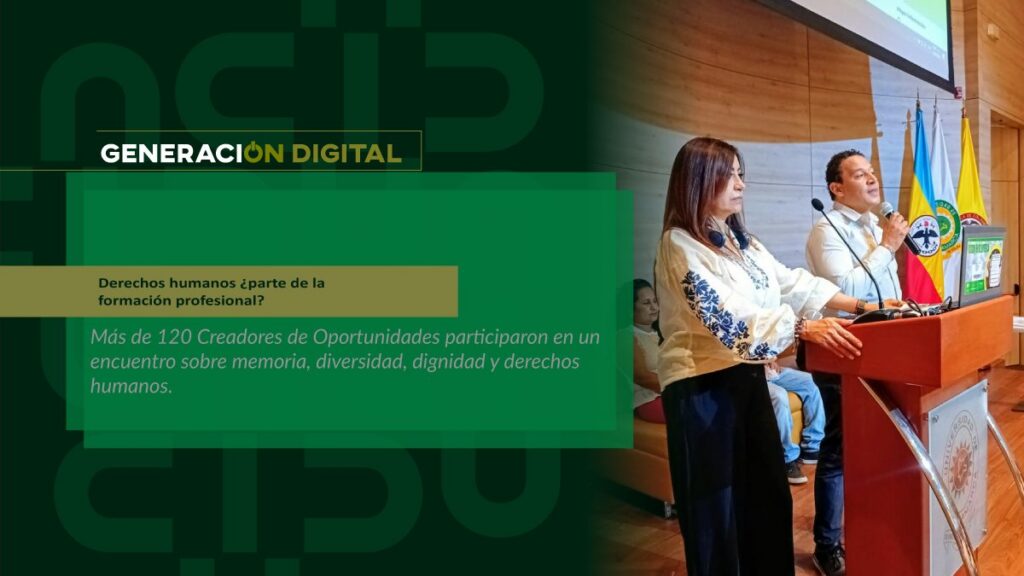
Human rights: part of professional training?
By: Alejandro García Suárez – Advisory Office of Communications



I am your virtual assistant, here to help you quickly and easily.
▲ Back to Top

By: Lorena Andrea Chacón
Journalist
Advisory Office of Communications
The University of Cundinamarca, in partnership with the National University of Colombia, will host the academic event: “International School of Artistic Research,” on August 10, 12, and 14, 2020. The event consists of a series of three online seminars and is aimed at musicians and artists interested in exploring their professional practice from the perspective of artistic research as a forum for discussing different approaches and paradigms to research and production in the arts. The seminars will be held via Zoom, using the University of Aveiro's institutional account.
It is worth noting that the seminars will be led by Gilvano Dalagna and Jorge Salgado Correia, musicians and professors from the University of Aveiro (Portugal) and researchers affiliated with INET-md, a research institute in music and dance, made up of a network of researchers affiliated with different Portuguese universities, such as the Nova University of Lisbon, the University of Aveiro, the University of Lisbon and the Polytechnic Institute of Porto.
In light of this important research event focused on the field of music, we spoke about this topic with León Salcedo, a distinguished professor of classical guitar and research leader in the Music program at the UCundinamarca Zipaquirá Extension, who has extensive artistic and teaching experience. Salcedo has performed as a soloist and guitarist in various chamber music groups, primarily in the fields of classical and contemporary music, as well as other genres such as jazz.
He has also taught at various universities, including the Universidad Distrital, Carnegie Mellon University in Pittsburgh, Pennsylvania, and the Universidad Tecnológica de Pereira. His academic training took place in Colombia, Cuba, the United States, and Portugal, at the Universidad Tecnológica de Pereira, the Universidad de las Artes, Carnegie Mellon University, and the University of Aveiro, respectively.
UCundinamarca: How is Colombia doing in terms of music research?
León Salcedo (LS): Traditionally, musical research in Colombia has mainly taken place in the field of musicology. In this sphere, there have been very important contributions from several Colombian researchers, both for the country and for the international musical and scientific community.
In recent years, interest in artistic research, also known in our field as research-creation, has grown considerably in Colombia and around the world. This is an area that is currently very rich in discussions and debates in our country and internationally, since the epistemological frameworks, methods, scope, formats of knowledge production and transfer, and public policies for its promotion and the valuation of its production are not as fixed in the academic tradition as, for example, in musicology.
However, in Colombia, we have a fairly well-defined conceptual and measurement framework for this type of artistic and research production since 2015, with the calls for proposals for recognition and measurement of research groups and researchers from Minciencias, formerly Colciencias. This has allowed Colombian artist-researchers to integrate into the STI system.
UCundinamarca: How does UCundinamarca support musical research?
LS: Within the general framework of UCundinamarca's research policy. That is, through opportunities offered by internal and external calls for proposals and inter-institutional agreements, for the development of research projects and the dissemination of the resulting academic output. This is carried out through research groups and incubators; in our case, the UDECARTE group and the SEINMUS incubator.
Taking advantage of these institutional spaces created by the research department, the Music program has developed eight research projects over the past three years and has shared some of this work at various national and international academic events in countries such as Mexico, Spain, Portugal, and, of course, Colombia. Likewise, the opportunities afforded by these research projects have allowed us to produce a range of ephemeral and permanent artworks as a result of these projects, in addition to the traditional formats of academic research such as articles, books, and book chapters.
UCundinamarca: What inter-institutional alliance or agreement exists between UDEC and UNAL to promote musical research? Are there other alliances with other universities, and if so, what are they?
LS: Within the framework agreement that exists between UNAL and UDEC, we have been advancing a joint work agenda for the realization of academic events and research and artistic creation projects.
With other universities, we are currently in the process of establishing framework agreements that will allow us to sign specific agreements. This year, we have made progress in finalizing a framework agreement with the University of Valle, as we intend to work with a research group from the School of Visual Arts. We have had a very good relationship with its members, and they have reciprocated this initiative at their institution. We are very interested in these kinds of interdisciplinary work opportunities across various art forms.
UCundinamarca: What are the main challenges regarding music research in Colombia?
LS: Continue to consolidate the link between artistic production and science, technology, and innovation (STI). Recognizing and promoting artistic production institutionally, as well as integrating it into the core missions of teaching, STI, and university outreach, remains a challenge for universities. While universities in Colombia have made significant progress in this area, there is always room for improvement in these aspects, both in terms of internal institutional guidelines and policies, and in their assimilation within the university culture.
Fortunately, there are now national frameworks that promote and require this. In this way, universities can consolidate artistic production as important and necessary academic assets in their processes of self-evaluation, accreditation, certification, and external recognition. Several universities in Colombia, such as Los Andes, Javeriana, and the National University, have chosen to create centralized offices responsible for promoting and managing artistic creation institutionally for these purposes.
UCundinamarca: What are the research lines in the field of music that stand out in Colombia and at UCundinamarca?
LS: It's difficult to summarize the number of specific lines of research that exist in Colombia in this field, but I would say there are those focused on musicology, those focused on ethnomusicology, those directed toward artistic research also understood as research-creation, and inter- and transdisciplinary lines. All of this is said in a very broad and general sense. In the Music program at UCundinamarca, we work on two lines of research within the Faculty of Social Sciences, Humanities, and Political Science: Artistic Creation and Production; and Philosophy and Culture of Music.
If you are interested in participating in this academic event, please register via the following link: https://forms.office.com/Pages/ResponsePage.aspx?id=oGfaB0MfjE6Xf1-ItkcO5nedWcEPzQRLroy4syZAbhVUMFhXWlRLQUhKWkxWQ1hKMkVaNUdaNVkxUS4u
Remember that the connection link will be sent to the emails of those registered one day before the event starts.
Radio Ucundinamarca · Academic event: “International School of Artistic Research”.
News
News
News
News