Fusagasugá Branch
2026-09-24
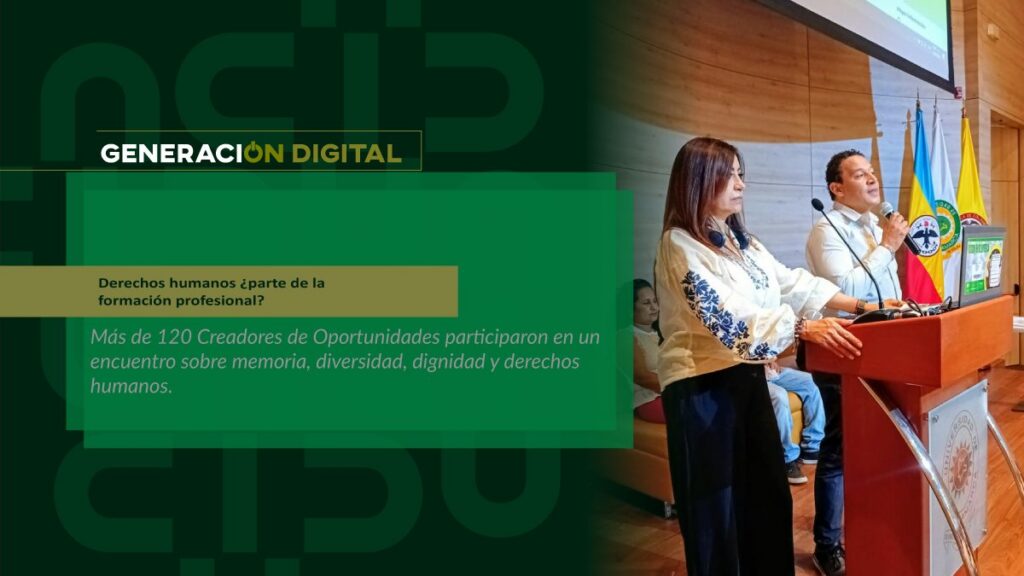
Human rights: part of professional training?
By: Alejandro García Suárez – Advisory Office of Communications
Loading...



I am your virtual assistant, here to help you quickly and easily.
▲ Back to Top
Located 20 minutes from the municipality of Fusagasugá, in the western district, is the village of Bosachoque, a place embraced by nature and of scenic beauty where internet telecommunications service providers do not provide coverage and community digital life is lived through free networks made visible with homemade antennas made of pot lids, can lids, PVC pipes, and old CDs, tools that capture the reception of the signal allowing the community of the area to make use of information and communication technologies.
The macro project called “Free Networks as an Alternative for Social Innovation and Digital Inclusion in the Bosachoque Village of the City of Fusagasugá”, led by the Faculty of Engineering, had a multidisciplinary group of twelve teachers from the area of systems and electronics, and a handful of young people who transferred knowledge through workshops, and in turn contributed to the technological assembly in this rural area of Cundinamarca.
“The project arose with the purpose of reducing the digital divide in the countryside, taking into account that in the 21st century society access to information and communication has become a right for human development. This initiative of social appropriation of community digital networks was born as an alternative for social innovation and digital inclusion,” highlighted Wilson Joven, dean of the Faculty of Engineering.
Currently, eight Wi-Fi hotspots have been installed in the Bosachoque district, transforming it into community Wi-Fi zones. The children and young people in this area, eager for knowledge and digital natives, are the happiest with the project, since they no longer have to travel to the city, go to an internet café, or spend money to do their schoolwork. Now, they can connect to the Wi-Fi signal from their cell phones to access numerous online libraries.
Adults also benefit from this initiative because, as digital immigrants, they explore out of curiosity a new service framed within technology, where they discover cultural and entertainment options, allowing them to gradually and progressively approach the use of new technologies in their daily lives without fear.
This internet access is made possible by a point-to-point radio link established between the University of Cundinamarca and the rural hill of San José del Chocho, in the municipality of Silvania. From there, a point-to-multipoint link has been used to reach locations selected by the local population to co-create community Wi-Fi zones.
It is worth noting that these community wifi zones enable internet access because the University of Cundinamarca shares part of its academic internet bandwidth with this community network.
“The technical refinement of these links is not yet complete. It has been determined that during peak connectivity hours, 125 simultaneous connections are registered in the territory, which demonstrates the degree of penetration in the use of the service by the community, the main objective of the project,” he explained. Wilson Daniel Gordillo Ochoa, professor at the Faculty of Engineering and one of the project leaders.
For a year and a half, approximately 25 community workshops were held in this rural area, focused on the social appropriation of knowledge. These workshops covered topics such as: what a community network is, how the internet works, network cable assembly, exploring Raspberry Pi (small-board computers), designing your network (mapping workshop), how a virtual radio station works, VoIP (free calls over the community network), retrospective workshops, and more.
This research project contributed to strengthening educational processes. Engineering students, acting as research assistants, designed and implemented an educational website as part of their graduation project to support the learning process of elementary school children at the rural school in the Bosachoque district.
Another noteworthy initiative is the Telemedicine project. In this case, student research assistants developed a web portal focused on diabetes in older adults as their graduation project. The portal is currently in beta version and will be implemented on the intranet of the Bosachoque-Libre community network.
The project became a participatory community living laboratory, for a year and a half weekly benefiting 400 families made up of peasants, pensioners, farmers, day laborers, teachers and professionals who exchanged the stress of the city for the tranquility and natural environment offered by the Bosachoque village.
One achievement worth noting is the digital literacy of grandparents over 70 years of age who live in this village; now these senior citizens have email, write letters, take photographs, communicate via Skype with their children abroad, and do other tasks typical of the computer age.
Behind this project, social fabric is also being built. After completing their household chores and childcare, rural mothers in this area use their free time to pursue professional degrees online.
In conclusion, throughout this time in the development of this initiative that addresses information and communication technologies, the community has taken ownership of the project and are now protagonists providing solutions to their daily tasks through technology.
Martha Liliana García Alonso
Don't forget to rate this article!
News
News
News
News