News
2026-09-24
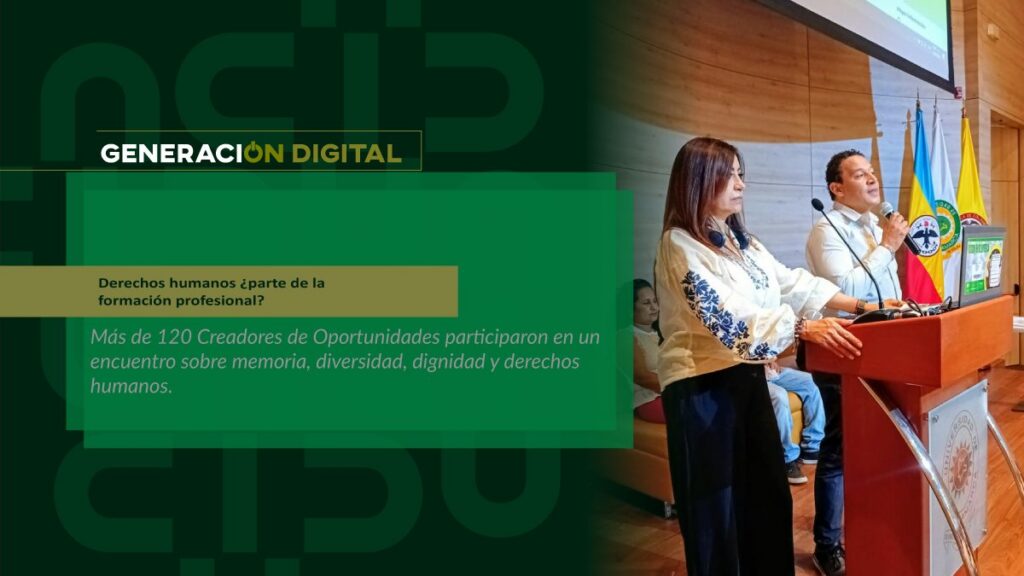
Human rights: part of professional training?
By: Alejandro García Suárez – Advisory Office of Communications



I am your virtual assistant, here to help you quickly and easily.
▲ Back to Top

Source: Observatory of Educational Innovation
The dream of creating a machine that emulates human behavior has been an obsession throughout human history. Artificial Intelligence (AI) It has been on our minds for many years.
Since the creation of Adam,“God creates him from a malleable material, programs him, and gives him the first instructions.” (Sánchez-Martín et al 2007); Even in Greek mythology, with Ovid's story of Pygmalion sculpting a figure of a beautiful woman who is given life so that Pygmalion can love her; in Hebrew mythology, the Golem was also created and animated from clay to save the inhabitants of a Jewish city; and in Norse mythology, with the giant Mökkurkálfi or Mistcalf, also made of clay, created to support the troll Hrungnir in his fight with Thor; for every era, the examples continue.
The Artificial Intelligence (AI)), in its most natural sense, refers to the way of simulating the intelligence capabilities of the human brain, so thinking about AI is also thinking about what makes it possible for us to interact and learn; therefore, its applications can contribute enormously to education (Ocaña-Fernández, Valenzuela-Fernández and Garro-Aburto, 2019).
The COVID-19 pandemic has brought about substantial educational changes, including the migration to virtual learning ecosystems. Teachers have faced the challenge of addressing a wide range of needs to ensure the continuity of students' education. AI can be a perfect pedagogical tool to streamline support for our students at all times.
Imagine it helping you by answering each student's questions in real time, ensuring the student is being guided correctly, and you can use that time to train in a topic of interest, deepen your lesson development, conduct research, build teaching sequences, and carry out activities. Mindfulness To boost your creativity and innovation, just to name a few ideas. Wouldn't that be fantastic?
“The main objective is to empower our colleagues with the opportunity to build a smart teaching assistant through a chatbot, which helps to resolve many of the students' concerns. The structure of the responses was designed using a flipped classroom approach to provide feedback on classroom questions.”.
What are the real possibilities of applying AI in education? Could AI be a key component in a new educational model? Can you imagine having a colleague who can help us answer hundreds of common student questions at any time? Or provide feedback to those who couldn't connect to the class on time? You probably think this means having an advising professor or a teaching assistant, but this isn't as far-fetched as it seems.
The journey of artificial intelligence began with Alan Turing in 1936 with the publication of his famous article “On computable numbers, with an application to The entscheidungsproblem”, where the foundations of theoretical computer science were established as well as the origin of the concept of "Turing Machine", the concept of algorithm was formalized and it would be the precursor process of digital computers.
In 1956, at the legendary Dartmouth conference, John McCarthy, Marvin Minsky, and Claude Shannon coined the term Artificial Intelligence. Although there had been good speculation about this technology, it wasn't until 1997, with Deep Blue, the IBM computer that defeated world chess champion Garry Kasparov, that a profound reflection from different fields—science fiction, computer science, mathematics, social sciences, and even the humanities—was brought to the world stage.
A little later, IBM's Watson computer would win a duel against the human brain on "Jeopardy," the famous quiz show on the American network ABC. Isaac Asimov formulated the famous Three Laws of Robotics, which helped us consider the ethical problems posed by the development of artificial intelligence, avoiding the kind of revelations found in science fiction, such as HAL 9000 from 2001: A Space Odyssey.
In recent years we have seen significant progress. In March 2019, a European Commission High-Level Expert Group on AI (AI HLEG) defined a Draft of the AI Ethics Guidelines which help us understand the importance of addressing the issue not only in the field of technology but also in the social sciences and humanities.
Artificial Intelligence can be categorized into three levels that allow us to locate ourselves to navigate the continuum of incremental innovation, starting from the incorporation of this technology into our daily lives and especially in education.
In education, trials have begun to work with level 3 tools, with the aim of building alternatives that respond to the needs of teaching; I will particularly talk about what can be called chatbot, These are platforms that understand natural language and allow you to program automatic responses, emulating human conversations.
At the University of the East in Mexico we use the tool Dialogflow for processes aimed at supporting our students with significant advantages that I share with you below.
The main objective is to empower our colleagues by giving them the opportunity to develop a pedagogical tool that helps address many of the students' concerns. structuring the responses It was based specifically on the approach of flipped learning, which It contributes to providing feedback on class concerns., but providing them with an accessible response and referring students to multimedia reference sources to extend and improve their experience.
The aim was to have the application mounted on the institutional academic reinforcement platform based on Moodle, which ensured that the pedagogical aids were personalized to the needs of the groups in question.
The expected outcome of this implementation was to equip our teachers with more competitive and functional tools to support our students in their learning activities within a context of constant communication. The main challenge for those of us participating in this project is to ensure that the responses are much more dynamic and lead to more meaningful contributions.
Academic work with this type of chats It allows us, in addition to maintaining a communication relationship with our students, to link the chat to other tools that help our students set learning challenges, through capsules that deepen or engage our students in professional development contexts.
Source: Own elaboration.
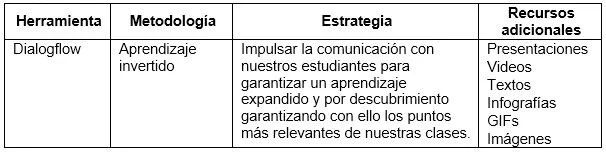
The opportunities that it brought chatbot The support our students received was very varied, ranging from answering questions about deadlines and assignment requirements to delving deeper into ideas seen in class. Of course, one of the fundamental points to work on was to nurture the chatbot Doing this constantly allows for greater fluency and assertiveness. In the end, there's nothing better than talking to the teacher; however, The attention given to students was undoubtedly a success in order to optimize the professor's teaching time. Some comments that helped enrich the chatbot They were: to give him greater flexibility in words and greetings, even adding stickers Or memes, a new language that makes any conversation more friendly on-line.
The construction of a chatbot You must have at least the resources shown in Table 1 to have clarity on the general elements in the construction of each of the questions and answers that will be programmed in the chatbot. Something we shouldn't overlook is the experimentation of each of the elements that are integrated into the chat, In order for this to be functional, the most important aspect of this exercise is the synthesis of the truly important and vital points, as well as their concrete link to the application of the knowledge or skill to be developed.
This contribution is a brief example of the benefits of AI in learning contexts, leveraging the advantages this technology offers. We will increasingly see examples of how to ensure extended teaching with AI. If you wish to implement this tool in your educational institutions, we can certainly support you by sharing the benefits these tools offer to all of us who love the profession of teaching.
Eduardo Hernández de la Rosa ([email protected] He is the Academic Vice-Rector of the Consortium of the University of Oriente and the San Ángel School, a Research Professor at the University of Oriente Puebla, and Editor of the scientific journals “Sinergias Educativas” and “Universciencia”. He holds a Master's degree in Regional Analysis and a Bachelor's degree in Educational Sciences from the Autonomous University of Tlaxcala.
Ocaña-Fernández, Yolvi, Valenzuela-Fernández, Luis Alex, Garro-Aburto, Luzmila Lourdes (2019). Artificial intelligence and its implications for higher education. Purposes and Representations, 7(2), 536-568. https://dx.doi.org/10.20511/pyr2019.v7n2.274
News
News
News
News