Fusagasugá Branch
2026-09-24
Human rights: part of professional training?
By: Alejandro García Suárez – Advisory Office of Communications



I am your virtual assistant, here to help you quickly and easily.
▲ Back to Top
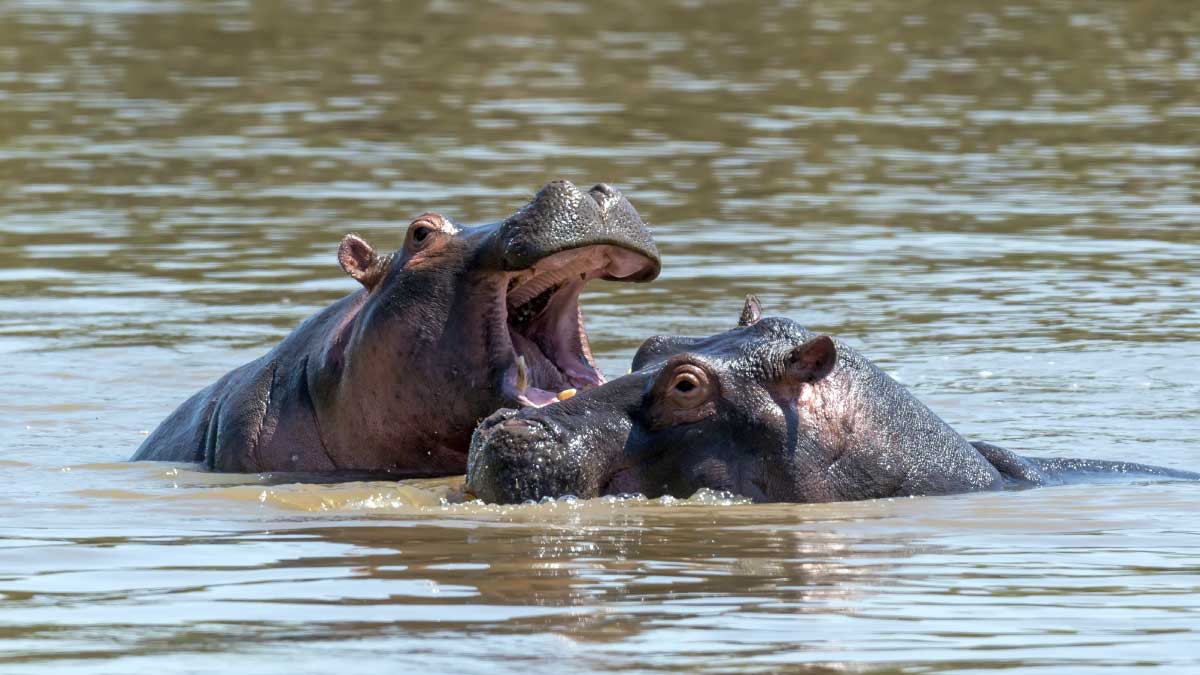
For the first time in Colombia, the Ministry of Environment and Sustainable Development, with the support of the Institute of Natural Sciences of the National University and the Alexander von Humboldt Institute for Research on Biological Resources, are responding to the call of the country's scientific community to take action regarding the management of the hippopotamus population that is currently located in one of the most important basins in Colombia, the Magdalena River.
José Fernando Pérez Osorio, a professor in the Animal Science program at UCundinamarca, spoke about this measure: “The intervention must happen as urgently as possible. These animals, despite being herbivores, have been able to modify, or in the not-too-distant future will be able to modify, any ecosystem. The Colombian ecosystem is not designed to support these types of animals, yet it is providing them with a large amount of resources that allow them to reproduce very quickly.”.
The teacher states that it is believed that there are currently around 80 to 120 animals and that in 10-15 years there could be around 700. And by 10 years later, around 2040, there would be 1700 animals.
The presence of the Hippopotamus amphibius species in the municipalities of Puerto Triunfo, La Dorada, Puerto Nare, Puerto Berrío, Yondó, and Doradal poses a risk to humans and biodiversity. Understanding this, the Vice Minister of Environmental Policy and Standardization, Francisco Cruz, led the Inter-institutional Technical Working Group on Hippos, which resulted in the development of the National Strategy for Hippopotamus Management.
“At this meeting, with the Humboldt Institute, Cornare, Corantioquia, and the National University, we have concluded that before making a decision, we must conduct a detailed study on this species, which was introduced to Colombia more than 30 years ago. With this strategy, we will work hand in hand with scientists and carry out a participatory process with the communities that live near the hippopotamus habitats. This is with the firm purpose of taking concrete and responsible actions in response to the current situation in the country regarding these animals,” stated Vice Minister Cruz.
The strategy focuses on three pillars: a population component, which will analyze the current distribution of the species and its habitat; a characterization of the perceptions and attitudes of the local communities that border the hippos; and an in-depth analysis of the ecological and social risks associated with the presence of this species in the territories.
“These types of strategies are important. We are talking about a species that is totally invasive. It has been documented that it eats dozens of animals, and in Africa, hippopotamus attacks cause far more deaths than lions or other animals because they are highly territorial. So, it not only becomes an environmental problem, but also a problem for the inhabitants of the area,” said the professor from UCundinamarca.
The results of this alliance will be presented in five months, when the actions and operational scheme to be followed for the management of the species will be specified.
A time bomb
Pérez Osorio, a zootechnician and professor at UCundinamarca, asserts that this is a ticking time bomb and that these measures must be taken soon, so that it does not affect the environment and perhaps the food security of the inhabitants of the municipalities where they are located.
“A specific example would be if these animals are consuming fish and might be eating around 50 kilograms of food. Then we're saying that 50 kilograms of fish intended for human consumption are going uneaten or uncaught by the people living in the area, thus jeopardizing food security. Furthermore, there's the pollution they can generate with their excrement, and our habitat or environment isn't adapted to receive these kinds of incursions,” the professor stated.
José Fernando explains that sterilizing the males would be a possible long-term solution to prevent the species from reproducing, thus protecting both the animals and the local residents. However, he welcomes the initiatives of environmental authorities who are proposing solutions that aim to achieve results as quickly as possible in managing this species of animal that is not native to our environment.
News
News
News
News