News
2026-09-24
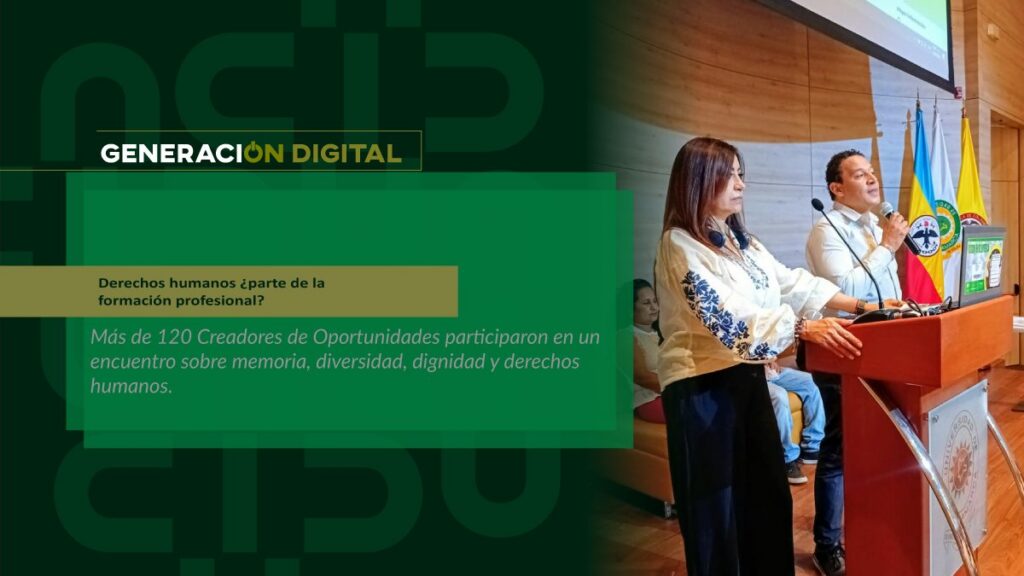
Human rights: part of professional training?
By: Alejandro García Suárez – Advisory Office of Communications



I am your virtual assistant, here to help you quickly and easily.
▲ Back to Top

By Iván Felipe Sánchez – Communications Advisory Office
It hasn't been easy for either teachers or students to teach or learn music using technology during these two years of the pandemic. For students, it's been an experience of improvising a recording studio in their bedroom or living room, and for teachers, it's been like having all the players on the field ready to play—in this case, the students ready to record with their instruments but in different spaces, which meant recording separately and then combining the pieces. Quite a challenge!
This is how some of their teachers, who experienced this transformation, describe it: “In the virtual environment, we met with the students twice a week and generally gave presentations by instrument section, then combined everything to record the musical pieces,” explained teacher Remberto Rodríguez.
The perfect analogy was that of Professor Rodríguez, who asserted that a football team's practice, when it trains its defenders, midfielders, and forwards before positioning the entire squad on the field, ready to play the match, is like a musical ensemble; the problem is that achieving such synchronization in the virtual world was a total challenge.
“The most complex aspect of the virtual format was achieving the ensemble, since initially we worked on each section separately, such as winds and percussion, and then synchronized each instrument to create the final piece, which was truly challenging. However, we did learn a great deal about using software for recording and editing audio and video,” added Maestro Remberto.
Therefore, the students also had to use their creativity by creating musical “studios” at home or at least spaces where there was not so much noise to be able to receive their class, then record -over and over again- their presentation to finally be edited.
“It wasn’t easy to coordinate 25 members in an ensemble digitally. To give you a clearer idea, while three songs are performed virtually, twelve are performed in person. Also, in a virtual setting, it’s more difficult to determine the students” abilities,” said music teacher William Ortiz.
However, for Maestro Ortiz, the virtual experience also brought very positive things that should continue in the face-to-face setting, such as the use of technological tools for music production and video evidence, something that he believes should be taken into account in the face-to-face setting.
Thus, with the return to in-person classes in the first semester of 2022, which will be at one hundred percent, UCundinamarca in the Zipaquirá extension has everything ready for the Music students who enter this Monday, February 14, to once again enjoy the 38 classrooms, library, rehearsal rooms, auditorium and other spaces and equipment appropriate to develop their professional career, while observing all biosafety protocols.
“We are truly happy to be back and hope to apply everything we learned virtually to the in-person setting. We hope the students come with a positive attitude after experiencing education from home, and that they have even more drive, because what's coming now is studying,” concluded Professor Ortiz.
News
News
News
News