Fusagasugá Branch
2026-09-24
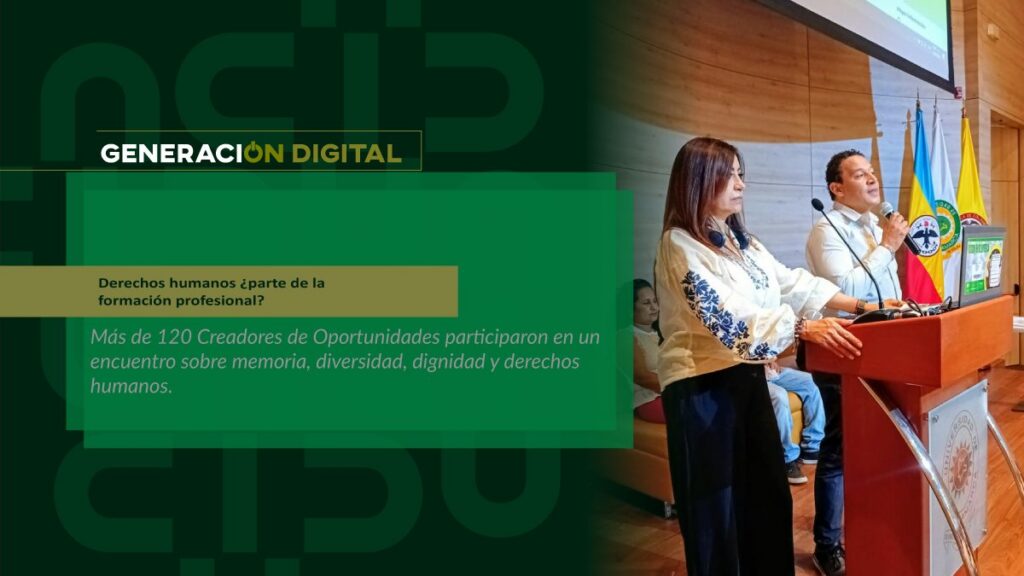
Human rights: part of professional training?
By: Alejandro García Suárez – Advisory Office of Communications



I am your virtual assistant, here to help you quickly and easily.
▲ Back to Top
The Faculty of Agricultural Sciences held the II International Meeting of Agricultural Sciences “Moving towards sustainable development, energy cities, rural challenge and successful experiences of S21 generation graduates” with the participation of international experts from Argentina, Canada, Chile, Colombia, Cuba and Panama.
“This meeting is an international academic showcase for the University and a way to increase the visibility of the Faculty of Agricultural Sciences, also allowing for research networks and the exchange of knowledge, experiences and expertise among the participants of the event, students, teachers, researchers, producers, and entrepreneurs, who reflected and discussed the strengthening of the agricultural sector and sustainable development where our Institution has a presence,”, Pablo Emilio Flórez Vargas, Academic Vice-Rector, highlighted this.
The International Meeting of Agricultural Sciences developed the thematic axes in alternative energies, rural development, natural resources and climate change, sustainable agricultural systems, animal welfare and good livestock practices, economics and administration, and agricultural education.
“One of the purposes of the event is to open spaces for academic debate, the sharing of experiences developed in the rural sector and theoretical and methodological reflection on different topics related to the agricultural sector and rural areas, such as food security, sovereignty and autonomy, environmentally and socially sustainable agricultural production, the impacts of climate change on the rural sector, new forms of production, among other topics,”, highlighted Vilma Moreno Melo, dean of the Faculty of Agricultural Sciences.
The event featured Mauricio Villaseñor, a Civil Engineer with 10 years of experience in applied engineering, project management, strategic management, and business development, as its international speaker. Currently leading the Energy and Local Development team at EBP in Chile, he presented on the Energy Cities project in Colombia, focusing on the project's key pillars and opportunities for the country and drawing on successful experiences in Chile, Colombia, and Peru.
Pablo Godoy Espindola, Director of Innovation and Technology at the Innovation and Sustainability Development Initiative Foundation (IDIS), presented "Renewable Energy: A Success Story in Rural Communities of Northern Chile." Natalia Mayorga, from the Swiss Embassy in Colombia's Economic Cooperation and Development office, presented the Energy City program, an initiative within the framework of international technical cooperation between the Swiss Embassy (Economic Cooperation and Development office).
The presentation Biomarkers for the diagnosis and control of Bovine Tuberculosis was given by Amador Goodridge, researcher at the Institute of Scientific Research and High Technology Services (INDICASAT – AIP), and vice president of the coordination mechanism of Panama.
From the University of Cundinamarca, the animal scientist Luis Miguel Acosta, specialist and master in Food Science and Technology, PhD(c), member of the Technical Council of the National Rabbit Chain, researcher in industrialization and quality of rabbit meat, and Scientific Director of the Center for Agro-environmental Studies of the UCundinamarca, presented the paper harmonization of the commercial cuts of the rabbit carcass in Cundinamarca.
The event, which took place in the Emilio Sierra Baquero auditorium on October 16, 17 and 18, had more than 400 attendees and featured four international and seven national presentations, eleven posters displayed and fourteen workshops from the research groups of the academic programs Zootechnics, Cartography, Agronomic and Environmental Engineering of the Faculty of Agricultural Sciences.
News
News
News
News