News
2026-09-24
Human rights: part of professional training?
By: Alejandro García Suárez – Advisory Office of Communications



I am your virtual assistant, here to help you quickly and easily.
▲ Back to Top
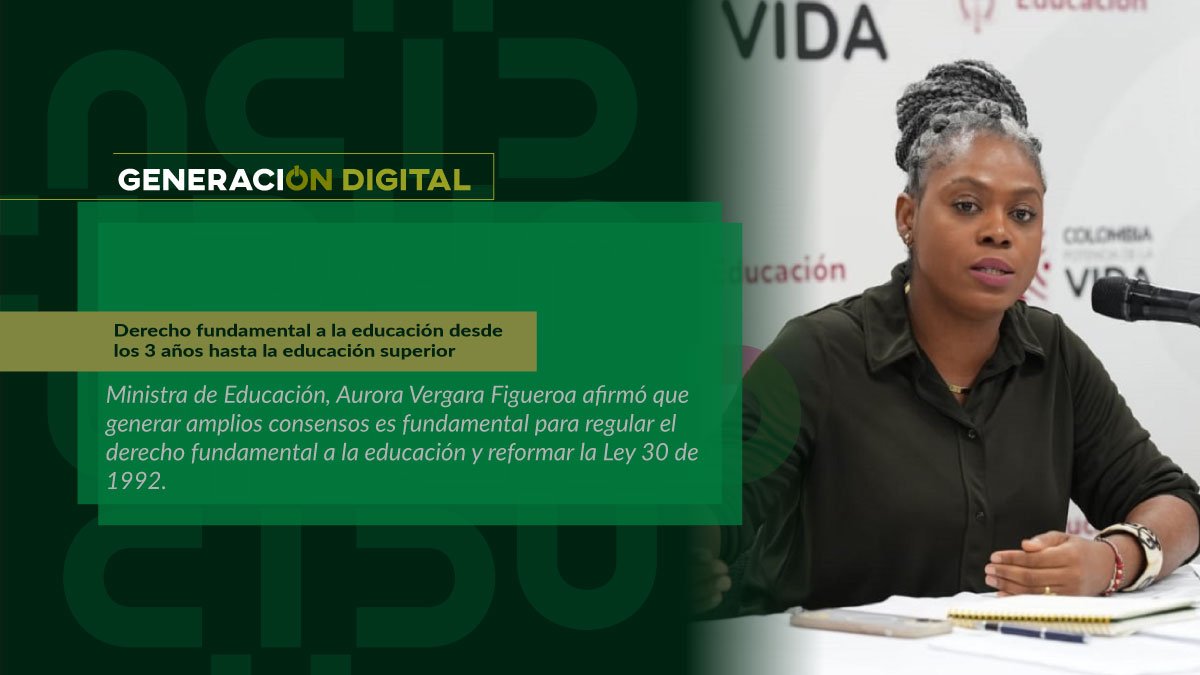
Bogotá DC, July 21, 2023. Today, the Minister of Education, Aurora Vergara Figueroa, along with the management team of the Ministry of Education and the Presidential Advisory Office for Youth, explained the details and scope of the first versions of the two bills that seek to regulate the fundamental right to education and reform Law 30 of 1992.
Both proposals were presented to the public on July 20th and will be widely discussed with the academic community and civil society before being submitted for their respective processing before the Congress of the Republic.
In general terms, both bills aim to reaffirm education as a fundamental right for all Colombians, which translates into gradually expanding access to education from early childhood to higher education.
Similarly, both proposals will be a vehicle to bring all of Colombian society together on the present and future of education.
Statutory bill
The proposed statutory law that seeks to regulate education as a fundamental right represents a significant change in Colombian legislation. According to Minister Vergara Figueroa, “the 1991 Constitution grants this right to the population between the ages of 5 and 18. Our proposal seeks to expand this range from age 3 through university studies.”.
In turn, this project will allow the Colombian education system to be updated to international standards of human rights and sustainable development.
In this regard, the Deputy Minister of Preschool, Basic and Secondary Education, Óscar Sánchez, stated that "the statutory law is a debt to be paid in order to comply with the constitutional mandates.".
The project strengthens preschool education from age three, comprehensive basic education, and the articulation of secondary education with higher education. It also establishes provisions to guarantee this right to adults and special populations, such as those deprived of their liberty. Furthermore, it proposes a roadmap for ethnic communities to design their educational policies.
“This statutory bill is comprehensive and touches on all aspects of the country's education system, with special emphasis on early childhood.
”Giving the status of a right to education for children from the age of 3 is not only an act of justice, but it is the most cost-effective thing the State can do to ensure the future of youth,” explains Minister Vergara Figueroa.
Regarding the creation of a mandatory 12th grade, the Ministry team emphasized that this is a misinterpretation by the media, and clarified that high school students will continue to graduate in 11th grade. “No one has said that high school in Colombia will not end in 11th grade. 12th and 13th grades already exist, for example, in the Higher Teacher Training Schools.”.
”What we want is for one of the strategies to strengthen the articulation between secondary and university education to be for schools to implement a grade level so that students can begin taking university courses, according to agreements they make with higher education institutions. But I repeat, a new grade level will not be mandatory; we will only provide the tools to strengthen this possibility,” stated Vice Minister Óscar Sánchez.
Amendment to Law 30 of 1992
In accordance with the statutory bill, the proposed reform to Law 30 of 1992 seeks to move from a vision of higher education as a public service to a fundamental right.
It is a new roadmap on the financing of public universities, university welfare, interculturality, autonomy and the role of quality, inspection and monitoring of higher education.
This first version of the reform contains the proposals received in the participatory scenarios promoted by the Ministry of Education such as the Permanent Dialogues for Higher Education and the popular student assemblies, held throughout the national territory, in which student and teacher movements, associations of the mixed system, unions, rectors of private and state HEIs, designated by the President of the Republic to the superior councils, congressmen, workers of the sector, among other actors of the educational community participated.
In this regard, the Presidential Advisor for Youth, Gabriela Posso Restrepo, stated that “from the Presidency of the Republic we have been committed to the active participation of young people, who have participated in the popular assemblies, there we listened to them and took careful note of their requests regarding university autonomy, co-governance, financing of education, university welfare, among other issues that have been included in this proposal and that will continue to be discussed until a majority consensus is reached.”.
The goals of the proposed reform to Law 30 of 1992 are aimed at closing gaps in access, retention, and graduation of students; strengthening the autonomy and governance of higher education institutions; guaranteeing the financing of state-run higher education institutions; giving a new status to technical education; promoting productive transformation through knowledge, in harmony with nature; preventing and addressing gender-based violence; and contributing to peacebuilding.
To continue gathering proposals from citizens, the Ministry of Education has set up the microsite 'Let's Rewrite the History of Education in Colombia' on its institutional portal.
There, citizens will find the project texts and can submit their contributions and ideas through a form. Simultaneously, the Ministry will continue to promote dialogue with various stakeholders in the educational community and civil society.
“These proposals are open to dialogue, and the idea is that all Colombians contribute to adapting the education system to the 21st century and laying the foundations for the 22nd century,” stated Minister Vergara Figueroa.
Source: Ministry of Education
News
News
News
News