News
2026-09-24
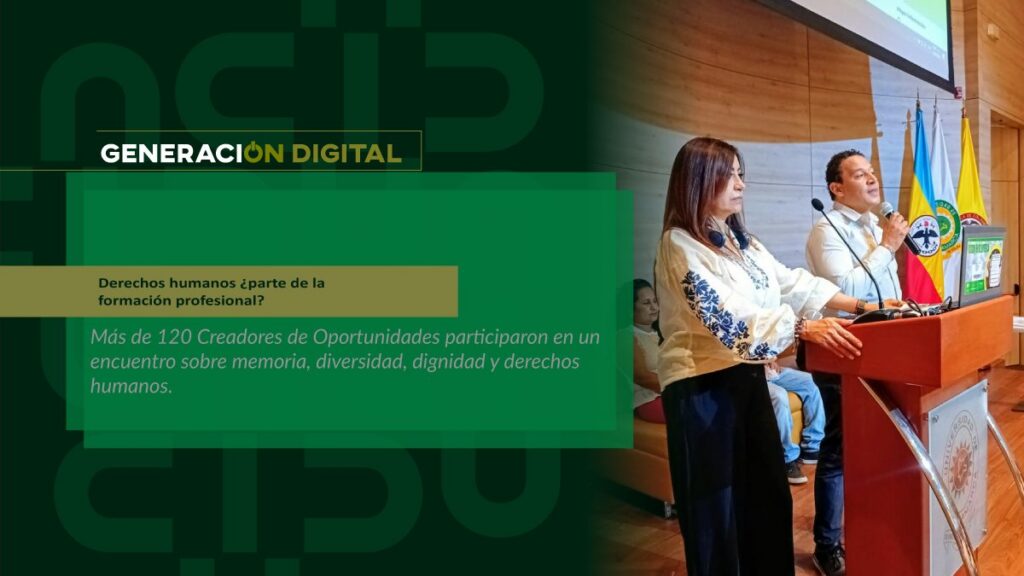
Human rights: part of professional training?
By: Alejandro García Suárez – Advisory Office of Communications



I am your virtual assistant, here to help you quickly and easily.
▲ Back to Top
Thanks to his interest in research and good academic performance, he was exempted from presenting a thesis, but he left his mark with a project that resulted in a booklet whose exercises are aimed at training the brain of adolescents and young people.
He dedicated 23 years to the National Army, reaching the rank of First Sergeant. However, despite the path he had chosen for his life, one day in 2012, he decided to embark on a new life project with the University of Cundinamarca.
Why did she choose psychology?
After analyzing my first life project, I decided to study Psychology at UCundinamarca because it seemed like a very interesting discipline, which I could use to develop my skills related to the analysis of human behavior in work contexts.
Why did you choose the University of Cundinamarca?
I definitely chose to study at UCundinamarca simply because of its geographical location and the good references I received from students of the institution; in addition, my wife is also a graduate of there as a Systems Engineer.
How enjoyable was the study of Psychology for you?
For me, studying Psychology was the best decision I made, because the academic environment was very pleasant; both students and teachers made me feel like just another person in the classes without discriminating against me because of my age.
All the activities the teachers organized kept me motivated. I have no complaints about the teachers; they seem like wonderful people, great professors—true teachers in every sense of the word.
Have you done any community work as a student? What was the experience like?
From the second semester I was part of the Research Seedbed of Neuropsidec Program, where the project to design a neuro-training booklet for use with tenth-grade students in Facatativá was developed. As a result, the University sponsored my participation in the VIII Meeting of Psychology Students in Havana, Cuba, in 2014.
I can say that during my academic career I carried out several projects with communities, based on the thematic areas that were being developed. My first social outreach was in a senior citizens' home, which was a very valuable experience.
On another occasion I made an approach to the school community in a school in the Cartagenita neighborhood where child abuse was addressed.
What did working with these children bring you?
The experience with schoolchildren is valuable because it's a challenge to know how to reach them and achieve the proposed objectives. The research projects lasted approximately two months, but the influence exerted on the children was so profound that personal and professional bonds were formed.
Are you currently working on any social projects? Where and what has your experience been like?
Currently, after graduating, I continue to collaborate with Professor Rafael Cortés on the Primer Project.
This experience has been very satisfying, as a psychologist the responsibility is great and with the collaboration of the University and the Systems Engineering Program the project has made significant progress.
Tell us about the booklet project, what is your role and how has the project been developing?
The booklet project is being developed with the aim of implementing it with ninth or tenth grade students in schools in Facatativá (for the time being) in order to exercise some of the brain's executive functions, such as attention and memory. The theory states that the brain should be treated like any other muscle; if we exercise a muscle in our body, it acquires certain skills, and the same happens with the brain.
I am a co-author of the Project, I participated in the preparation of the Booklet and in making it known to the World at the meeting of Psychology students in Havana.
The project has made significant progress, with interdisciplinary work underway. For example, Systems Engineering students created an application to systematize the booklet. The project and the application are currently managed by the research group; the only remaining step is securing a server to make the booklet available online.
The booklet project is something I started with the Research Group, and I don't intend to abandon it just because I've left the university. The idea is to continue with the project until it's implemented. This project is one of my academic goals. I'm currently working on the project, but I'm doing it voluntarily.
Who is the target audience for the booklet?
The booklet is intended for ninth or tenth grade high school students.
News
News
News
News