News
2026-09-24
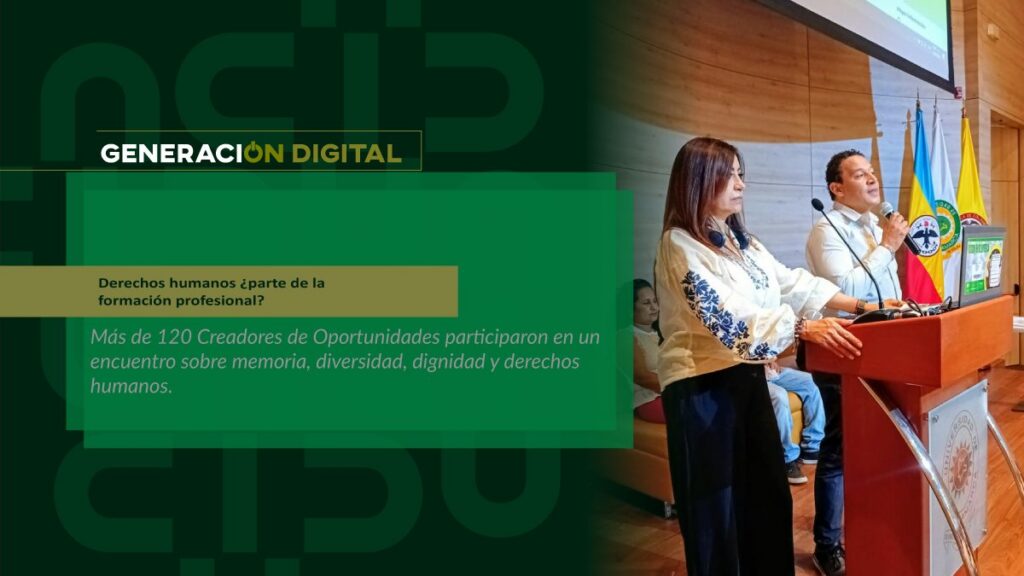
Human rights: part of professional training?
By: Alejandro García Suárez – Advisory Office of Communications


I am your virtual assistant, here to help you quickly and easily.
▲ Back to Top
In the Emilio Sierra Baquero auditorium, Fusagasugá campus, deans, program coordinators and directors, professors, senior management and other members of the academic community participated in the discussion Socialization Transmodern Digital Pedagogical Model. The event featured the participation of Estela Beatriz Quintar, Director General of the Institute for Thought and Culture in Latin America (IPECAL), Galo Adán Clavijo Clavijo, PhD in Pedagogy, among other researchers and theorists of the transmodern paradigm.
The University of Cundinamarca is based on a pedagogical model under the premise of cultural plurality and the new paradigm of transmodernity, characterized as an academic, scientific, visible, dynamic, open, reflective, critical, interconnected reality, sustainable with the environment, capable of incorporating into its reason for being the consensuses of humanity with the purpose of giving a real-time response to the knowledge society.
View our Institutional Educational Project
“For almost two years, we have been engaged in constructive dialogue with expert colleagues, educators, theorists from Latin America, and the educational and academic community of the University of Cundinamarca, regarding the key aspects of the Transmodern Digital Educational Model, in order to gather their needs and interests. Today, we are presented with a document that is finalizing its educational policy commitment centered on the ethics of knowledge, learning, and action, in an education for life, democratic values, civility, and freedom.”, highlighted Estela Beatriz Quintar, the general director of the Institute of Thought and Culture in Latin America (IPECAL).
The transmodern digital pedagogical model centers an ethics of knowledge, learning, and action, prioritizing multidimensional learning, understood as the process that takes place in a multidimensional campus (virtual, institutional, face-to-face, cultural, and international) that is open, inclusive, collaborative, and transcendent, and uses strategies, methods, techniques, and instruments to foster the integral development of the human being, the disciplines, and the academic community.
“Our mission is no longer to transmit or generate knowledge; we are here to prepare people for life, and today we focus on action. The educational model is not synonymous with virtuality or technology, although these are learning environments. We understand the digital realm as thinking, doing, and acting. We are proposing an inclusive, dialogical, co-creative, collaborative, non-binary, and non-dualistic digital approach.”, Adriano Muñoz Barrera, rector of UCundinamarca, highlighted this during the discussion.
You can also view previous discussions
Finally, Galo Adán Clavijo, PhD in Pedagogy, highlighted: “The University has to rethink the kind of citizen it will train; participatory, democratic, so that the person can transcend to society, hence the importance of the skills of knowledge: knowledge and the ability to live together.”.
News
News
News
News