News
2026-09-24
Human rights: part of professional training?
By: Alejandro García Suárez – Advisory Office of Communications



I am your virtual assistant, here to help you quickly and easily.
▲ Back to Top
By: Alejandro García Suárez – Advisory Office of Communications
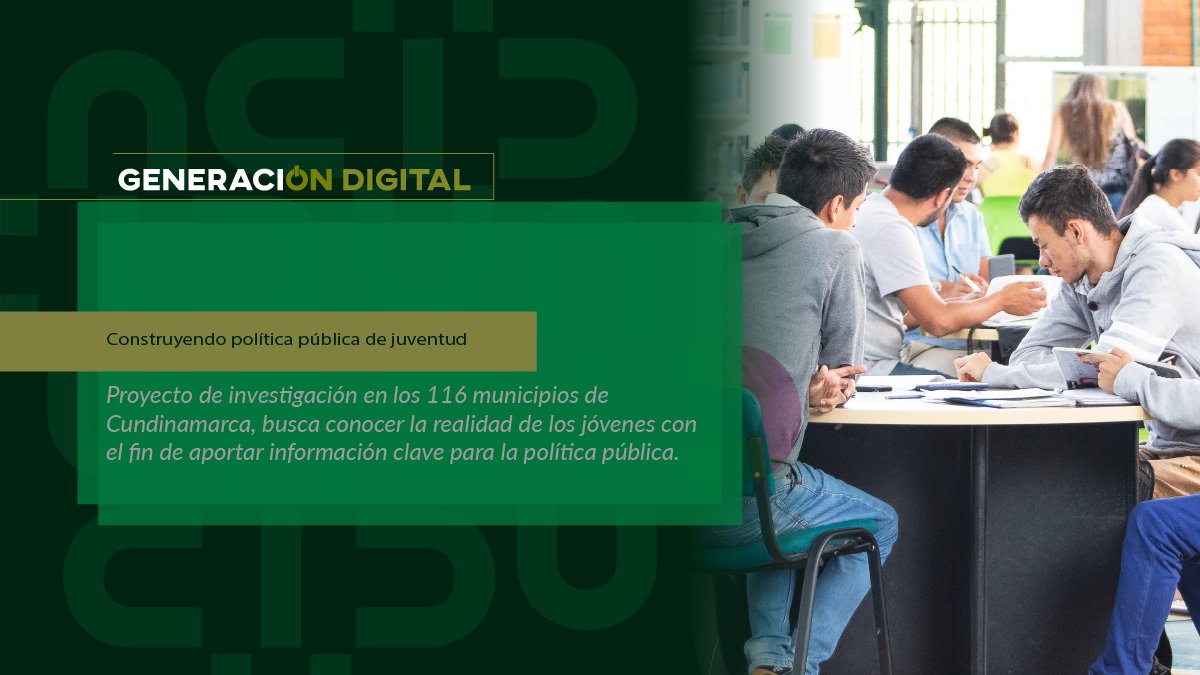
The Psychology Program in Facatativá, in partnership with the Cundinamarca Governor's Office of Social Affairs and Family, is advancing an ambitious research project that seeks to understand the needs of young people in the department's 116 municipalities. Through surveys and psychosocial analysis, this initiative aims to provide key information for the development of public youth policies.
The research is led by Felipe Ramírez Cortázar, Knowledge and Learning Manager in Psychology and coordinator of the Creser research group, along with professor Sara Niño and student Luisa González, youth representative of Mosquera. “It is a joint effort between academia, the community, and the government, with the goal of listening to and understanding the realities of young people,” Ramírez Cortázar stated.
International reach and innovative methodologies
One of the most innovative aspects of the project is its international scope. The University of Naples Federico II (Italy) is participating in the research with the support of experts Roberto Fasanelli and Sofia Foglia, who are contributing methodologies for data analysis and the design of effective policies. “We are learning from global experiences to apply them to our local context,” the researcher emphasized.
The study seeks to evaluate crucial issues such as mental health, political participation, and the impact of climate change on young people. “Each municipality has a different reality. What affects a young person in Chía is not the same as in Facatativá or Medina,” explained Ramírez Cortázar.
Collaboration and social transformation
Researcher and professor Roberto Fasanelli, from the University of Naples Federico II (Italy), highlighted the value of collaborative work and the integration of cultural perspectives in research. “I have always believed in cooperation between academia and the public sector. This study is an example of how combining different approaches can generate a real impact on society,” he stated.
For her part, Sofía Foglia, a doctoral student in Learning Sciences and Digital Technologies in Italy and a collaborator on the research, emphasized the importance of applying academic theories to real-world scenarios. “This initiative demonstrates that research should not remain in the realm of speculation, but rather become a tool for action and decision-making,” she stated.
For the University of Cundinamarca, this project reaffirms its commitment to social development and the empowerment of youth as key players in the transformation of the region. “It’s not just a study; it’s a tool for generating real, long-term change,” the researcher concluded.
This joint effort between the University of Cundinamarca and the departmental government demonstrates how research can transcend the classroom and become a tool for social well-being. Furthermore, it encourages new generations of researchers to develop their curiosity, critical thinking, and commitment to change.
Listen to our Podcast:
News
News
News
News