News
2026-09-24
Human rights: part of professional training?
By: Alejandro García Suárez – Advisory Office of Communications


I am your virtual assistant, here to help you quickly and easily.
▲ Back to Top
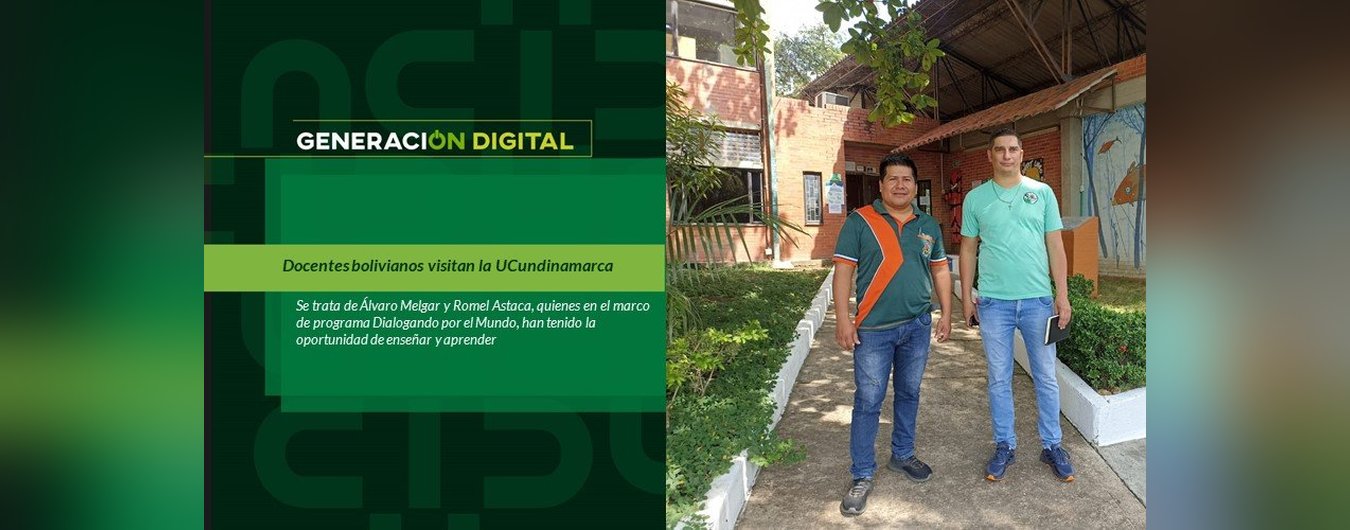
They are Álvaro Melgar and Romel Astaca, who, within the framework of the Dialoguing for the World program, have had the opportunity to teach and learn.
The internationalization of higher education is a key tool for UCundinamarca, as it allows the institution to learn from other cultures to strengthen its teaching and learning processes under the Transmodern Digital Educational Model. Hence the presence of these professors from the Autonomous University of Beni, who have contributed their academic perspectives to the education of the institution's students. Therefore, UCundinamarca News interviewed them at the Girardot campus about what this experience has meant to them.
UCundinamarca News: How did you find out about this exchange?
Álvaro Melgar: I found out through the internationalization department at my university, which at the University of Cundinamarca is led by Dr. Fabián Leal. So I decided to apply and I was selected.
UCundinamarca News: What does the work you are doing in this exchange consist of?
Álvaro Melgar: I'm here primarily for a knowledge exchange. I've brought a number of experiences from my university that I'd like to share. I teach tourism, as I have a degree in that field. I arrived in the country on November 15th and will be here until the 29th of this month.
UCundinamarca News: What have you enjoyed most about this academic experience?
Álvaro Melgar: I really liked the way the professors work and how they're instilling a research mindset in students from their very first semesters. I see students starting to defend class assignments and small research projects they conduct from the very beginning, and that was very gratifying for me. I was also very impressed by the concept of mirror classrooms they're implementing with other universities, and I'd love to be able to replicate it at my own university.
UCundinamarca News: What image do you take away from the country?
I'm leaving with a very positive impression. The country has many tourist destinations that it should leverage to become a powerhouse in that sector of the economy, thereby generating foreign exchange and, above all, employment, which is what people need now that we're nearing the end of the pandemic. I think they should incentivize it much more.
“I enjoyed seeing how young people work in research” Romel Astaca
UCundinamarca News: What has this internationalization experience been like at the University of Cundinamarca?
Romel Astaca: This is my university's first experience with Colombia, which is why I'm here. It has been very beneficial, as it has allowed me to exchange knowledge and broaden my perspective on what I'm doing in my country, enabling me to compare it with and improve pedagogical processes there.
UCundinamarca News:What would you highlight about the Transmodern Digital Educational Model?
Romel Astaca: What I would highlight about this model is how young people work from their first semesters on research topics that are tied to the realities of their own lives. I also really like the concept of mirror classrooms, as it helps to measure the level of education one provides and the multidimensional fields of learning that extend beyond the traditional classroom.
UCundinamarca News: What has the experience of teaching at UCundinamarca been like?
Romel Astaca: Very interesting. I'm an environmental engineer, and I was able to do this in the engineering program they have in Facatativá. There, I spoke about soils, reforestation, and forest inventories. I saw that the students enjoyed it quite a bit since Colombia, like many Latin American countries, has problems in these areas that require our help.
UCundinamarca News: What image do you take away from Colombia?
Romel Astaca: I'm leaving with a very good impression of the country. I've been particularly struck by how the economy is divided by region. For example, in Facatativá you see the flower industry, and here in Girardot it's commerce and tourism, and that's good because it helps to better stimulate the economies by focusing on specific sectors in different geographic areas.
In this way, UCundinamarca, within the framework of its policy "Dialoguing with the World," promotes visits from academic missions, the internationalization of the curriculum, and research, as part of its process of opening up to knowledge and realities from other countries that contribute to educational excellence.
News
News
News
News