News
2026-09-24
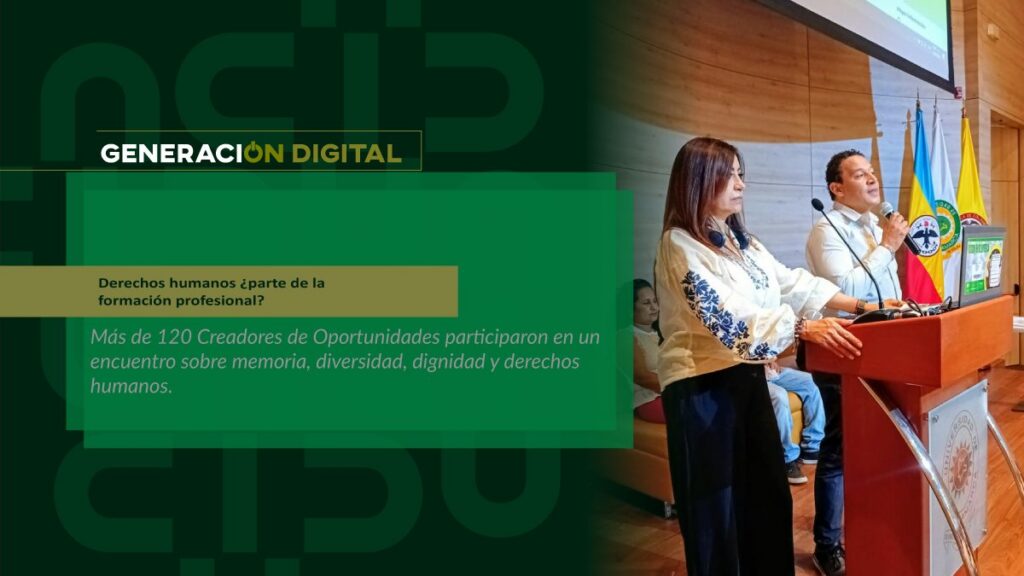
Human rights: part of professional training?
By: Alejandro García Suárez – Advisory Office of Communications



I am your virtual assistant, here to help you quickly and easily.
▲ Back to Top

Source: The Weather
By: Francisco Cajiao
“Educational systems around the world will undergo major changes between now and 2030, driven by the technological revolution. Over the next fifteen years, the internet will transform schools into 'interactive environments' that will turn traditional learning methods upside down and change the way teachers, parents, and students are.‘.
This is one of the conclusions of a group of 645 international experts interviewed for a survey that defines what school will be like in the next decade. The report was produced by the World Innovation Summit for Education (WISE).
Weeks ago, more than two thousand educators, decision-makers, and experts from over one hundred countries gathered in Doha around the theme 'Unlearning, relearning. What it means to be human'. The discussion points show that education in many societies goes far beyond simply meeting coverage targets and international test scores: Should schools teach students how to be happy? Will artificial intelligence make teachers obsolete?
Can the latest discoveries in neuroscience make our children smarter? Do students care about what they're learning? Should schools get rid of grading systems? Should students commit a percentage of their future salary to fund their higher education?
In Colombia we remain very attached to an operational vision of the provision of educational services, as if the mere efficiency of the system and the slight improvement in academic results were enough for the progress of the country.
That's why we haven't yet reached fundamental questions like those discussed in Qatar's capital.
Without addressing these questions, one could say that in ten years our education will be very similar to the current one, which in turn is similar to that of 1990., as could be corroborated by reading the 1992 UNESCO report on the state of education in Latin America in the 1980s.
Expert predictions for 2030 indicate that:
1.
Lectures will disappear and the teacher's main mission will be to guide the student through their own learning process.
2. The curriculum will be personalized to meet the needs of each student, and personal and practical skills will be valued more than academic content.
3. The Internet will be the main source of knowledge, even more so than most basic education institutions.
The summit's final report – in which participants included linguist Noam Chomsky, former Australian Prime Minister Julia Gillard, and Professor Sugata Mitra – indicates that "schools will become networks" where students will interact with each other and with the teacher in a way that fosters "collaborative learning.".
Students have changed a lot in the last decade, given the ease of access to countless sources of knowledge.
In the coming years, these changes will accelerate even further, as information technologies and mobile devices have broken down barriers of language, subject matter, and format. Ten years ago, it wasn't easy to access videos, photos, documents, or consult libraries and databases from anywhere using a smartphone. Nor was it easy to share information with thousands of people constantly present on social media.
Eighty-three percent of the experts consulted by Wise believe that the curriculum will have more personalized content tailored to each student. This will have consequences for the hierarchical relationship with the teacher, as it blurs the line between those who teach and those who learn. Changing the role of teachers will necessitate changes in their training.
The current one seems increasingly obsolete, and this has negative implications for their professional identity.
We will need to shift towards a cultured teacher, capable of identifying talents and sowing enthusiasm for learning, rather than a specialist in transmitting disciplinary content.
Spanish experts agree that the boundary between school and home will become blurred And learning will not be restricted to specific times and places, so schedules will have to be more flexible.
One of them says: “I see more online courses, and at odd hours. We’ll see schools offering classes in the summer and on weekends.‘ Regarding homework, another expert points out that rather than assigning homework, we need to encourage students to continue seeking out information, sharing knowledge, and developing a passion for research.
Higher education
Universities are also being challenged by social changes that seem to leave their centuries-old structures untouched. It is paradoxical that the very institutions where research in neuroscience, information theory, biotechnology, and complexity theory has advanced remain clinging to a disciplinary segmentation that clashes with the social practices of the main fields of scientific and technological innovation.
Many professional boundaries have become blurred. It is no longer so clear where architecture ends and engineering begins, or how to resolve the dilemma between a machine's efficiency, its aesthetic design, and its marketing strategy.
In these cases, companies prefer to train their employees.
More rapidly than in basic education, students have changed their work habits, but the repertoire of aspirations and expectations regarding higher education has also changed for them and their families.
Different paths will have to be explored to consider models for certifying knowledge that can be acquired in ways other than regular access. and by university schedules.
Curricula must become increasingly flexible: many of the current models respond to conceptions that have lost validity both due to the irruption of information technology and the dramatic changes in the world of work.
In Colombia, the population willing to pay high costs and invest a lot of time in training has been dwindling, when it is possible to work in fields that do not require university degrees.
To avoid disappearing, many private universities will have to combine in-person and virtual learning modalities., as well as job training programs, project-based methods, non-degree credit offerings, and strategies for certifying knowledge and skills acquired outside of formal education.
This means that the State should approach quality assurance processes with a more innovative and less restrictive vision, since with the current regulations the only thing guaranteed is that there will be no significant changes in the coming years.
Will this be our future?
Many countries are already doing what futurists predict for 2030. A BBC bulletin published in 2015 says: “Finland, known for having one of the best education systems in the world, is preparing a radical change with which it hopes to improve the quality of its schools: the abolition of different subjects.
And that is because, starting in 2016, all educational centers in the Nordic country will begin to apply a new method known as 'phenomenon learning'.
Under this system, traditional classes will be replaced by thematic projects in which students will take ownership of the learning process. Now, instead of acquiring isolated knowledge about different subjects, the students' role is active. They participate in the planning process, "They are researchers and they also evaluate the process," explains Marjo Kyllonen, education manager in Helsinki.
The reason is that the traditional form of education is not preparing children for the future.”.
It is clear that this is not simply a matter of passing a law, but rather years of serious discussion about a societal project, addressed with dedication and continuity by governments in conjunction with society as a whole. Therefore, those who think it is possible to transfer the model with a few simple formulas are naive. This example, however, helps us see that what others are already doing is still science fiction for us, and will remain so unless the right questions are asked by the government, teachers' associations, business guilds, and all state institutions.
In the world of work
Today, we are already talking about cyber-physical systems, which combine machinery with digital processes and are capable of making decentralized decisions and cooperating—among themselves and with humans—through the Internet of Things. This will soon allow us to see smart factories and cities, capable of self-programming and decision-making. These transformations are changing the world of work, just as computers did twenty-five years ago: many jobs disappeared, and others that didn't exist had to be invented, first in practice and much later in universities.
But automation and artificial intelligence are just a couple of pieces of a huge puzzle that includes nanotechnologies, neuroscience, energy storage, robotics, genetic engineering, and biotechnology.
What matters is that such progress will only benefit those who are able to innovate and adapt. We must ask ourselves whether our education systems are preparing for these challenges, or whether we continue to make small adjustments., equivalent to those carried out in the 1980s while the developed world was conquering space.
FRANCISCO CAJIAO*
Special for EL TIEMPO* Francisco Cajiao is a philosopher, former Secretary of Education of Bogotá, and an international consultant in the field of education.
News
News
News
News