News
2026-09-24
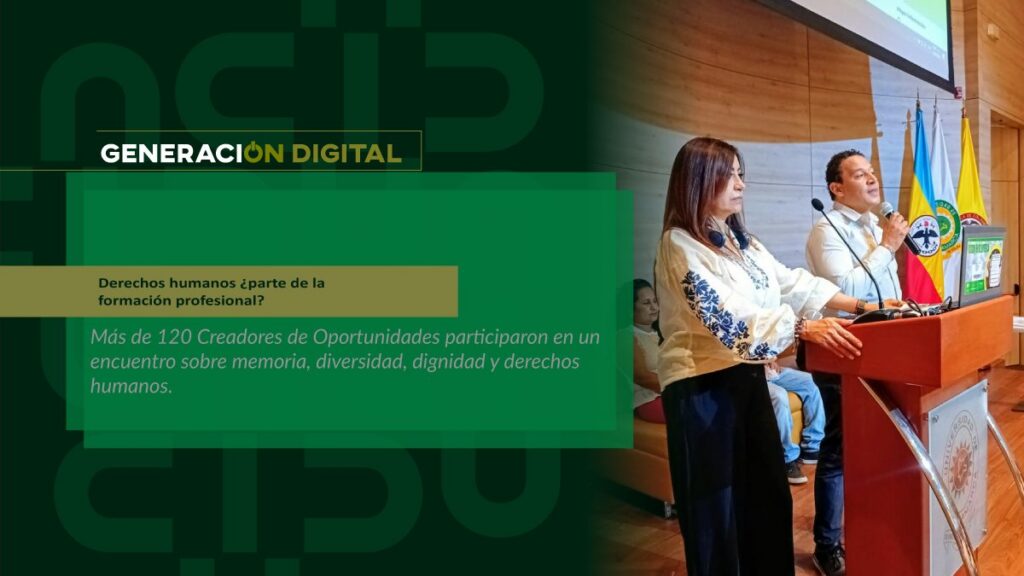
Human rights: part of professional training?
By: Alejandro García Suárez – Advisory Office of Communications



I am your virtual assistant, here to help you quickly and easily.
▲ Back to Top
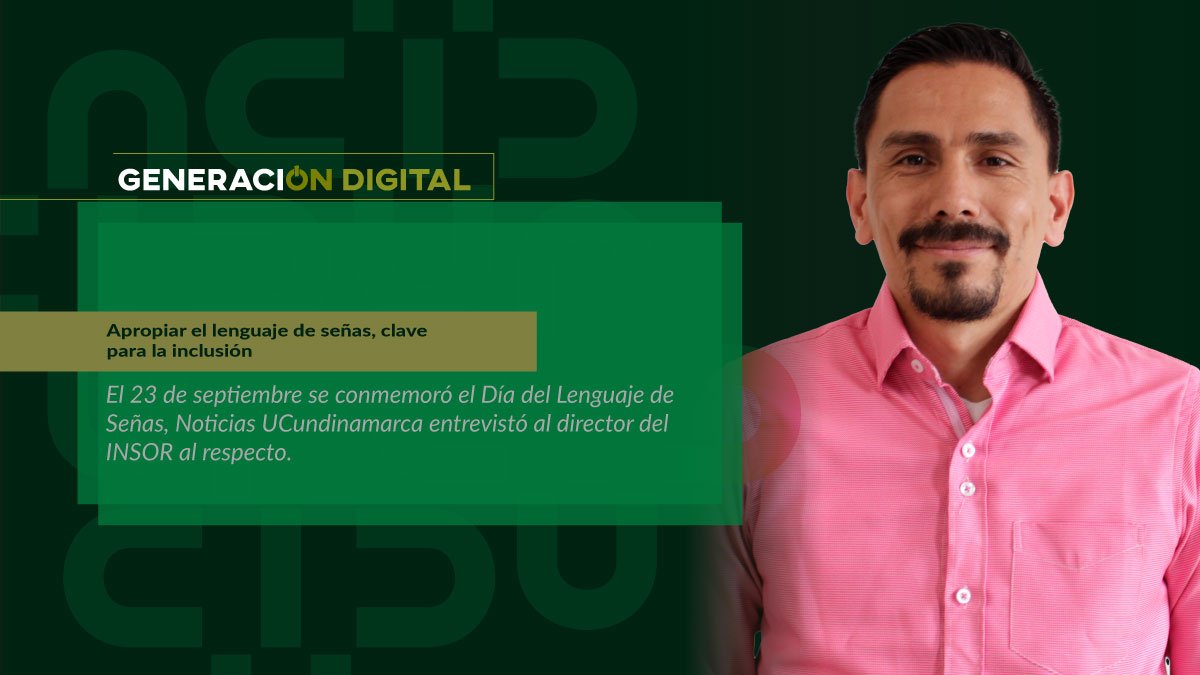
Geovani Meléndres has led the National Institute for the Deaf (INSOR) since 2022, becoming the first director from the deaf community to hold this position in the institution's 67-year history. He is a linguist from the National University of Colombia and holds a master's degree in Education with a focus on Intercultural Communication, Ethnoeducation, and Diversity from the Francisco José de Caldas District University. He also has over five years of experience in the study and research of sign language. This impressive track record lends weight to this interview, which aims to provide insight into this reality.
UCundinamarca News: Why is sign language important in an inclusion process?
Geovani Meléndres: Knowing and understanding who deaf people are, as well as the language they use, is a fundamental exercise in social awareness. In the case of deaf people in Colombia, their language is Colombian Sign Language (LSC). It is important to emphasize that the term 'language' to refer to communicative expression is not appropriate, since language refers to the innate capacity of human beings.
From this premise, it becomes clear that there are no fundamental differences in language itself between people, since we all share a common biological makeup. However, where we do find significant differences is in the way people express themselves and communicate, and this is where languages come into play. These languages are distinguished by their composition, grammatical structure, and other linguistic features.
Sign languages are characterized by a visual, gestural, bodily, and spatial grammatical structure, while spoken languages are linear and transmitted through the auditory channel. It is essential to recognize that sign language has its own grammar and is designed to meet the needs of the deaf community.
This recognition is crucial and is supported by international standards, such as the Convention on the Rights of Persons with Disabilities, as well as by specific laws and regulations in Colombia. These laws guarantee the recognition of deaf people, their language, their culture, and their heritage. Furthermore, they equate the deaf community with ethnic communities, ensuring the protection of their linguistic rights and promoting their full participation in society.
UCundinamarca News: How does the institute promote the recognition and understanding of sign language in our society?
Geovani Meléndres: On the other hand, the institute has played a crucial role in promoting the recognition and understanding of the sociolinguistic characteristics of deaf people through workshops on deaf culture and communication skills. This helps facilitate accessibility in public institutions when a deaf citizen, a user of Colombian Sign Language, seeks assistance or uses their services. It is important to remember that September is Deaf Awareness Week, culminating on September 23 with the celebration of Sign Language, as established in Law 2049 of 2020 and in United Nations General Assembly Resolution A/C.3/72/L.36.
UCundinamarca News: What does it mean for sign language to be included as a native language?
Geovani Meléndres: It's important to clarify that the concept of native language has been the subject of debate, especially when it relates to sign language. According to academia, this term refers to the language that is passed down from parents to children and acquired spontaneously. It is the language most used in an individual's immediate environment, regardless of whether or not they come from a linguistic minority community. Furthermore, this native language facilitates the development of thought.
Often, similar terms such as natural language, mother tongue, and first language are used to describe this concept. The inclusion of sign language as a native language is currently under review. This is because sign language has been recognized as the natural language of the deaf population, with its own grammatical structure that has developed and solidified within the community of native users of different ages. This defines it as the language of this linguistic minority.
In the specific case of deaf people, and considering the diversity of existing family structures (where some parents are hearing and have deaf children, while other parents are deaf and have deaf children), the initial definition of native language, which refers to the language transmitted by the parents, does not always apply to deaf people. For this reason, this concept is being analyzed and debated. These cases have also posed challenges in the educational field, since, in some cases, it is at school where children acquire and develop language.
The inclusion of sign language as a native language is based on ongoing discussions about this concept. It is defended from the perspective of deaf parents with deaf children, who transmit the language naturally, as well as from the perspective of deaf adults who are sign language users and are present in the close environment of individuals who are in the process of acquiring it.
UCundinamarca News: What does the law say about the use of sign language in events and media?
Geovani Meléndres: The country has Law 1712 of 2014 on Transparency and Access to Public Information, as well as Resolution 5960 of 2020 issued by the Communications Regulatory Commission (CRC). These regulations are fundamental because they provide guidance and establish guidelines to ensure access to communication for the deaf population by entities and the media.
UCundinamarca News: Should a hearing person learn sign language? Yes, no, why?
Geovani Meléndres: Yes, of course. Sign language is a language like any other, just like English or any other. Interested people can learn it, which contributes to creating more inclusive and respectful spaces. It's important to emphasize that those who teach sign language should be proficient deaf people, since they are native users who understand and possess a comprehensive view of deaf identity and culture based on their own life experiences. This is crucial in the training process.
UCundinamarca News: Where can a person learn sign language and what does it cost?
People interested in learning sign language have various options, such as universities, deaf organizations that offer courses, and the library network, among other places. However, it is important to understand that learning sign language can have two distinct approaches. One is for communicative purposes, to acquire linguistic competence at various levels in order to interact with deaf people, without the intention of becoming a sign language interpreter. The other approach is professional, aimed at those who wish to become sign language interpreters and translators.
The latter requires a solid foundation in sign language and a more rigorous training process with academic competencies to carry out linguistic transfer, among other components. Currently, the country offers five training programs at the higher education level that are distinct from sign language courses. The cost varies depending on the purpose of the learning and the educational offering. From our institute, we offer consulting services to organizations through workshops on Deaf culture and communication skills, especially in the areas of public relations and citizen services, where Deaf people seek assistance.
News
News
News
News