Fusagasugá Branch
2026-09-24
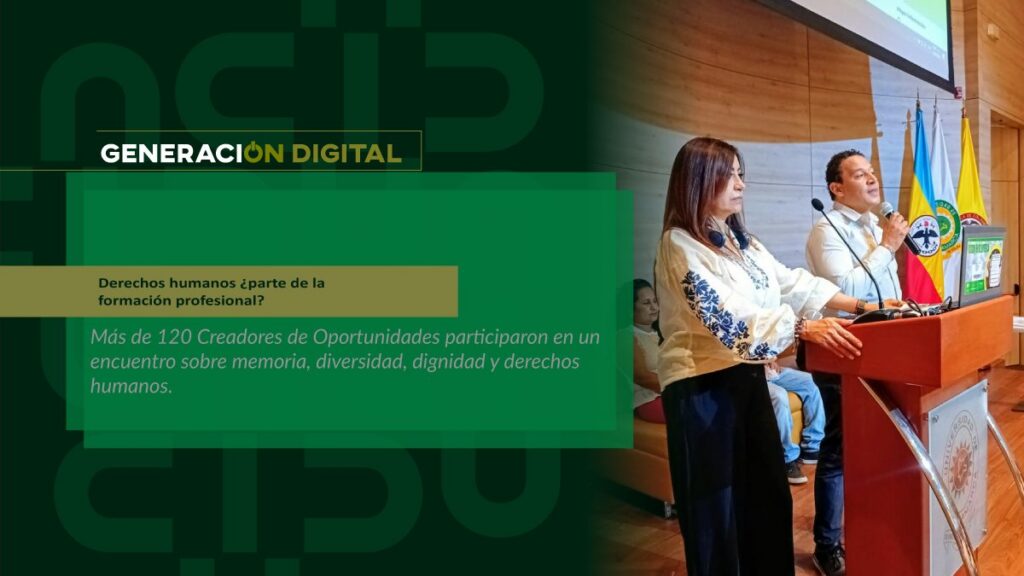
Human rights: part of professional training?
By: Alejandro García Suárez – Advisory Office of Communications



I am your virtual assistant, here to help you quickly and easily.
▲ Back to Top

How many of us have felt overwhelmed and frustrated at some point in our lives by the rigid language of learning mathematics? I would guess many. However, in this 21st-century digital age, emerging technologies and pedagogies offer a different perspective, facilitating the teaching and learning of mathematics in a flexible, dynamic, personalized, and participatory environment.
The idea of formulating new pedagogical and methodological strategies to improve the academic performance of "Passed" and minimize the "Did Not Pass" emerged from the SARA (Scientific Academic Research Activity) and AXIOMA research groups of the Engineering faculty extension Chía, who repeatedly observed critical data on the low performance in the area of mathematics in Systems Engineering students.
The teacher researchers, using ICT, formulated the macro-project called: Design and development of pedagogical strategies through the use of emerging technologies for the teaching of mathematics at the University of Cundinamarca, which contributes to the learning and comprehension of mathematical knowledge in students.
The research, of an exploratory descriptive and mixed qualitative-quantitative nature, began with a diagnostic evaluation in the mathematics groups in the faculty, Systems Engineering program, to know the conditions and level of basic knowledge in the students in the area.
Following the application of interviews and surveys of experts and academics, the project proceeded to explore pedagogical and methodological tools framed within the context of ICT and emerging technologies in education to establish a metric for the current teaching model and to create the model to be implemented. This also included a review of specialized literature, among other structural elements that underpin the project. In this sense, the project tested hybrid learning in conjunction with mobile learning to strengthen the teaching and learning process of mathematics, articulated with the flipped classroom model.
“The project aims to motivate teachers and students to become familiar with and acquire the digital skills necessary to function in a ubiquitous environment, since by combining these three elements of education in the same scenario, the possibility of proposing new teaching and learning options under a technological platform that has become consolidated in the educational environment such as the Internet and mobile technology is explored,”, Jairo Eduardo Márquez Díaz, research professor at Ucundinamarca.
The flipped classroom, known by the English acronym Flipped Classroom It proposes a learning model that invites the student to solve problems, assigns tasks, provides feedback inside and outside the classroom, uses virtual classrooms, computer programs for editing text, audio, video and presentations, and even electronic resources such as ebooks, MOOCs, podcasting and printed materials, among others, in order to provide students with diverse resources that facilitate their acquisition of knowledge. It should be noted that the teacher's role is fundamental in this educational context, assuming the primary role of guide and tutor.
Mobile learning offers information both synchronously and asynchronously, anytime, anywhere, and is characterized by a variety of applications for teaching and learning. It also allows teachers to manage information and conduct assessments through chats, social networks, wikis, and blogs, among other digital resources.
Hybrid learning integrates virtual learning, ICT-mediated learning, and flexible, personalized instruction, both inside and outside the traditional classroom. This allows for monitoring student progress through various digital resources. Furthermore, teacher-student interaction can be asynchronous, with feedback and subsequent assessment conducted using a variety of tools designed for this purpose.
Having explained the previous triad: Hybrid inverted mobile learning as a pedagogical and methodological approach, it presents new teaching and learning options for mathematics on a technological platform. Based on this, the project incorporated proposals for the development of Web 2.0 tools, supported by current trends such as massive open online courses (MOOCs), flipped classrooms, augmented reality, and virtual worlds.
It is worth noting that the project developed invites the teacher to create their own cyber classroom space with the support of ICT and emerging technologies, so that the classroom transcends and becomes a dynamic, flexible, participatory and ubiquitous space.
Finally, the project authors highlight a review and adjustment to the curriculum and pedagogical models, since the adoption of ICT and emerging technologies worked on in the project implies an adjustment of the digital resources and technology that accompany the contents of each mathematics subject, in addition to aspects related to intellectual property rights and usage licenses.
Research faculty involved in the project:
Jairo Eduardo Márquez Díaz
Arles Prieto Moreno
Harvey Giovanni Hernández Yomayusa
Angelica Bravo Bohórquez
Luz Jaddy Castañeda Rodríguez
Luis Alejandro Hernandez Hernandez
Lady Alejandra Morales Espinosa
Camilo Andrés Domínguez Saldaña
Camilo Alberto Rodríguez Ávila
News
News
News
News