News
2026-09-24
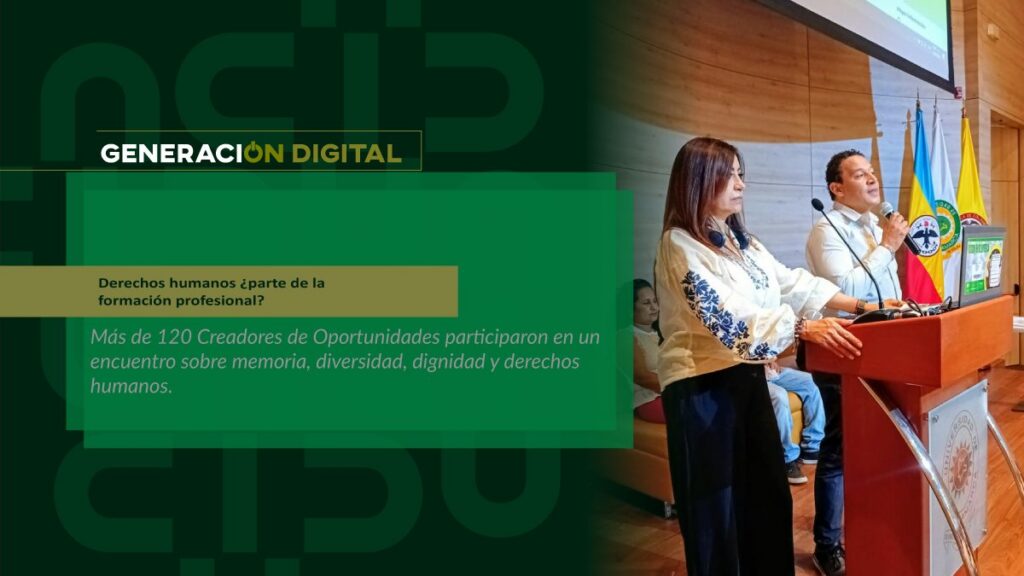
Human rights: part of professional training?
By: Alejandro García Suárez – Advisory Office of Communications



I am your virtual assistant, here to help you quickly and easily.
▲ Back to Top

Source: El Tiempo
According to the German statistics portal Statista, up to 2019 the English It was the most widely used language in the world with 1.5 billion speakers. This figure takes into account the 375 million native speakers and the 1.125 billion people who learned it as a foreign language.
Its importance lies, among other things, in the fact that it is the main language used in business and social media.
If you are learning it, Follow these expert tips to make your process quick and easy., effective and, most importantly, a pleasant experience.
Before we begin
Please note that there is no 'magic formula' for learning English. Each person has different goals and needs, so a good first step is to ask yourself what works best for you and what doesn't.
Before betting on any methodology The resolution of a learning styles questionnaire could be useful to him. One of these is the Vark 'test', which is used in pedagogy to determine how information is perceived and acquired.
This 'test' works based on four categories: visual, auditory, reading and writing, and kinesthetic.
Thus, for example, 'more auditory' people can benefit from listening to audio in English and having conversations, explains Stephanie Vargas Isoza, English teacher at the Michigan Master Institute.
But this does not mean that you should stop practicing any of the four skills that make up language proficiency (speaking, listening, writing and reading), but knowing your profile can help you be aware of the mechanisms you are using or will use to learn the language.
Academy or self-learning?
Keep in mind that there is no single learning system.
On the one hand, If you plan to take a course, don't forget to check its features before enrolling.. Experts recommend personalized classes or classes with few students, as this allows professionals to consider the particularities of each student.
Self-teaching is also valid, as long as there is an established routine. In this case, Vargas recommends doing so with the help of someone with a higher level of proficiency.
“The role of a 'tutor', someone who clarifies doubts or serves as a guide, is fundamental.”,” the expert clarifies, adding that, in fact, both systems can be combined to achieve a learning even more effective.
The secret of immersion
It is often said that language immersion (intensive exposure to a foreign language) is fundamental to learning English because it allows you to become familiar with the language.
However, it is not recommended that beginners (A1) force themselves to have direct interaction with native speakers because, in some cases, This can be frustrating.
For the most basic level, Vargas advises engaging with the language through listening.
This can be done with movies subtitled and songs.
At this stage it is also useful to emphasize grammar, “Because English, first and foremost, is a very structured language,” says Edgar Cavelieri, English teacher and founder of the company Mec Speak English.
For intermediate learners, having regular contact with native English speakers is an excellent way to solidify their level and overcome what some teachers call "the intermediate level block" that occurs when the student feels stuck," explains Cavelieri.
Fortunately, traveling to an English-speaking country is not the only way to 'immerse yourself' in English.
On the internet, for example, there are several applications where you can practice with native speakers.
“I recommend Tandem, a free language exchange app with native speakers; Cake, a website that includes conversation simulation features; and the BBC's English Mobile online course.”Cavelieri stated.
Say 'goodbye' to frustration
“It is said that at least 600 hours of practice to have a good command of English, "But that doesn't mean it has to be a traumatic process," Cavelieri pointed out.
Although it may seem redundant, the best way to improve a skill is to put it into practice.
The experts consulted agreed that making mistakes is the best way to learn.
Furthermore, it is essential to integrate the language into its own context since “The brain stores information that it finds useful.”,” explained Julie Enciso, a graduate in Modern Languages and an English teacher at the University of La Sabana, who advises associating practice with experience.
Keeping a journal in English can be useful for achieving meaningful learning and reinforcing two aspects that often cause headaches: grammar and vocabulary.
“Transform your daily life in English; learning a verb tense is useless if you don't apply it to your interests and goals.”,” the expert stated.
The experts' bonus
1. If you find it too embarrassing to speak English, ask yourself if the same thing happens when speaking Spanish. Do not rule out the possibility of consulting an expert to find the underlying cause of the problem.
“All learning has a psychological component and 'stage fright' can originate from specific situations or traumas that must be recognized,‘ explains Tizziana Russo, a social communicator, therapist and English teacher at Externado University.
2. Everyone has a different level and pace of learning, but mastering a foreign language takes time.“Don't trust courses that promise fluency in three months”,” Vargas asserted.
3. To strengthen your vocabulary, make a glossary.
Write down any new English words you hear and review them constantly by associating them with an image. “If you’re learning how to say ”flower,’ watch a gardening video from an English-speaking creator on YouTube,” Enciso suggests.
4. Read at least one page of an English text daily and write down new words in the glossary. This will help you expand your vocabulary and internalize English syntax (sentence order).
5. Listen to podcasts specially designed to practice your listening skills. To mention one example, the website Podcast in English has podcasts for all levels.
6.
Learning that involves emotions is the most effective, Vargas says. Make sure to integrate creativity and art into your methodology. However, studying with movies and music is only useful if it is done consciously and in an organized manner.
According to Cavelieri, “it’s no use listening to a song until you can hum it if you don’t know what it’s saying.” And he recommends“"Find the original lyrics, write down the words you don't know, and then listen.".
7. Avoid using translators unless absolutely necessary. If you are unsure of the definition of a word, it is best to use an English dictionary.
“To master English, you have to try to think in English,” says Enciso.
8. Parents interested in their children under 12 learning English are encouraged to get involved in the process.. According to Vargas, studying with children can help them see that "what they are doing is important and helps motivate them.".
For very young children, Cavelieri urges parents to take advantage of platforms that offer engaging content in English, such as YouTube Kids.
9. Do imitation exercises. According to Cavelieri, “listening to, understanding, and repeating” phrases from native speakers improves pronunciation and generates fluency. This, he says, is related to the way humans learn to speak as babies.
See article in The Weather
News
News
News
News