News
2026-09-24
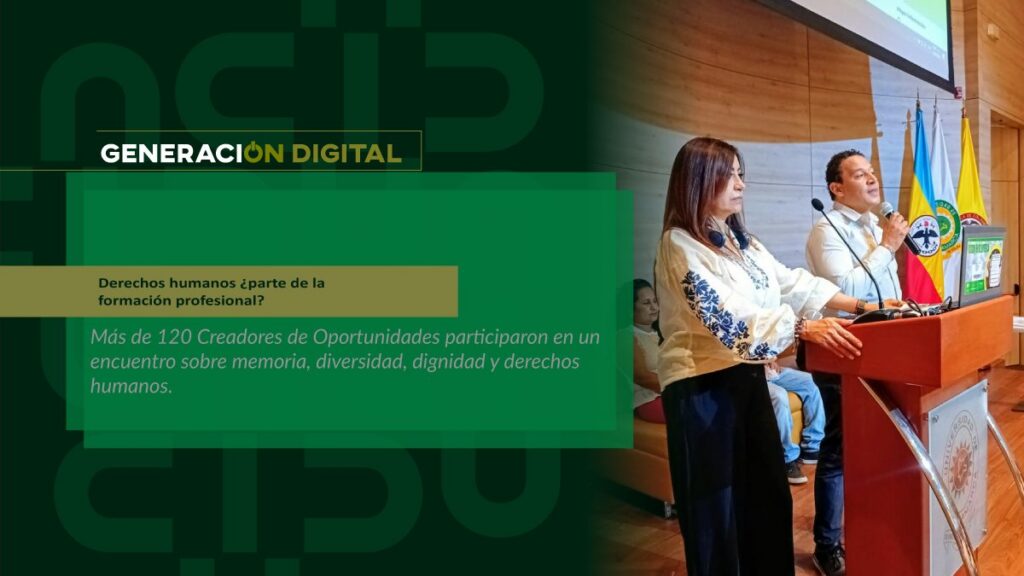
Human rights: part of professional training?
By: Alejandro García Suárez – Advisory Office of Communications


I am your virtual assistant, here to help you quickly and easily.
▲ Back to Top

By: Carolina Rojas – Advisory Office of Communications
Climatic conditions are key to successful planting, harvesting, irrigation, and, in short, any agricultural activity. For this reason, Knowledge and Learning Managers from the Animal Science and Systems and Computer Engineering departments joined forces to carry out a project that would benefit the El Tíbar Agro-environmental Unit of the University of Cundinamarca.
The UCundinamarca News Agency interviewed the Knowledge and Learning Manager, engineer Guillermo León from the Ubaté branch, who told us about the development, objectives and goals of the project.
UCundinamarca News Agency (ANUC) What is the objective of the project?
Guillermo LeónThe project seeks to collect real-time information on eleven climate variables, which will provide us with data in Excel, which is organized, analyzed and passed to a program called R-Study; this looks for the correlation between them and tells us how these variables are related.
We use a pre-established mathematical model to analyze which conditions work and which don't, so we can make two-day weather predictions, that is, 48-hour predictions.
ANUC Why develop this project in the El Tibar Agro-environmental Unit?
Guillermo León: It helps in decision-making; that is, depending on weather predictions specifically for the UAA El Tibar campus, activities such as mowing the lawn or letting it grow can be planned, as well as deciding whether to let the rabbits graze or leave the sheep to graze in the afternoon, since this species retains a lot of static electricity and attracts lightning. Furthermore, it allows for identifying the stress on the pasture and whether it is advisable for goats, sheep, and cows to graze it. Another important aspect it allows for recognizing is the movement of bees, depending on the weather, so that they don't lose their environmental bearings.
ANUC What equipment or devices are being implemented?
Guillermo León: We acquired two weather stations, one for control and one for initial data collection, which are located at UAA El Tibar, installed and calibrated.
ANUC: What stage is the project at?
Guillermo LeónWe're currently at 601 TP3T of the project because we're analyzing the data and need to reach 5,000 data points; we're at approximately 4,000. We started collecting data in August of last year, and we met our goal in August of this year. With that, we can include the data in R-Study to perform the corresponding analyses and draw conclusions. We estimate that the project will reach 1001 TP3T by September or October of 2024.
ANUC Who else is working on this project?
Guillermo LeónWe are working with a ninth-semester student from the Systems and Computer Engineering program. He is in charge of the website, which will display real-time data and the weather forecast for El Tíbar for the next 48 hours. Engineer Néstor García and specialist Iván Olimpo Velásquez, both Knowledge and Learning Managers at the Ubaté branch of the Systems and Computer Engineering and Animal Science programs, are also involved.
ANUC How did the idea for this project come about?
Guillermo LeónIt was a brainstorming session that we conducted in response to a call for proposals made by the University.
ANUC How was the project linked to University Social Interaction (ISU)?
Guillermo LeónWe linked it with ISU by conducting a forage and weight analysis of the animals. Depending on the climate and their behavior, we determined the amount of forage to use, based on their weight and species. This was calculated using various applications, taking into account factors such as field width and number of animals.
ANUC How does this project relate to the Transmodern Digital Educational Model, MEDIT?
Guillermo LeónProblems are solved in real time and the community is helped to make sound decisions, just like MEDIT since it proposes that we have to help the community solve problems.
News
News
News
News