News
2026-09-24
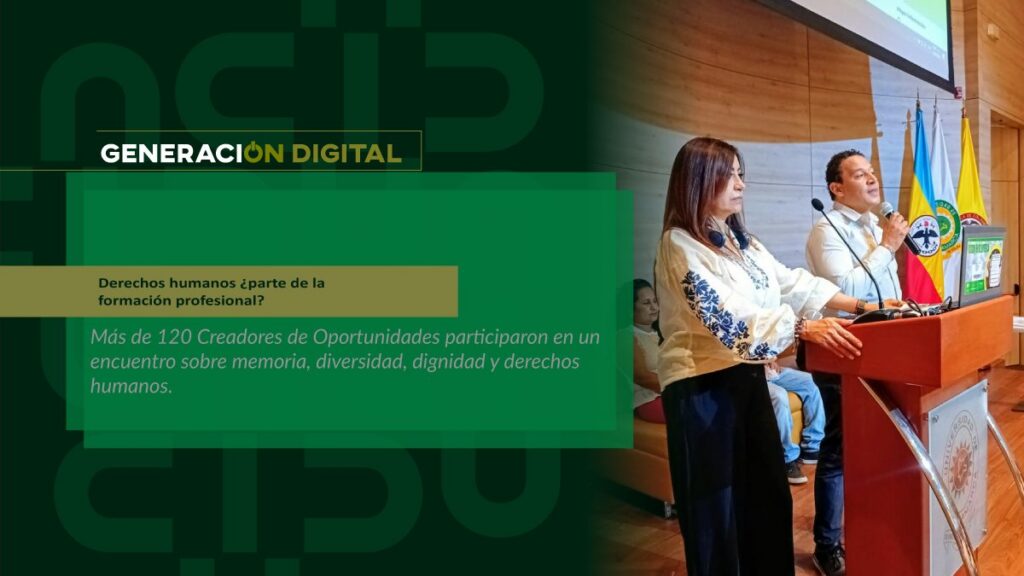
Human rights: part of professional training?
By: Alejandro García Suárez – Advisory Office of Communications



I am your virtual assistant, here to help you quickly and easily.
▲ Back to Top

Source: El Tiempo.
With the publication of the results of the Saber 11 tests by Icfes last weekend, registrations were also opened for the Generación E program, which this year seeks to finance the higher education of 84,100 young people.
It is worth remembering that the program is aimed at 80,000 people for the Equity component (for young people in vulnerable situations) and 4,100 for the Excellence component (high school graduates with the highest results in Saber 11 tests).
Young people will be able to find out how to apply through a pop-up window that will be activated immediately after they check the results of the Saber 11 tests and in which the component they can access (Excellence or Equity) will be specified, or on the website of the Ministry of Education.
Each of these components has its own requirements and registration dates, as follows.
Excellence Component
The Excellence component through the call grants a forgivable loan (which will not be charged if certain requirements are met) to finance the value of tuition at a public or private Higher Education Institution (HEI) that has high quality accreditation, or that has at least 25 percent of its academic offer accredited in high quality, and provides you with support for academic and/or general expenses – maintenance.
Requirements:
A. To have Colombian nationality.
B. Obtain the bachelor's degree title in 2020.
C. To have taken the SABER 11th State Tests on October 18, November 7, 8, 14 and 15, 2020 and meet one of the following requirements:
– To be among the top 10 high school graduates with the best scores on the SABER 11° Test for the Departments of Amazonas, Arauca, Caquetá, Casanare, Cesar, Chocó, Guainía, Guaviare, La Guajira, San Andrés, Vaupés and Vichada.
– For the rest of the Departments, the 3 high school graduates with the best scores on the SABER 11° Test apply.
– Obtain a score equal to or greater than 351 in the Saber 11° tests.
D.
Be registered in the national database of the System for the Selection of Beneficiaries for Social Programs (SISBEN), as of October 30, 2020**, with a score equal to or lower than:
– 57.21 in Bogotá, Medellín, Cali, Barranquilla, Cartagena, Cúcuta, Bucaramanga, Ibagué, Pereira, Villavicencio, Pasto, Montería, Manizales and Santa Marta.
– 56.23 in the rest of the country's urban areas.
– 40.75 in rural areas.
AND.
To have been admitted to the academic program to be studied.
What does it cover?
100 percent of the tuition fees charged by Higher Education Institutions, whether public or private.
It also includes a living allowance for academic or general expenses as follows:
– 1 minimum wage when the chosen Higher Education Institution is located in the same city where you completed your high school studies.
– 2 minimum wages when the chosen Higher Education Institution is located in a different municipality than where the student completed their high school studies and their department had accredited Higher Education Institutions.
– 3 minimum wages when the chosen Higher Education Institution is located in a different municipality than where the student completed their high school studies and their department did NOT have accredited Higher Education Institutions.
Dates:
Applications will be open until February 25th and the legalization process closes on April 30th.
Equity Component
This component aims to give more young people in economically vulnerable situations greater opportunities to access public higher education in the country.
Requirements:
A. To have Colombian nationality.
B. Be between 14 and 28 years old at the time of validation of requirements of the call to which you are applying.
C. Be registered in the SISBEN national certified database with a maximum score of 32 points (only people in validated status will be considered.)
D. Not having a university professional degree.
AND.
Be enrolled in the first year of an undergraduate academic program with current qualified registration (technical, technological or university program), taught under any methodology (face-to-face, traditional distance or virtual) and offered in one of the public Higher Education Institutions that are linked to the program.
What does it cover?
Equity subsidizes up to 4 SMMLV of the tuition fee charged by public Higher Education Institutions for undergraduate programs with current qualified registration (professional technical, technological or university program) under any methodology (face-to-face, distance or virtual).
In addition, it has a support stipend from the Youth in Action program or with resources from the Ministry of Education.
See article in The Weather
News
News
News
News