Graduates
2026-08-31
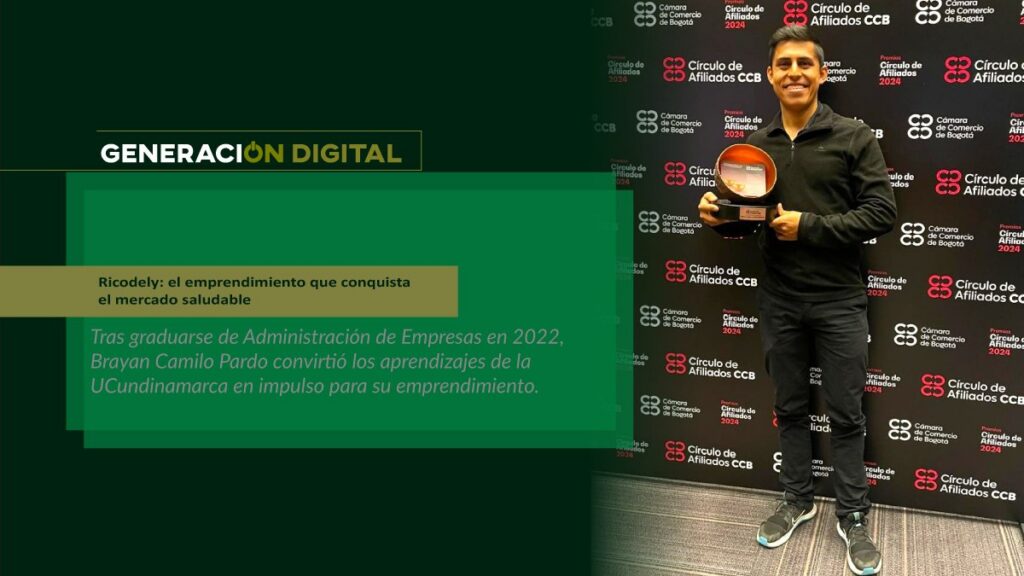
Ricodely: the startup conquering the health market
After graduating with a degree in Business Administration in 2022, Brayan Camilo Pardo turned the lessons he learned at UCundinamarca into an impetus for his entrepreneurship.



I am your virtual assistant, here to help you quickly and easily.
▲ Back to Top
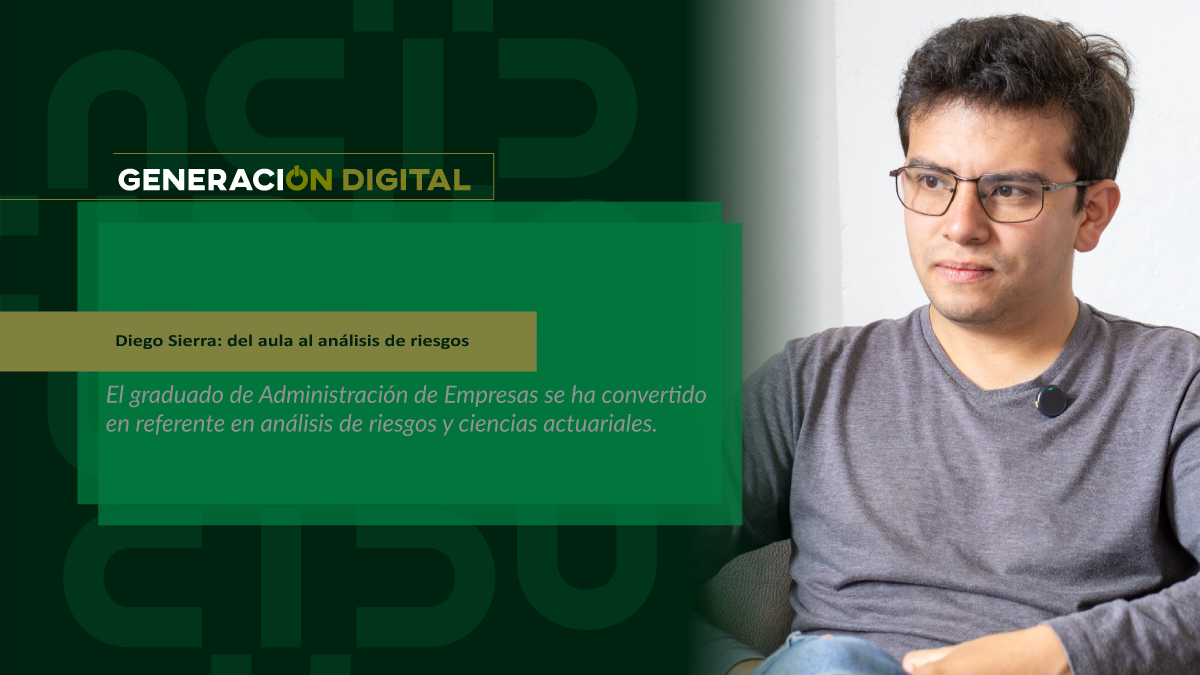
The Business Administration graduate has become a benchmark in risk analysis and actuarial science.
By: Carolina Rojas
Academic training, a passion for numbers, and an interest in understanding economic phenomena led Diego Alejandro Esguerra Buitrago, a Business Administration graduate from the Universidad de Cundinamarca, Chía extension, to build a professional career that today positions him as a speaker and researcher in topics related to risk analysis and actuarial science.
Her professional background demonstrates how the knowledge acquired in the classroom can be transformed into a tool to interpret society's challenges and contribute solutions from academia, research, and teaching.
Diego remembers that since his student years he found a special affinity for mathematics, statistics, and finance, an interest that led him to explore unusual paths for a business administrator. “I always liked numbers. I consider myself an outlier within the profession because I oriented my career toward risk analysis, mathematics, and statistics,” he states.
That inclination for quantitative analysis was strengthened during his formative process, especially in subjects such as mathematics, probability, statistics, economics, and finance, areas he recognizes as fundamental for understanding the behavior of society and the decisions that influence economic development.
His interest in knowledge also found a space in teaching. The opportunity to teach economics in educational institutions sparked new academic and professional interests, driving him to delve deeper into topics related to risk and its impact in various scenarios.
It was precisely during a postgraduate diploma in risk analysis that he discovered the field that would set the course for his career. Later, he entered the Julio Garavito Colombian School of Engineering, where he pursued a Master's degree in Actuarial Science, consolidating a specialized training that he now applies both in academia and in his research processes.
One of the topics he has recently addressed is the analysis of the risks associated with longevity and their relationship with Law 2381 of 2024, regulations that introduced changes to the Colombian pension system. From his perspective, demographic changes represent a major challenge for the sustainability of social protection systems.
According to the explanation, the decline in birth rates and the increase in life expectancy generate transformations in the population structure that can affect the financial balance of pension systems. Understanding these dynamics makes it possible to anticipate risks and promote informed discussions about the challenges the country will face in the coming decades.
For Esguerra, risk analysis goes beyond numbers. It is a discipline that makes it possible to identify future scenarios, assess potential impacts, and support decision-making in various areas of economic and social life.
Recalling his time at the University of Cundinamarca, he highlights the role of several Knowledge and Learning Facilitators who contributed to his professional development. Among them, he mentions professors who strengthened his critical and analytical vision, and who instilled in him an interest in research, economics, and organizational analysis.
Currently, in addition to working as a university professor, he participates in research projects and continues to explore new academic challenges. Among his goals are the possibility of pursuing further postgraduate studies and expanding his contribution to the development of scientific knowledge.
His message to students and future graduates focuses on perseverance and the ability to embrace challenges as opportunities for growth. “When a person chooses a career, they choose it because it represents a challenge. There will always be difficulties and barriers, but if there is a passion for what one does, those barriers can be overcome,” he points out.
Likewise, it invites young people to understand education as a process of transformation that requires discipline, commitment, and the ability to adapt to increasingly changing environments.
Finally, the graduate highlighted the role of the University of Cundinamarca in his professional and personal development, ensuring that the institution provided him with the necessary tools to build his life project and contribute from his knowledge to the strengthening of society.
Today, through research, teaching, and risk analysis, Diego Alejandro Esguerra Buitrago continues to demonstrate that academic training, when accompanied by curiosity, discipline, and a vocation for learning, can open paths that transform both professional life and the environment in which it unfolds.
Graduates
Graduates
Graduates
Graduates