Institutional high-quality accreditation link stiky-sticky

▲ Back to Top

About the program

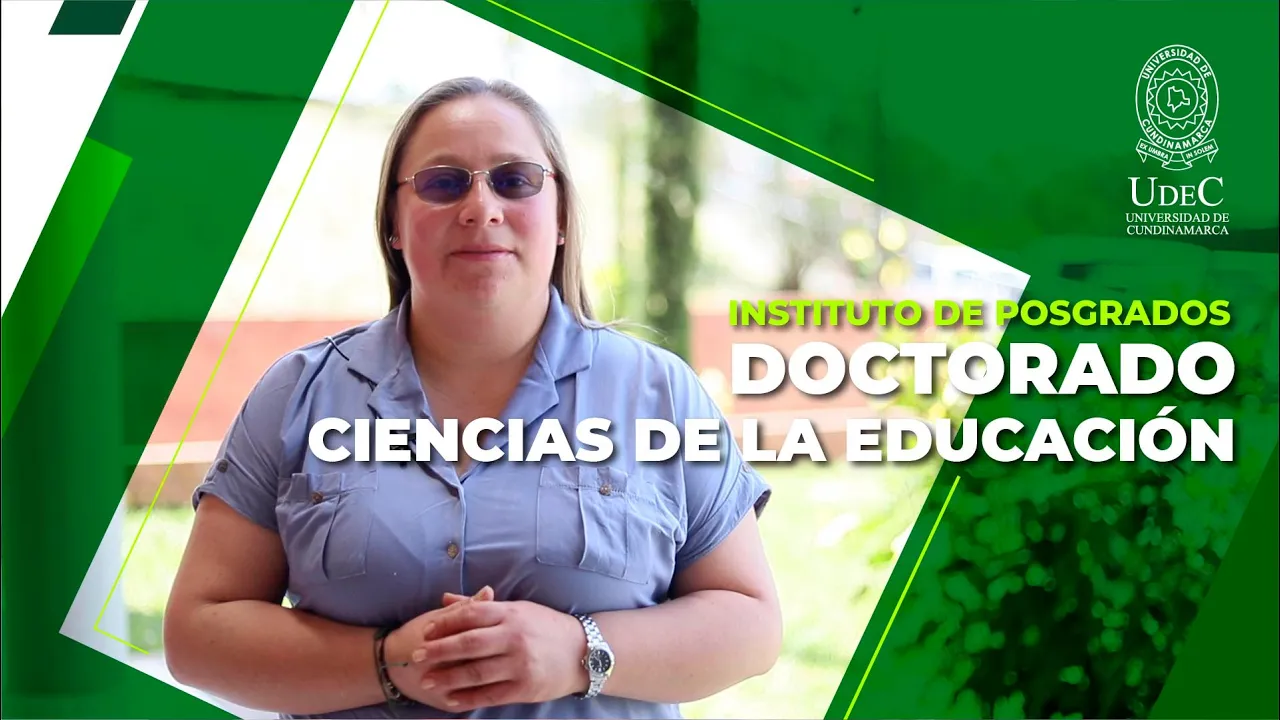
The Doctorate in Educational Sciences at the University of Cundinamarca, besides being the first at the University of Cundinamarca, and the only one so far in the region offered by a public higher education institution, has special relevance when considering the essential elements of the context in which it is situated.

It is a pioneering doctorate in terms of the extremely high levels of training required, desired, and deserved by a region which, although close to the country's political, economic, institutional, and educational center, and despite making progress in raising the levels of professional, technological, and socio-humanistic training, has largely lacked doctoral programs that contribute to positioning the regional population of Cundinamarca at the highest educational levels, resulting in the projection of comprehensive territorial development, in harmony with its imminent integration into the national and international spheres.

The integration of educational dynamics, knowledge, vitality, and regional and local culture into global knowledge and global education processes for the elevation of human development levels and the recognition of the importance of the territory and its value as an enhancer of the population's quality of life, based on the provision of training at the highest educational, pedagogical-educational, and scientific-research level, constitutes the greatest and best distinguishing feature of our academic program.

General information

Get to know the information that will help you take your next step.

User User User faces 1.5 K

+ 1.500

Graduated students

Institution

University of Cundinamarca.

Program Name

Doctorate in Educational Sciences.

Degree to be awarded

Doctor of Education in Science.

Educational level

Postgraduate.

Type of training

University Professional.

Methodology

Information regarding the in-person meeting classes, Fusagasugá campus, Fridays from 2:00 pm to 10:00 pm and Saturdays from 8:00 am to 4:00 pm. (Dates to be coordinated)

Academic Credits

80 credits.

Estimated duration

3 to 5 years (6 to 10 semesters)

Investment

18 S.M.L.M.V. per semester during the first two years. Starting in the third year, 12 S.M.L.M.V. per semester. A 20% discount applies for graduates and/or a 10% discount for those with a voter registration certificate. Discounts are cumulative.

Education
Campus icon

Location of development

Fusagasugá Branch

Resolutions - SNIES: Resolution No. 003235 of March 2, 2021 MEN SNIES: 110008.
fusagasuga-3
REGISTER HERE

Professional profile

The graduate of the Doctorate in Educational Sciences from the University of Cundinamarca will be an autonomous researcher with the ability to identify problems, design solutions, propose changes and transformations in the educational and social fields, and to carry out and guide processes in pedagogical knowledge, environmental education, learning in peace and resilient populations, and their relationship with the Quality of Education, the results of which will be an original and significant contribution to the advancement of Educational Sciences.

Occupational profile

Doing this doctorate allows professionals to access management and teaching vacancies in schools, universities, and entities in the educational field. It also allows them to strengthen their research skills in the socio-educational field and articulate this knowledge as a university professor, project manager in government entities, or establish themselves as an agent-researcher in the educational field through the creation of educational institutions, consultancies, or other ventures that favor advancements in education and human training.

Maxresdefault PhD Maxresdefault

Learning path

View the subjects and phases that make up your postgraduate program.

Education

Semesters

Semester 1

  • Seminar I.
  • Thesis Seminar Workshop I
  • Elective 1: Disciplinary Deepening Seminar

Education

Semesters

Semester 2

  • Seminar II.
  • Thesis Seminar Workshop II
  • Tutoring and/or Thesis Direction I
  • Elective 2: Disciplinary Specialization Seminar

Education

Semesters

Semester 3

  • Seminar III.
  • Thesis Seminar Workshop III
  • Tutoring and/or Thesis Direction II
  • Elective 3. Discipline Specialization Seminar

Education

Semesters

Semester 4

  • Participation in the national and international academic community (*)
  • Interaction with academic and scientific education communities
  • Tutoring and/or Thesis Direction III
  • Elective 4. Disciplinary Specialization Seminar

Education

Semesters

Semester 5

  • International internship
  • Academic Production

Education

Semesters

Semester 6

  • Participation in the national and international academic community (*)
  • Doctoral thesis

Everything you need to know

Check out the most common questions about your major and college. Everything you need to know, made simple.

Register

The Doctorate in Educational Sciences at the University of Cundinamarca, besides being the first at the University of Cundinamarca, and the only one so far in the region offered by a public higher education institution, has special relevance when considering the essential elements of the context in which it is situated.

It is a pioneering doctorate in terms of the extremely high levels of training required, desired, and deserved by a region which, although close to the country's political, economic, institutional, and educational center, and despite making progress in raising the levels of professional, technological, and socio-humanistic training, has largely lacked doctoral programs that contribute to positioning the regional population of Cundinamarca at the highest educational levels, resulting in the projection of comprehensive territorial development, in harmony with its imminent integration into the national and international spheres.

The integration of educational dynamics, knowledge, vitality, and regional and local culture into global knowledge and global education processes for the elevation of human development levels and the recognition of the importance of the territory and its value as an enhancer of the population's quality of life, based on the provision of training at the highest educational, pedagogical-educational, and scientific-research level, constitutes the greatest and best distinguishing feature of our academic program.

Duration 3 to 5 years
Degree Doctor of Education
Investment

Methodology: Information about the face-to-face class meetings, Fusagasugá campus, Fridays from 2:00 PM to 10:00 PM and Saturdays from 8:00 AM to 4:00 PM. (Dates to be coordinated) Investment: 18 S.M.L.M.V. per semester during the first two years. Starting in the third year, 12 S.M.L.M.V. per semester. A 20% discount applies for graduates and/or a 10% discount for those with a voter registration certificate. Discounts are cumulative.

Payment methods Bank payment, PSE, card or ICETEX Loan
Modality In-person
Schedules

Fridays: 1:00 pm to 10:00 pm (every 15 days) Saturdays: 8:00 am to 6:00 pm (every 15 days)

Qualified status Resolution No. 003235 of March 2, 2021 MEN SNIES: 110008

Faculty Education.

Admission Annual
Academic credits 80 Credits

Héctor Mauricio Rincon Moreno

PhD Coordinator

[email protected]

Registration, Selection, and Admission Requirements.

In compliance with the regulations in force in the Rudecolombia Student Regulations, Agreement No. 001 of 2016, which determines the criteria and mechanisms for selecting the program, applicants to become students in the Ph.D. in Education program must meet the following criteria and requirements.

On the Registration Requirements.

a) Submit a resume in accordance with a format established by Rudecolombia. This format indicates: Degrees, Academic Productivity, and Qualified Experience with their respective supporting documents.
b) Provide proof of undergraduate and master's degrees.
c) Provide academic transcripts for the Undergraduate and Master's degrees.
d) Applicants who have completed specialization studies must accredit: The degree or degrees of the respective postgraduate program, as well as the academic transcripts, or failing that, accredit research experience.

In case of having teaching experience, participation in events with a presentation, and publications, present the corresponding certifications.

Present and defend a research proposal in one of the doctoral program's research lines. The proposal must contain (Title, topic, justification, research problem, objectives, theoretical framework, methodological elements, basic bibliography).

Selection and Admission.

Applicants must meet the following criteria and requirements:

Article 2. The National Academic Committee shall define the procedures and quality requirements for selection and admission.

Article 3. The academic committee of the program, CADE, in each university of the network (UdeC), will carry out the respective process and will draw up the corresponding minutes. Both the call for applications and the results thereof will be published.

Article 4. Admission is the procedure by which the member universities of the network (UdeC), following the corresponding call for applications, select their students through a rigorous process that prioritizes academic excellence.

Article 5. To be admitted, applicants must meet the following requirements, which will be weighted for a total of up to 100%.

1. Submit a resume along with supporting documents that verify undergraduate and graduate degrees, academic and research output, and any other requirements determined by the National Academic Committee (40%). The resume and supporting documents must be paginated.

- (HEADQUARTERS, BRANCH, OR EXTENSION) -

2. Submit and defend a research proposal in one of the research areas of the doctoral program offered by the universities in the network (30%).

3. Complete an interview with the academic committee of the Doctor of Education program at the Network University (CADE) with which you wish to enroll (30%).

4. Other requirements set by the university in the network to which the applicant is admitted. Paragraph. Applicants who obtain the highest percentage will be admitted; in all cases, this percentage must be greater than 70%.

For the evaluation of the requirements, the following assessment will be taken into account:

Observations.

  • The minimum admission score is 70 points
  • For the allocation of points in items 1 to 6, evidence of documents and/or certifications from the competent authority is a condition.
  • For item 7, attach the research proposal
  • Deadline for receiving documents at CADE.
Assessment Criteria
Resumes 40%
Research Proposal (Presentation and defense) 30%
Interview 30%
Resume
Related degrees in the field:
Education, Social Sciences
Humanities.
(Up to 10 points)
Undergraduate 2
Specialization 3
Master's degree 5
Work experience in education.
(Up to 10 points)
For each year 1
Participation in events in
the mentioned areas
(Up to 10 points).
National Presentation 2
International presentation 3
Assistance 1
Publications in the fields
mentioned
(Up to 15 points)
Non-indexed Journal 1
Indexed Journals 4
Book Chapter or Module 2
Book 5
Research in
the mentioned areas
(Up to 10 points)
By Completed Investigations 5
By Thesis Directions 5
Awards and merits (Up to 5 points) Acknowledgments 3
Merit 2
Presentation / Interview (Up to 40 points) Proposal Defense 20
Axiological Component 20
Defense of the Proposal
Axiological Component Up to 20 points
Motivation versus Doctoral Studies Up to 4 points
Availability Up to 4 points
Institutional Support Up to 4 points
Attitudes and Skills Up to 4 points
Interaction Up to 4 points
Academic Component Up to 20 points
Defense of the Proposal Up to 4 points
Quality of the Argumentation Up to 4 points
Statement of the Problem Up to 4 points
Conceptual Clarity Up to 4 points
Internal Project Consistency Up to 4 points
Information Form

Your future starts today

Information Request Form

Study at the University of Cundinamarca. Leave your details in the form to receive more information.


    Graduate studies

    PhD

    Graduate studies

    PhD