21st Century Generation



I am your virtual assistant, here to help you quickly and easily.
▲ Back to Top
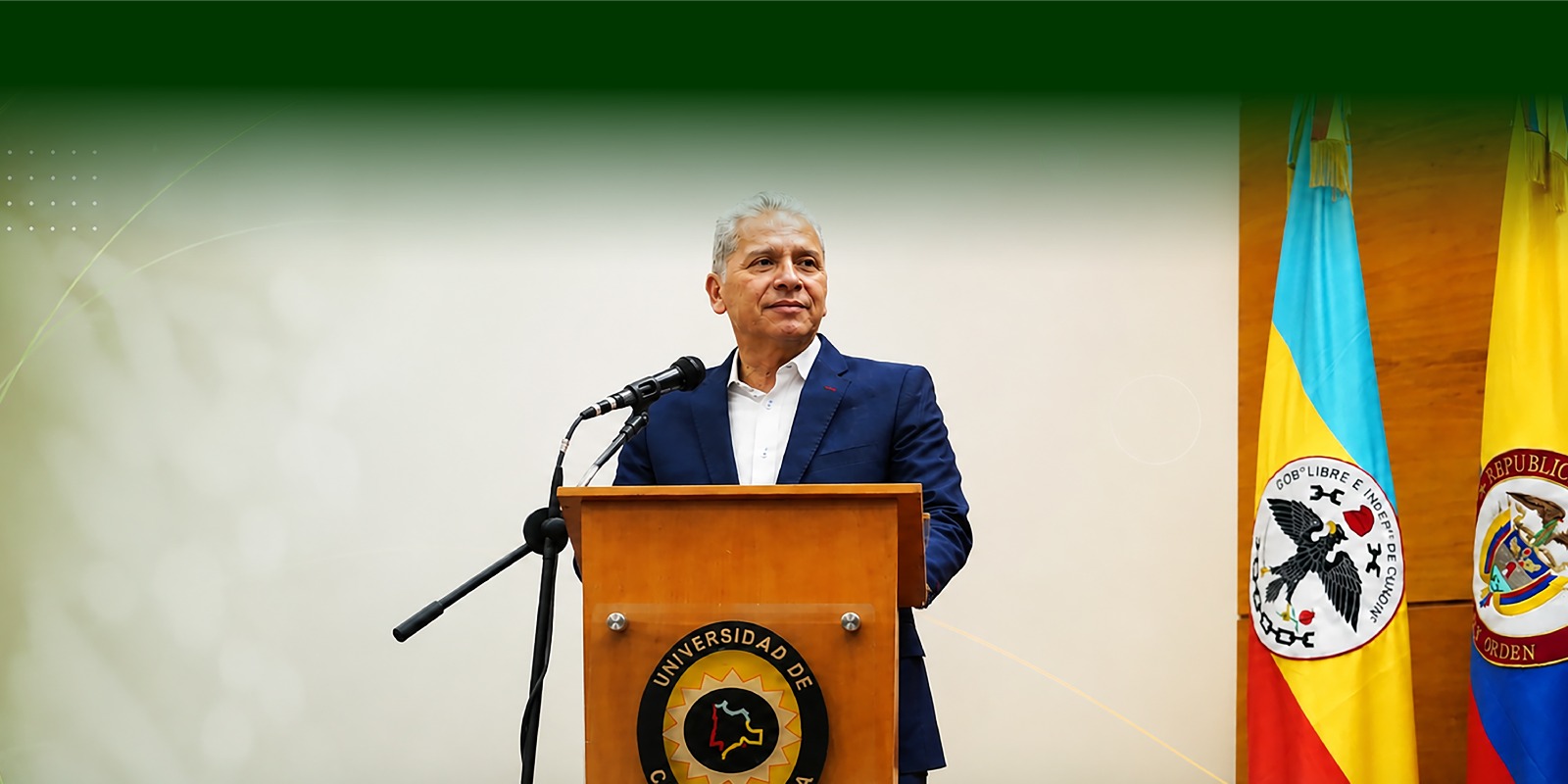
Rectoral Plan 2015 - 2019
Adriano Muñoz Barrera (Rector)
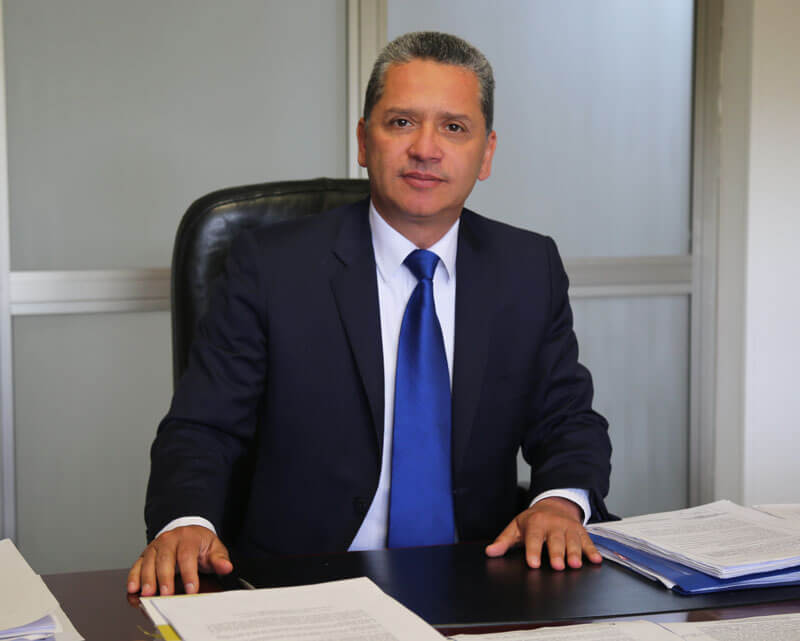
On December 14, 2015, the process of election and designation of the Rector of the University of Cundinamarca for the institutional period 2015 – 2019 was completed, in which the Superior Council elected Adriano Muñoz Barrera, a lawyer from the Externado University of Colombia, specialist in the areas of Economic Private Law from the National University of Colombia and Management for Organizational Development from the University of Cundinamarca, Master in Quality Management of Higher Education from the University of Pamplona and candidate for doctorate in Law from the Santo Tomás University.
He has worked in the areas of economic and commercial law, providing legal advice, consulting, and litigation services. He has extensive experience in higher education, having held positions such as: General Secretary, Acting Dean of the Faculty of Social Sciences, Humanities, and Political Science, and Professor in the Business Administration and Public Accounting programs at the University of Cundinamarca.
The Rector is well aware of the reality of the institution he leads and understands its urgent needs. As he states in his governance plan, he recognizes that since the end of the 20th century, higher education—due to globalization—has been undergoing a transformation, and that the nature of the traditional university is experiencing a global crisis. Therefore, today, more than ever, the presence of a public and autonomous institution is crucial to ensuring the survival of humanity. He believes a generation suited to this historical moment is essential, one that engages and commits students, professors, graduates, administrative staff, and the entire Department of Cundinamarca. This generation will be innovative, entrepreneurial, scientific, and collaborative, grounded in nature and facilitated by information and communication technologies, and will incorporate global consensus into its daily work. It will be a generation that acts as an agent of transmodernity, characterized by a visible, dynamic, open, reflective, critical, and interconnected academic and scientific reality.
The university, as an institution that emerged in the 12th century, being one of the oldest institutions in the world, even older than the state, has played a fundamental historical role, thanks to its capacity to adapt to the changes undergone by society. However, many theorists and researchers on the subject agree that today, in the knowledge society and economy, the university is in crisis.
According to De Sousa Santos (2005), the university is going through a series of crises, which on the one hand refer to hegemony, in relation to traditional functions and those assigned in the 20th century; a crisis of legitimacy, “(. . .) caused by the fact that the University has ceased to be a consensual institution (.. .)”. Another crisis relates to the institutional sphere., “(. . .) result of the contradiction between the demand for autonomy in defining the values and objectives of the university and the growing pressure to subject it to criteria of efficiency and productivity of a business nature or of social responsibility” (De Sousa Santos, 2005).
Munera (2009) states that since the end of the 20th century, higher education, due to globalization, has been undergoing a process of transformation. Indeed, the traditional university is giving way to other institutions such as technical or technological universities and “transnational corporations, corporate universities, or franchise institutions” that respond to the needs of private enterprise and the market.
However, today more than ever, the presence of the public and autonomous university is urgently needed to guarantee the survival of humanity; therefore, I agree with the words of De Miguel (2012) when he points out “(…) with the new knowledge society we are witnessing a renaissance of the University (…)” and I add “or its end”, if it does not assume the role demanded by the new century.
This is the paradox in which the University of Cundinamarca finds itself; therefore, a generation specific to this historical moment is needed, including professors, students, graduates, administrative staff, and all of Cundinamarca; a generation that undertakes the task of redefining, rethinking, and reinventing the University, in order to respond to the challenge of educating for life, democratic values, civility, and freedom, and that is capable of solving problems in its environment through the generation, management, and transmission of knowledge.
This 21st-century generation, characterized by being innovative, entrepreneurial, scientific, collaborative, supported by nature and mediated by information and communication technologies, which incorporates the global consensus of humanity into daily life, has the challenge of leading the University of Cundinamarca along the path of regional and national visibility through the appropriation, creation, management and transmission of impactful knowledge, allowing the accreditation of programs and subsequently the institutional accreditation.
Consequently, the University of Cundinamarca must be an agent of transmodernity characterized as an academic, scientific, visible, dynamic, open, reflective, critical, interconnected reality; whose operation is in real time, sustainable with the environment, capable of incorporating into its reason for being all the consensuses of humanity, to give an effective and impactful response to the knowledge society and economy.
It is a social organization of knowledge, public, diverse, translocal of the 21st century, autonomous and democratic, formative for life, student-centered and whose high quality depends on the teacher.
Academic culture is understood as the set of meanings that integrate beliefs, customs, practices, habits, activities, norms, and values that guide the conduct or behavior of an academic community.
Therefore, the University of Cundinamarca must ensure an academic culture that prioritizes learning, knowledge, and training for life, so that its academic campus is a learning environment; generating a culture that promotes democratic values, freedom, solidarity, civility, and knowledge for life.
The University of Cundinamarca, within the framework of its institutional policy, structure, institutional practice, internal communication, daily work, participation, institutional values, symbols, relationships, and resource management, must generate a scientific and formative academic culture for life, in order to create a frame of reference that leads or guides the community along the path of science, life, civility, and freedom.
Academic culture is understood as the set of meanings that integrate beliefs, customs, practices, habits, activities, norms, and values that guide the conduct or behavior of an academic community.
Therefore, the University of Cundinamarca must ensure an academic culture that prioritizes learning, knowledge, and training for life, so that its academic campus is a learning environment; generating a culture that promotes democratic values, freedom, solidarity, civility, and knowledge for life.
The University of Cundinamarca, within the framework of its institutional policy, structure, institutional practice, internal communication, daily work, participation, institutional values, symbols, relationships, and resource management, must generate a scientific and formative academic culture for life, in order to create a frame of reference that leads or guides the community along the path of science, life, civility, and freedom.
The University of Cundinamarca must offer an education that fosters life skills, democratic values, civility, and freedom.
Education for life is the great challenge of the 21st century, which, according to Torroella (2001), aims to promote “(…) the integral development of the personality, of the potential of the human being and of human fulfillment (…)”, characterized by the fact that it is “(…) focused on the student, as a fundamental attitude of the educator (…)’ (Ibid), where autonomy, freedom, democracy and spontaneity flourish for creation and initiative, aimed at civility and the survival of the human being, in order to form not only professionals, but to make the academic community a set of integral, responsible, supportive and tolerant human beings.
It is necessary to form a global citizen where the University integrates the values of the department, the region and the country; the global values of human rights; respect for ethnic, cultural and personal diversity; gender equality and sustainable development.
That education must include at least the following defining components:
- Multidimensional learning
Understood as a process that takes place on a multidimensional campus (virtual, institutional, face-to-face, cultural, international), open, inclusive, collaborative and transcendent, which uses strategies, methods, techniques and instruments, to promote the integral development of the personality, the potential of the human being, the disciplines and the academic community.
It is necessary to strengthen virtual learning as a support for learning processes, the possibility of meeting the educational demand in the Department of Cundinamarca, and the gateway to dialogue with the world.
- Curriculum reform
The University of Cundinamarca must build, design, implement and manage a flexible, systemic and comprehensive curriculum that leads to giving life to the institutional educational project; oriented to the disciplines, to the values for life, democracy and freedom, in tune with the new institutional, local and global realities.
- Professor as knowledge manager
The professor at the University of Cundinamarca, understood as a free, transformative, interactive, collaborative, and knowledge-managing individual, is the one who makes the translocal public university of the 21st century possible. To achieve this, their profession must be dignified through categorization, incentives for academic production, and payments for advising and directing theses. Likewise, efforts will be made to hire tenured professors at a minimum of seven (7) per program; to offer eleven (11) month contracts for full-time professors; to provide training and professional development; to ensure job security; and to create a specialized center to strengthen and support educational technology.
- Student who creates opportunities
The student is at the heart of academic culture: a creator of opportunities, autonomous, critical, and proactive. In this sense, the relationship is based on enhanced communication between teachers and students, and vice versa.
It is necessary to graduate an innovative, entrepreneurial student, and therefore a job creator, so that the University, through its training, contributes to solving problems in the local, departmental, and national environment, giving birth to a new being for life, democracy, civility, and freedom.
It is imperative to revive the academic campus, where artistic, cultural, musical, and sporting spaces unleash university life in an explosion of colors, aromas, and sounds; change the logic of space for a poetics of space and enable the amnesia of problems experienced by students within their lives, thus creating scenarios of peace, coexistence, and mental health.
Similarly, strengthen University Welfare and expand the coverage of the programs it offers to ensure the well-being of students, professors and administrative staff.
- Graduates who are integrated and have a sense of belonging
Incorporate the graduate as an active part of the academic community of the University of Cundinamarca, making him its ambassador and linking him to its processes; creating the labor observatory, making strategic alliances through business agreements and issuing the graduate statute, where his rights and duties and the academic relationship with the University are enshrined.
The identifying and differentiating hallmark of a knowledge organization, such as the University of Cundinamarca, must be the component of science, technology, research and innovation, reflected in academic products, incorporation of ICTs, relationship with technology at the service of social, regional and productive development, articulated with the need to contribute to the resolution of problems that affect the sustainability of non-renewable resources, with significant importance towards water.
It is necessary for the University to incorporate and reflect in its daily work these components that identify it as a 21st century organization, raising the respective budget allocations to at least five percent (5%).
Research at the University must be applied, systemic, and impactful; therefore, it must consolidate its research system; incentivize the academic production of professors; decentralize processes; generate high-impact products in the region; generate inter-institutional relationships and strategic alliances with other university and research centers; promote scientific and technological training; foster research groups; institutionally recognize internal groups; strengthen and expand the groups recognized by COLCIENCÍAS; and create areas or topics of translocal impact.
One must proceed in an articulated manner along the path of research seedbeds, research groups, degree works, Master's degrees and Doctorates.
Internationalization, understood as an academic dimension, through which our university faculty is incorporated into the world, to engage in dialogue with it, and to exchange knowledge, experiences, and expertise.
This is an opportunity for the University of Cundinamarca to engage in dialogue with other cultures, in order to strengthen its teaching and learning processes and break down the barriers of knowledge. To achieve this, the following should be promoted, among other things: the management of internationalization, academic mobility of professors, students, and researchers, university networks and the exchange of experiences and knowledge, the formulation of joint research projects, the internationalization of the curriculum, the teaching of foreign languages, an internationally oriented library, joint publications, the presence of foreign students and professors; the promotion of the university as an educational destination and experience, international university interaction and the export of educational services; the strengthening of inter-institutional relations, the implementation of extracurricular activities to raise awareness of other cultures; and the offering of programs with an international focus.
Consequently, policies and an administrative structure must be established, including internships, stays, academic semesters, a foreign language institute, summer camps and courses for foreigners, and cultural exchange cooperation agreements.
The University must be characterized as an organization in constant transformation, whose operation is in real time, where most administrative services are provided online, with processes certified by academic peers or national or international bodies, which requires strengthening the technological platform.
It is equally imperative to establish a digital university government, characterized by self-control, university social control and good practices of university governance; university social control understood as a space or instrument where the main protagonist is the student and the professor, who participate in the governance of the university.
The administration should be decentralized, service-oriented, and academically focused.
At this University, public resources must be sacred and its own resources strengthened through the celebration of agreements, university services, continuing and virtual education.
Documentary Sources
- Castell, M. (1999). Globalization, identity and state in Latin America. UNDP. Santiago- Chile.
- Castells, M. (2000). “The Information Age’. Mexico. Siglo Veintiuno Editores. Mexico.
- De Sousa Santos (2005) “The University in the 21st Century for a Democratic and Emancipatory Reform of the University’. Edited by the Public Policy Laboratory. Buenos Aires. Miño y Dávila. ISBN: 84-95294-74-5. Printed in Argentina. 86p.
- De Miguel, J. (2012). University and Democracy. Cadiz, Spain: Municipal Foundation of Culture, City Council of Cadiz.
- Múnera, L. (2009). 'The university in the 21st century'. (Three fragments) in Zerda, A. Bejarano, Jiménez, P. , Orjuela, F. . Higher Education. Trends, debates and challenges for the 21st century. Sustainability and financing. (pp. 49-64). Bogotá. National University. Bogotá.
- Rodríguez, R. (2004). 'Transmodernity'. Spain. Anthropos Editorial. (pp. 31-46).
- Torroella González-Mora (2001) 'Education for life. The great challenge'. Latin American Journal of Psychology. Volume 33 – No. 1 73-84
- University of Cundinamarca (2015). Policy and Guidelines for the Integration of ICT in Education at the University of Cundinamarca. p. 8:56
Master plan 2019-2023
Master plan 2019-2023
Master plan 2019-2023
Master plan 2019-2023
Master plan 2019-2023